





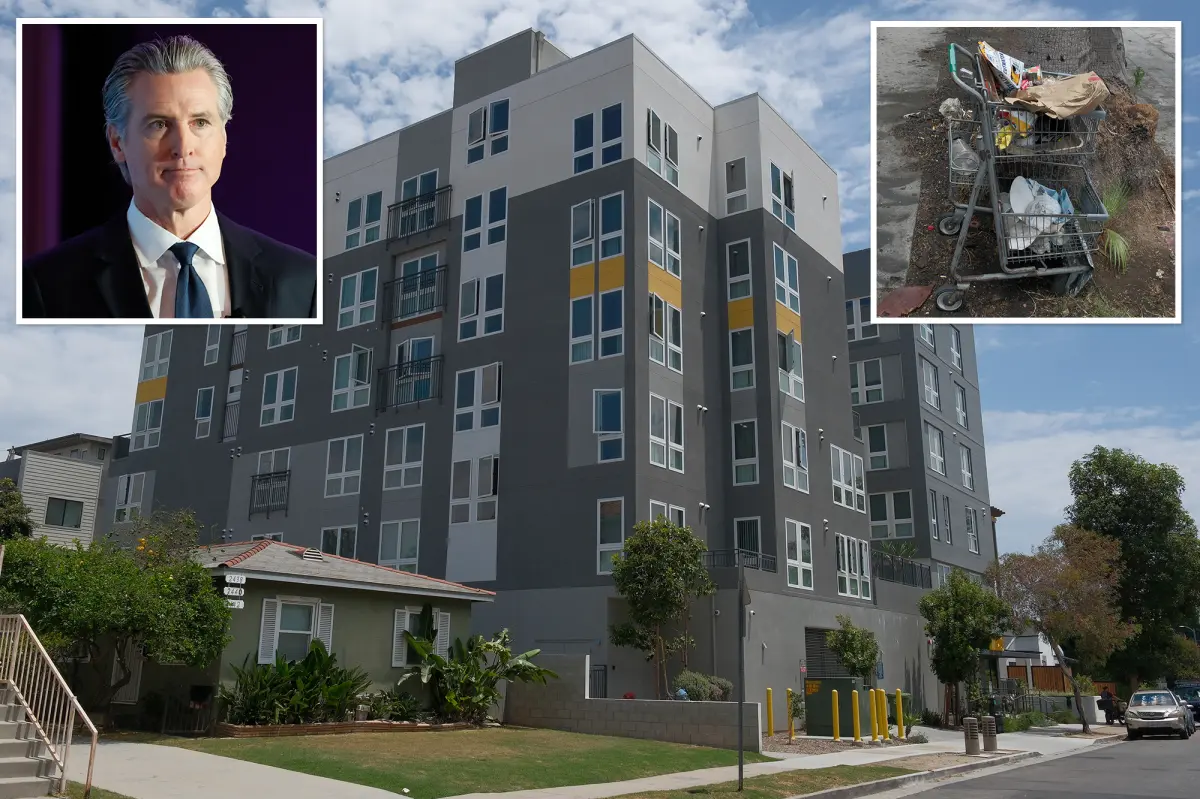
Los Angeles has always occupied a distinct space in the global imagination as a sun-drenched sanctuary of unbounded potential where palm-lined avenues and historic neighborhoods form the peaceful backdrop to the bustling creative capital of the world. Yet, beneath this aspirational veneer lies a profound, deeply visible humanitarian crisis: the long-standing, heartbreaking struggle to support and house tens of thousands of vulnerable individuals living on the streets. In an urgent attempt to address this systemic tragedy with deep compassion, state and local leaders embarked on an unprecedented, multibillion-dollar real estate experiment, promising to transform upscale apartment buildings, luxury motels, and modern urban developments into supportive sanctuaries. Backed by over two billion dollars in taxpayer funding, drawn from Governor Gavin Newsom’s signature Project Homekey program and Los Angeles’ voter-approved Proposition HHH bond measure, the city sought to rewrite the story of poverty by moving individuals directly from tents into high-quality housing. However, the idealistic dream of converting premium residential spaces into stabilizing environments has recently collided with an incredibly harsh, complex reality. Instead of serving as calm, therapeutic environments of recovery, many of these newly established properties have transformed into localized epicenters of chronic trauma, generating thousands of emergency calls that stretch city resources to their absolute limit. Public records reviewed by The California Post reveal a deeply troubling pattern of near-constant police dispatches to almost fifty publicly financed homeless housing developments across the city over a two-year window. The volume and severity of these incidents, ranging from severe psychiatric breakdowns and self-harm attempts to violent physical assaults, domestic emergencies, and drug overdoses, illustrate a fundamental truth: placing highly vulnerable citizens into physical structures without providing intensive, round-the-clock physical, mental, and safety support does not cure chronic trauma; it merely relocates it behind closed doors, straining neighborhoods and testing the absolute limits of local emergency personnel who are forced to manage these complex mental health emergencies daily, leaving local communities to grapple with the complex and sometimes dangerous consequences of these systemic policy failures.
Nowhere is this crisis of execution more painfully evident than at 5050 Pico Boulevard, a sleek, modern mid-rise apartment complex situated just minutes from the affluent enclaves of Beverly Hills and the high-end shopping district of The Grove. Originally engineered and marketed as a luxury residence boasting quartz countertops, secure gated parking, and upscale finishes, the property was purchased through the Homekey program for a staggering thirty-five million dollars, working out to roughly one point two million dollars per individual apartment unit. Once converted into permanent supportive housing, the building was meant to offer a dignified path forward, yet it emerged instead as one of the city’s most active and destabilizing emergency response zones. Over a two-year period, the Los Angeles Police Department was dispatched to this single address more than one thousand two hundred times, responding to a relentless stream of severe calls involving physical assaults, batteries, domestic violence, acute mental health crises, trespassing, and urgent ambulance dispatches. The tragic human cost of this chaotic environment was made physically visible to visitors when a makeshift memorial of flickering candles and flowers appeared just outside the building’s entrance. Neighbors whispered in hushed tones about a young woman who had reportedly fallen to her death from the building’s roof while under the heavy influence of illicit substances, a loss that underscored the deep, unaddressed despair festering within the facility. For local homeowners like Raphael Swann, who purchased his nearby townhouse in 2019 expecting the local neighborhood to thrive with the opening of a new Metro transit line, the transformation of the property without community consultation felt like a profound betrayal. Swann expressed the deep demoralization felt by many working-class residents, noting that while they invested their life savings into their homes, the city bypassed public input entirely, leaving them to live in a state of constant, daily anxiety and fear while municipal leaders offer absolutely no support, communication, or guidance to help alleviate their very real, painful, and fully justified neighborhood safety concerns today.
To understand how such an immensely well-funded initiative fell so dangerously short of its humanitarian goals, one must examine the dizzying financial and political network that powers these housing acquisitions. Since its inception in 2020, Governor Newsom’s Homekey program has allocated roughly one point three billion dollars in state funds to help municipal governments purchase hotels, motels, and private apartment complexes. This state-level war chest was subsequently matched by another one point three billion dollars committed by Los Angeles city and county agencies, creating a collective regional investment exceeding two point six billion dollars aimed at purchasing and operating these modern supportive complexes. Because many of these properties also drew heavily from Proposition HHH bond funds, taxpayers found themselves double-funding projects that ultimately bypassed traditional community safety screenings and local oversight. This massive allocation of capital has drawn fierce criticism from political figures and residents alike who wonder why astronomical sums are spent on physical units while essential local public services face devastating cutbacks. Scott Meyers, a Republican candidate running to represent California’s thirtieth congressional district, has spoken out forcefully about this fiscal disconnect, highlighting the unfair burden placed upon ordinary citizens. Meyers pointed out that local governments are deferring critical infrastructure maintenance, like vital road repairs, and stripping funds from basic municipal services, only to funnel hundreds of thousands of dollars per unit into structures that quickly degenerate into unpoliced crime hubs. This allocation strategy, Meyers argues, represents a political shell game that leaves police and fire departments underfunded and unable to safely manage the very emergencies these under-supported sites regularly generate. Meanwhile, local leaders in City Hall and federal congressional representatives remain deeply silent, avoiding the tough questions regarding the lack of oversight and the severe deterioration of safety in the neighborhoods they were elected to protect. This lack of direct political accountability leaves ordinary, hardworking citizens feeling completely abandoned as their valuable tax dollars are continuously poured into these flawed projects that actively degrade the safety of their local neighborhoods.
The devastating real-world consequences of this systemic oversight are perhaps most heartbreakingly illustrated in West Los Angeles, inside the vibrant and culturally rich neighborhood of Sawtelle. There, a beautiful residential complex known as The Iris on Barry Avenue was converted into a permanent supportive housing site using nearly seven million dollars in Proposition HHH funding. Designed to offer sixty-one apartments, including thirty-four specifically reserved for formerly unhoused individuals, the building was supposed to represent a model of compassionate community integration, but police dispatches to the property quickly mirrored the pattern of violence seen elsewhere across the city. Amidst ongoing calls for burglaries, severe domestic disputes, and mental health emergencies, the facility became the epicenter of a deeply disturbing violent crime that completely shattered the neighborhood’s sense of safety. On February 27, 2025, a resident named Ishmail Bangura allegedly ran naked from the building, broke into a nearby family home, and carried out a horrifying, unprovoked assault on an innocent three-year-old child and a sixty-three-year-old woman. This tragedy was made even more egregious by the fact that Bangura had been arrested twice by local law enforcement in the days leading up to the attack, yet he was repeatedly released back into the supportive housing facility without adequate intervention or supervision. He eventually entered a plea of no contest to charges of assault with intent to commit rape, first-degree burglary, and felony child abuse, admitting that he committed these crimes while free on bail for another pending criminal case. This horrific incident exposed the profound vulnerabilities of a system that places highly unstable, criminally involved individuals into residential neighborhoods without the rigorous institutional supervision or secure mental health treatment required to protect both the building’s residents and the families living in the surrounding streets. This painful failure underscores that sheltering people must go hand-in-hand with active, preventative support systems to prevent innocent, vulnerable citizens from continually becoming the targets of predictable, highly devastating violence within the confines of their own private family residential homes today.
While affluent enclaves like Sawtelle and the areas surrounding Beverly Hills have been deeply shocked by these sudden increases in localized crime, the impact on historically marginalized and lower-income neighborhoods in Los Angeles has been even more severe. In areas already struggling with systemic poverty, such as the streets surrounding Skid Row, the addition of these highly unstable housing developments has intensified preexisting safety challenges, putting an immense strain on local emergency services and exhausting the resilience of nearby residents. For instance, a single supportive housing development located at 601 San Pedro Street logged approximately seven hundred and fifty police dispatch calls over a two-year period, while its sister property down the road at 566 San Pedro Street registered an astronomical eight hundred and forty emergency responses. These calls were not minor complaints; they documented a terrifying landscape of physical violence, severe cutting injuries, reports of individuals brandishing firearms and knives, active gunfire, and rampant open-air narcotics sales. Similarly, a development at 517 San Julian Street drew nearly four hundred police responses for trespassing, attempted suicides, and criminal threats, while adjacent properties on Crocker Street accumulated over four hundred and twenty emergency calls involving domestic violence, assaults, and armed groups. In these historically neglected neighborhoods, working-class families, school children, and local small business owners must navigate this relentless daily chaos, feeling that their personal safety has been completely sacrificed in the name of political expedience. The high concentration of these severe crises in economically vulnerable areas demonstrates that without comprehensive, on-site medical treatment and strict security protocols, these housing projects do not lift people out of poverty; instead, they lock vulnerable residents and their struggling neighbors into a permanent, exhausting state of fear and hyper-vigilance. The heavy, unfair burden placed on these historic communities proves that simply relocating the unhoused without adequate, specialized care only perpetuates the deep systemic cycle of trauma, leaving the most vulnerable citizens to continuously pay the steep, highly damaging price of these persistent governmental policy planning errors today.
The growing crisis surrounding these permanent supportive housing sites has sparked a desperate, community-wide call for accountability from local citizens, yet state and city leaders remain largely silent. When The California Post requested comments from Governor Gavin Newsom’s office and Los Angeles Mayor Karen Bass regarding the alarming volume of police dispatches and the severe crimes occurring at these properties, they received no immediate response. This daily silence from top officials underscores a profound, deeply frustrating disconnect between the high-flying rhetoric of political campaigns and the daily, lived experiences of ordinary Angelenos who are forced to navigate the chaotic fallout of these policies on their own. True compassion for the unhoused population cannot simply be measured by the raw number of real estate acquisitions or the dollar value of taxpayer-funded bonds; it must be measured by the genuine safety, healing, and long-term rehabilitation of the human beings placed inside these physical walls. Merely handing a room key to a vulnerable individual suffering from severe schizophrenia, advanced substance abuse, or a history of violent behavior, without providing the intensive, wrap-around medical and psychiatric care they desperately need, is a profound disservice to their personal humanity and a direct, ongoing threat to the neighborhoods that welcome them in. Because these struggling, vulnerable individuals are left without the vital psychiatric assistance they need to successfully reintegrate into society, they are unfortunately set up for devastating personal failure. Moving forward, the city must abandon its superficial, quantitative “housing first” metrics and instead adopt a balanced, human-centered approach that prioritizes psychiatric stabilization, strict security, and authentic, community engagement with local taxpayers who fund these facilities. Only when local governments listen to the voices of concerned neighbors like Raphael Swann, protect innocent children in places like Sawtelle, and provide genuine psychiatric treatment to the vulnerable souls residing within these buildings, can Los Angeles begin to heal its deep social divisions and build a safe metropolitan environment where safety and compassion can truly coexist for everyone inside and outside these walls alike.