





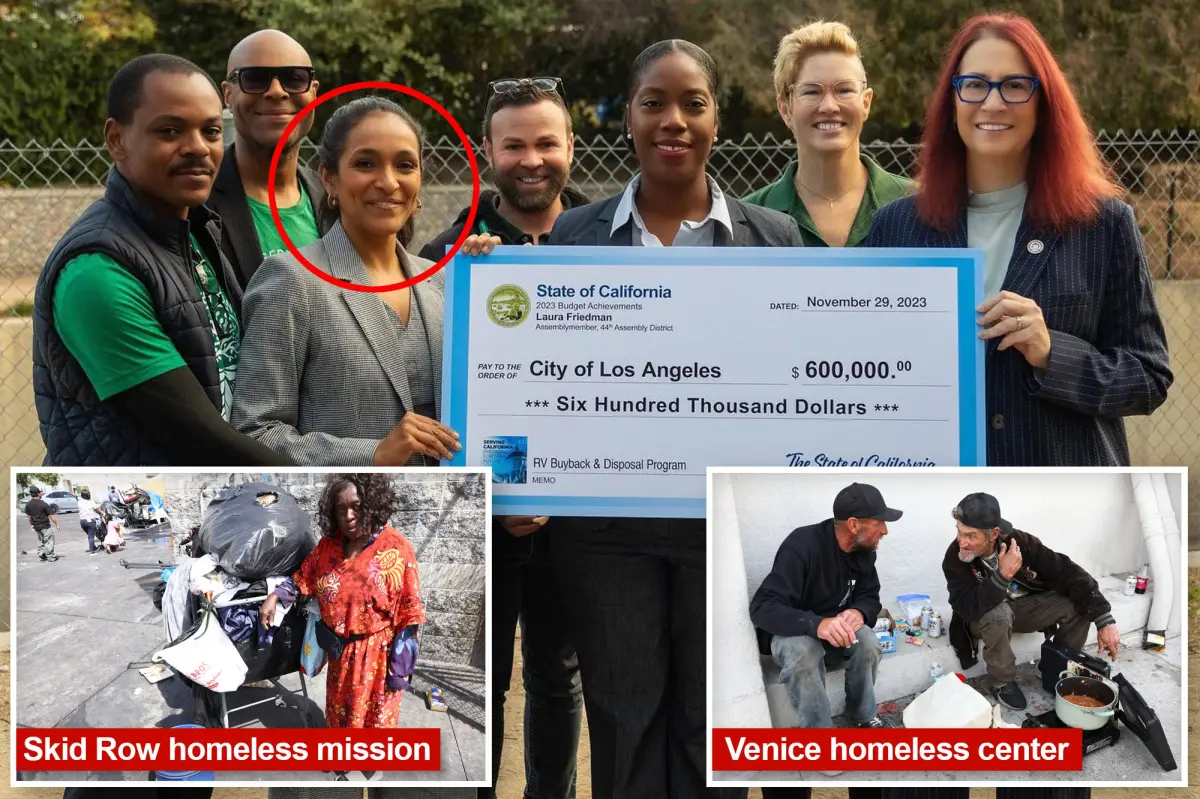
In the sun-drenched expanse of Los Angeles, a city defined by the stark contrast between glittering Hollywood success and the harrowing reality of a worsening homelessness crisis, the democratic process has found a controversial and complicated base of operations. Following a highly charged city council race in which incumbent Nithya Raman defeated challenger Spencer Pratt, investigative eyes turned to the methods used to mobilize voters on the margins of society. At the center of this scrutiny is the discovery of thousands of voter registrations tied directly to homeless shelters, service centers, and drop-in clinics that do not actually house the people registered there. A deep dive into public records revealed that 7,600 registered voters are linked to these service-providing locations, including places like the St. Joseph Center in Venice Beach. While this drop-in facility received a substantial $600,000 in taxpayer funding from the city’s housing committee during Raman’s tenure as chair, records show it serves as the official voter registration address for 185 individuals despite containing no beds or residential accommodations whatsoever. When journalists attempted to investigate this relationship, a promotional photograph of Raman presenting the check was quietly removed from the center’s website, leaving behind a trail of unanswered questions about how civic engagement, municipal funding, and political campaigns intersect in the city’s poorest neighborhoods.
Behind these startling statistics are real human beings, navigating the daily struggles of life on the streets while being pulled into the complex gears of modern political campaigns. For men like Martin Rowe, a homeless resident of Venice, the act of becoming a voter was not a calculated civic decision, but rather a fleeting interaction outside a local Ralphs grocery store. He recalls being approached by energetic canvassers holding clipboards, who handed him papers, asked a series of rapid-fire questions, and quickly added him as a registered voter on the state’s rolls. Further east in the heart of Skid Row, a resident named Norman described a highly transactional street-level registration system that has operated in the area for several years. Norman admitted that he had previously been paid to help sign up voters during these aggressive drives, noting that canvassers often distributed free cigarettes to incentivize unhoused individuals to fill out the paperwork. Sitting on the concrete sidewalks under the shadow of downtown’s massive skyscrapers, these individuals are frequently viewed not as citizens with distinct voices, but as easily obtainable signatures to satisfy political campaigns or specialized voting organizations eager to boost registration numbers in specific zip codes.
The absolute epicenter of this concentrated voter density is the historic Midnight Mission on Skid Row, an institution that serves as a vital lifeline for the destitute but has recently become a focal point of intense legal and ethical scrutiny. According to official voting records, an astonishing 1,160 registered voters claim the Midnight Mission as their residential address, a figure that wildly clashes with the facility’s operating capacity of just 84 beds for men and 36 beds for women. Outside the mission’s doors, the disconnect between registration statistics and human reality becomes immediately apparent in stories like that of Bo Jackson, an unhoused man who was surprised to learn he was registered to vote at the address, yet could not recall registering and was entirely unfamiliar with the candidates running for mayor. The mystery deepens when examining how mail-in ballots are handled once they arrive at the crowded facility, a question that mission staff aggressively refused to answer when directly questioned by reporters on site. This pattern of concentrated registration strongly echoes a notorious historical case in which a Marina Del Rey woman was prosecuted and pleaded guilty to a decades-long, 20-year scheme where she paid Skid Row residents cash and toys to secure signatures and voter registrations for petition drives, proving that the exploitation of the vulnerable for political output has deep roots in the city.
This phenomenon is not isolated to a few landmark missions, but rather extends through an intricate web of supportive housing developments, mental health clinics, and highly specialized addiction treatment facilities across Los Angeles County. A detailed review of public directories revealed a massive surge in late-stage registrations, with multiple long-term facilities adding hundreds of new voters to their rosters in the final weeks leading up to the official state deadline. More than 80 registered voters were traced directly to four behavioral health and addiction-treatment centers, including the Corner of Hope Mental Health Service Center, Volunteers of America Alcohol Services, the Los Angeles Centers for Alcohol and Drug Abuse, and the Harm Reduction Center operated by Homeless Health Care Los Angeles. Furthermore, over 300 registered voters are currently tied directly to administrative buildings used by Los Angeles County social services. For individuals undergoing acute psychiatric crises or struggling through the painful initial stages of drug rehabilitation, the introduction of high-pressure voter registration forms raises serious ethical questions about their capacity to consent and whether these wellness facilities are being utilized as reliable clearinghouses for political organizers.
The uncovering of these irregularities has sparked a fierce political backlash and triggered promises of official intervention from high-ranking legal authorities. Conservative U.S. Attorney Bill Essayli expressed profound alarm over the findings, publicly pledging that his office would launch an investigation into these concerns and aggressively follow the evidence to determine if state or federal laws have been violated. Essayli leveled a blistering critique against California’s progressive election policies, arguing that the state has systematically decriminalized potential election fraud by removing essential, common-sense safeguards that are standard practice throughout the rest of the country. He criticized the combination of outdated voter registries, the lack of strict voter identification laws at polling stations, and the broad legalization of third-party ballot harvesting, calling the current framework an open invitation for corrupt organizations to manipulate election results. Promising to restore lost public confidence in the electoral system, Essayli has demanded that state authorities comply with federal statutes and allow independent agencies to thoroughly audit California’s massive voter registry, challenging state politicians by asking what they are trying to hide.
However, from the perspective of legal experts who work within the system, these dense concentrations of untraditional voter addresses reflect exactly how California’s election laws were consciously designed to function. Election attorney Garrett Fahy explained that state policymakers have spent decades dismantling barriers to voting, crafting an expansive system designed to prioritize maximum physical participation over preventative security. In California, local county election workers do not possess the legal authority to independently investigate the validity of a voter’s address; instead, they are legally bound to administer elections based on the ultra-inclusive guidelines established by the state legislature in Sacramento. Under current state law, voters are fully permitted to list shelters, parks, or business addresses to establish their eligibility, and they can legally designate any third party to collect and submit their completed ballots. Ultimately, the presence of thousands of voters registered at bedless shelters represents a calculated choice by California’s lawmakers to bring the most marginalized voices into the electoral fold, leaving society to debate whether this system represents a triumph of democratic access or a vulnerable framework ripe for systematic exploitation.