






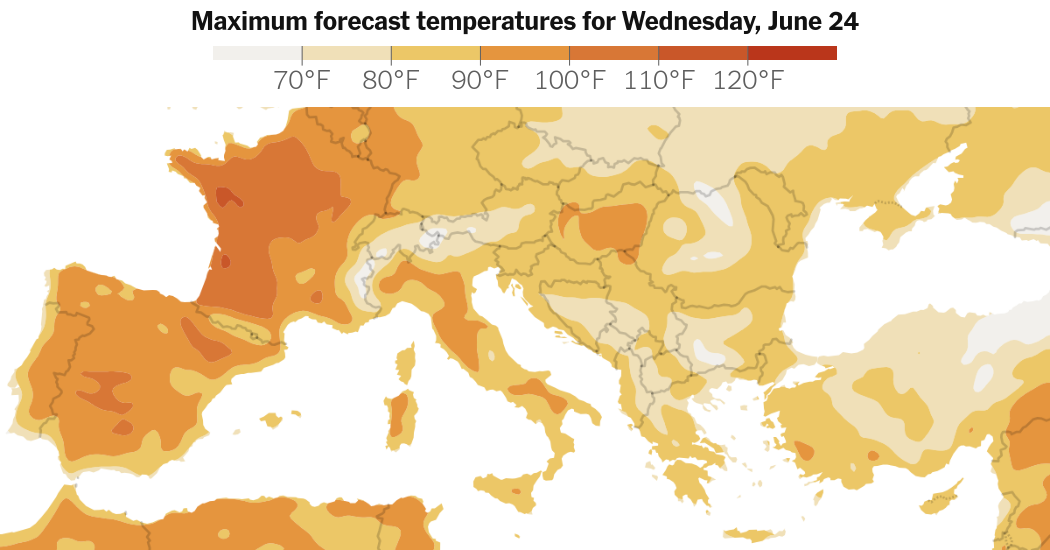
Across a continent famously celebrated for its mild, temperate summers and historic stone architecture, a suffocating reality has taken hold as Europe grapples with its second severe and unusually early heatwave in just two months. The oppressive, heavy air has settled over cities and villages alike, trapping millions of people in a sweltering embrace that has pushed public infrastructure to its absolute limits and tested the resilience of societies historically unaccustomed to such extreme conditions. From the sun-baked plazas of Spain to the usually breezy suburbs of London, the sheer intensity of the heat has transformed daily routines into battles for physical comfort and safety. Sidewalks shimmer with heat haze, parks are crowded with families seeking the meager shelter of tree canopies, and the collective anxiety of a warming world hangs as thickly in the air as the humidity itself. This is no longer a rare, once-in-a-generation weather anomaly; rather, it is a stark and recurring reminder of a shifting global climate that is transforming the European way of life before our very eyes, forcing communities to adapt in real-time to a climate that is warming faster than almost any other on Earth.
The sheer scale of this meteorological crisis is reflected in the record-breaking numbers and the subsequent systemic failures that have left thousands of households in vulnerable situations. In France, the national weather office, Météo-France, reported that the average temperature across thirty key weather stations reached an unprecedented 29.8 degrees Celsius (around 86 degrees Fahrenheit) on a single Tuesday—a staggering milestone that represents the highest average temperature ever recorded in the country, not just for the month of June, but for any season of the year. This relentless heat translated into an immediate crisis for the electrical grid as desperate citizens switched on whatever cooling fans and air conditioning units they could find, causing a surge in power demand that left more than 68,000 French homes plunged into darkness. The national grid operator, RTE, explained the delicate physics of this modern vulnerability, noting that for every single degree Celsius the temperature rises, national electricity consumption jumps by a massive megawatt due to the sudden, desperate reliance on artificial cooling. Meanwhile, across the English Channel, Britain’s weather service issued a provisional assessment revealing that temperatures in a county just outside London had soared to 35.7 degrees Celsius (96.3 degrees Fahrenheit), making it the hottest June day ever recorded in British history and leaving a notoriously damp nation completely overwhelmed by the dry, searing heat.
At the heart of this environmental emergency is a deeply human struggle defined by an architectural mismatch between Europe’s historic past and its volatile present. For centuries, homes, businesses, and schools across northern and western Europe were meticulously designed to trap and retain heat, protecting inhabitants from long, damp winters; today, however, these very same structures have transformed into stifling insulation chambers that act like ovens. On a stifling Monday in a North London park, thirty-nine-year-old Julie Green sought refuge in the shade with her infant son, Roman, describing the unbearable reality of living in a typical London flat that becomes utterly boiling inside during these heat spikes. Her voice echoed the frustrations of millions when she pointed out that the entire city—its very bricks, mortar, and urban planning—simply was not built for a hot climate. This structural trap is felt perhaps most acutely by the youngest members of society, as millions of school-aged children in the United Kingdom and France find themselves confined to stuffy, un-air-conditioned classrooms, attempting to study and learn while the heavy summer heat saps their energy, concentration, and physical well-being.
The geographic reach of this extreme weather event is staggeringly vast, triggering high-level, urgent heat warnings across more than a dozen European nations, including Andorra, Austria, Belgium, Bosnia and Herzegovina, Britain, Croatia, France, Germany, Hungary, Italy, Luxembourg, Poland, Serbia, Slovakia, Slovenia, Spain, and Switzerland. This collective emergency has brought with it a profound human cost, illustrated most tragically in France, where authorities reported that at least forty people had drowned in a matter of days—many of them young teenagers who, in their desperate and impulsive search for relief from the suffocating air, plunged into unsupervised, unfamiliar bodies of water. These tragic losses highlight a painful irony of the modern climate crisis: when communities lack safe, accessible, and air-conditioned public spaces to cool down, the natural human drive to escape physical distress can lead to fatal decision-making. The crisis has prompted scientists to reiterate what the data clearly shows: while attributing any single, localized weather event to climate change requires careful and prolonged scientific study, there is absolutely no doubt that global warming is making these heatwaves significantly hotter, more frequent, and perilously longer-lasting, leading to tens of thousands of heat-related deaths across the European continent each and every year.
As the heatwave moves across the landscape, it leaves behind a trail of disrupted systems and political debates, revealing that finding a solution to extreme heat is far more complicated than simply plug-in cooling units. In the United Kingdom, the transport network buckled under the strain as National Rail warned passengers to avoid traveling unless absolutely necessary, with high temperatures threatening to warp metal tracks and disrupt major commuter routes in and around London. In the Mediterranean, where cities historically utilized clever architectural styles like central courtyards, heavy wooden shutters, and thick white-stone facades to naturally repel the sun, rapid modern development has unfortunately favored cheaper, heat-trapping materials that render newer apartments nearly uninhabitable during summer peaks. Furthermore, the installation of modern air conditioning has erupted into a highly charged debate, considered an environmental and political flashpoint in France, and a financial luxury that many families in Britain simply cannot afford due to soaring energy prices. While Western Europe looks forward to the arrival of cooler Atlantic air to break the fever, the scorched weather is merely shifting eastward, with Spain experiencing highs of 41 degrees Celsius (106 degrees Fahrenheit), Italy issuing severe red warnings for major cultural hubs like Florence and Milan, and Germany bracing for a weekend where temperatures are expected to peak near historic records.
In the face of this intimidating new reality, learning how to safely navigate extreme heat has become an essential life skill, requiring a blend of practical household adjustments, personal self-care, and community vigilance to prevent heat-related tragedies. To keep living spaces livable, experts recommend blocking out windows during the day with dark sheets or blankets—particularly those that face the blistering afternoon sun—to prevent solar heat from penetrating the home, and then opening those windows wide at night while running fans to draw in the cooler evening air. On a personal level, maintaining hydration is vital, as is utilizing simple cooling techniques such as misting your skin with tepid water, taking cool showers, or placing cold, damp cloths on your forehead and neck to naturally lower your core body temperature. When stepping outside is unavoidable, carrying a water bottle packed with ice, dousing your head in cold water before exercising, and planning public outings around air-conditioned refuges—such as museums, grand stone cathedrals, or dedicated municipal “climate shelters” like those established in Barcelona and Paris—can provide temporary but lifesaving relief. Most importantly, as temperatures continue to trend upward, communities must look out for one another by staying highly alert to the warning signs of heat stroke, which can manifest as dizziness, a dangerously rapid pulse, nausea, severe headaches, or fainting, reminding us that survival in a changing environment ultimately depends on our collective care and adaptability.