


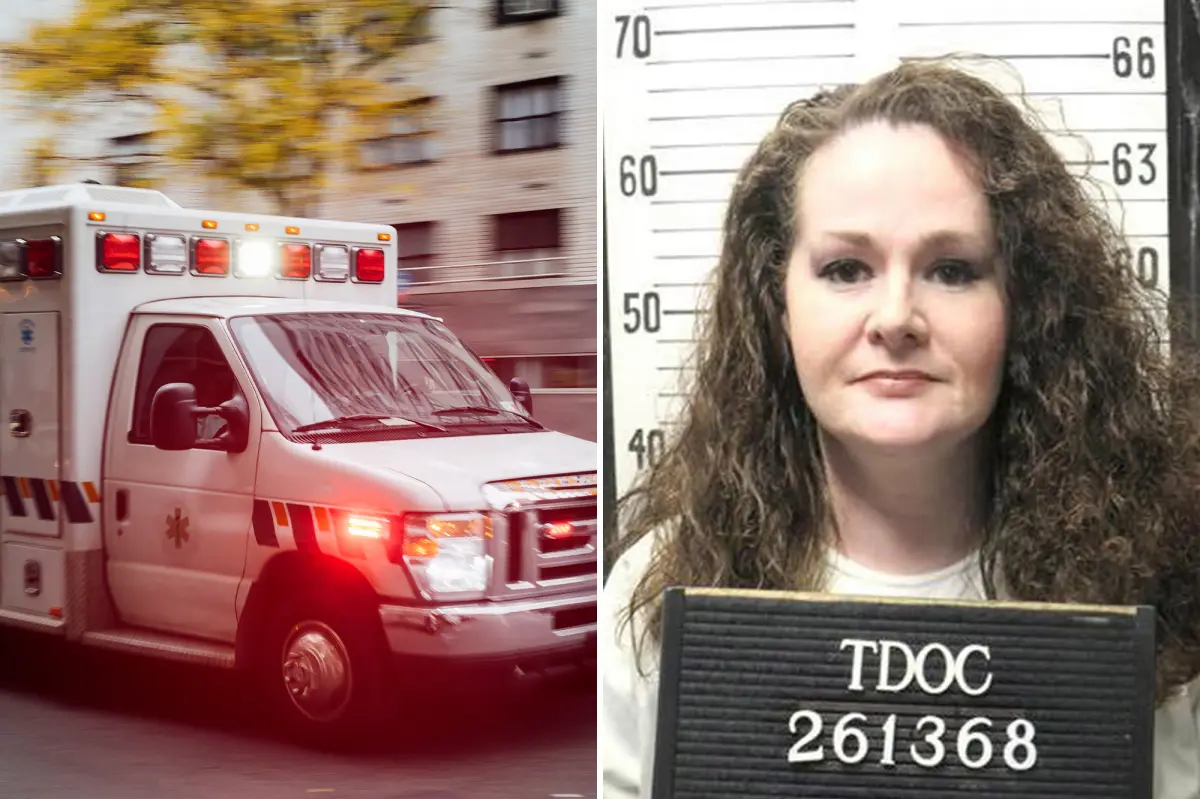
For nearly thirty minutes on the evening of September 30, emergency responders were left waiting outside the gates of Riverbend Prison, unsure whether the woman inside was dying or already dead. The woman was Christa Pike, a 50-year-old convicted killer who had just survived what was supposed to be her lethal injection. A 911 call had been placed at 8:40 p.m., but the people trained to rescue her were kept in the dark as dispatchers, prison officials, and first responders argued over whether the plea for help was real. It was not a hoax, not a drill, and not a mistake in judgment. It was a botched execution, and for the first twenty minutes or more, no one could agree on what was happening. The 911 audio, later obtained by the Associated Press, reveals a deeply human and deeply unsettling moment: a system designed to end a life suddenly forced to confront the impossible question of whether to save one. At 9:03 p.m., an unidentified voice said, “Per supervisors here at the DEC, we have been informed it is a false call. There is no medical assistance needed at Riverbend Prison.” But by 9:07 p.m., another responder was at the gate, insisting that someone official was demanding entry. The conflicting accounts created a strange bottleneck between death and care, and for a brief window, Christa Pike occupied both sides of that barricade.
The sequence of events, pieced together through call logs and recordings, shows how chaotic the botched execution really was. The first request for emergency medical assistance reached dispatchers at 8:40 p.m., a straightforward call that should have triggered an immediate response. Instead, prison officials did not confirm that the emergency was legitimate until 9:11 p.m., a full thirty-one minutes later. In that interval, the emergency communications center was actively telling first responders to stand down. “There is no medical assistance needed at Riverbend Prison,” the dispatcher relayed, echoing a message that had come from higher up. But four minutes later, a different responder reported something that cut through the official reassurances. “Somebody is outside the gate at the prison telling us that it’s real and demanding us to go in. They say they are some sort of state official. I need somebody to get out to the gate and talk to those people.” It was only at 9:11 p.m. that the request for emergency help was confirmed as legitimate, and only then were first responders permitted to rush through the gates. What took place inside those gates during those lost minutes remains unknown in full detail, but the delay in an emergency that would ultimately involve a ventilator, a hospital transfer, and a woman left unconscious with her lawyers fearing brain death is a reminder that even the most carefully planned systems can unravel when faced with the unexpected. The confusion at the gate was not bureaucratic malice; it was likely the disbelief of officials who had every reason to expect the execution to go as planned, and who struggled to accept that the lethal injection had failed.
What Christa Pike endured inside the execution chamber is harrowing in its own right, regardless of the crime that put her there. Her attorney, Randy Spivey, later described a scene that sounds less like a dignified legal procedure than a medical nightmare. Pike was strapped to a gurney for about an hour while medical staff attempted to insert at least seven needles into her body. One of those needles bent when it came out of her arm, a detail that speaks to the physical difficulty of the process. She was supposed to receive a lethal dose of pentobarbital, the drug used in Tennessee’s execution protocol. Instead, she received two doses, both of which failed to kill her. After the execution was abandoned, she was rushed to the hospital, unconscious and hooked up to a ventilator. Her lawyers feared she had suffered catastrophic brain damage, and they were not alone in that fear. For days, the woman who had been moments from execution lay in a hospital bed, her body struggling to process the powerful drugs that had been intended to stop her heart. The image is complicated, to say the least. She was a convicted murderer, a woman who had participated in the brutal torture and killing of a nineteen-year-old classmate. Yet she was also a human being, and in that hospital room, surrounded by medical staff who had no connection to the cruelty she had committed decades earlier, her body was fighting to survive. The two facts cannot be separated easily, and the botched execution forced both her supporters and her critics to confront the uncomfortable reality that the machinery of state punishment is not infallible.
Then came the miracle, or whatever one chooses to call it. Last week, after days of grim uncertainty, Christa Pike regained consciousness. She opened her eyes and began to communicate. When she first woke, she reportedly asked, “Where am I and who are you?” It was a question that seemed almost unbearably human, a sudden return to awareness after a brush with death that had been deliberate and state-sanctioned. The next day, she was walking. For a woman who had been expected to die by lethal injection, who had been written off by many as dead or close to it, the recovery was stunning. Her lawyers described it as a shocking survival, and the word “miraculous” slipped easily into the media coverage, even though the context remained dark and uncomfortable. The execution had not just failed; it had left her broken, and yet here she was, pulling herself out of a bed that had been prepared for her final moments, asking questions, moving her legs, returning to a life she had long expected to lose. There is no way to tell this story without acknowledging the victim, Colleen Slemmer, the nineteen-year-old college student whose life was cut short in 1995 by Pike and two others. But the focus of this particular moment was Pike’s physical survival, and the strange second chance that had been handed to her, not by mercy, but by incompetence or luck, depending on one’s perspective. Her recovery was not a moral vindication. It was simply a biological fact, and it raised questions that Tennessee’s prison system was not prepared to answer.
The physical and psychological aftermath of the botched execution has been severe. According to her lawyers, Pike suffered from a blood clot in one of her arms, developed pneumonia, and experienced extraordinary swelling in the days after the failed lethal injection. She also faced cognitive challenges and profound psychological trauma, the kind of damage that cannot be measured in a single scan or test. The experience of being strapped to a gurney, injected repeatedly, and left to die while the people around her debated whether the emergency was real is not something a person simply walks away from. Ten days after her shocking survival, Pike was released from the hospital and sent back to prison. She had been so close to death that her lawyers were preparing for the possibility that she would never wake up again, and then she was suddenly well enough to return to the prison system that had tried to execute her. The long-term effects remain unclear, and her attorneys have said that significant questions remain about what she endured and what ongoing harm she may carry with her. The phrase “profound psychological trauma” is heavy, and it will likely follow her for the rest of her life, whether she lives in a cell for years to come or eventually faces another execution attempt. This is not a story with a clean ending. It is a story about a physical failure in a system that was supposed to be precise, and about a woman who was forced to live through the failure.
To understand the full weight of these events, it is necessary to remember who Christa Pike is and what she did. In 1995, Pike was just eighteen years old when she and two friends lured Colleen Slemmer, a nineteen-year-old Jobs Corps classmate, to an isolated area on the University of Tennessee’s Knoxville campus. What followed was a jealous, brutal act of torture that ended in murder. Pike bashed Slemmer’s head in and, in a detail that has haunted the case for decades, kept a piece of Slemmer’s skull as a twisted souvenir. Pike was sentenced to death, and for years she sat on death row while her appeals moved through the courts. She was due to become the first woman executed in Tennessee in more than two hundred years. Instead, she became the first person in the United States to survive a lethal injection. That is an extraordinary and grim distinction, one that no one involved in the case expected. The Tennessee Department of Correction has not said what went wrong, and the silence leaves a gap in the public’s understanding. Did the medical staff fail to place the IVs correctly? Was the pentobarbital weakened or improperly administered? Was there a problem with Pike’s veins or her body’s response to the drug? None of those questions have been answered officially. What is known is that Christa Pike is alive, in prison, recovering from a tragedy she both committed and suffered. The victim’s family, the prison system, and the public must now wrestle with the consequences of a failed execution that has left everyone in an impossible place. There are no easy answers, only the tangled and deeply human aftermath of a death sentence that did not work as designed.