





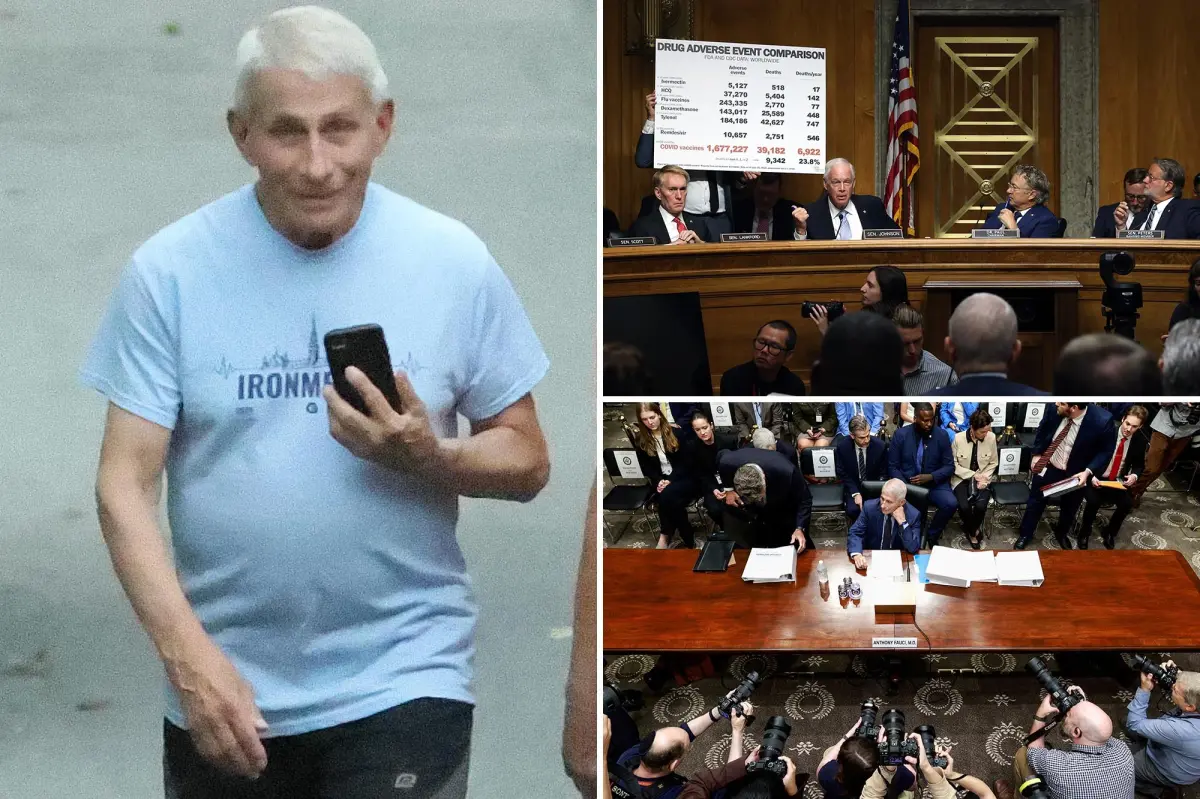
In the quiet corridors of Capitol Hill, a small, unassuming piece of modern technology has suddenly become the focal point of a massive, unresolved national drama, carrying with it the potential to unlock some of the most closely guarded secrets of the pandemic era. On a quiet Wednesday evening, Senator Ron Johnson of Wisconsin, who serves as the head of the Senate Homeland Security Permanent Subcommittee on Investigations, made a startling announcement that sent shockwaves through both the political and scientific communities: his panel had successfully obtained a copy of Dr. Anthony Fauci’s COVID-era cellular phone. Handed over by the Department of Health and Human Services, this single device represents a digital time capsule from one of the most turbulent, frightening, and deeply divisive chapters in modern American history, containing the personal communications of the man who served as the director of the National Institute of Allergy and Infectious Diseases during the height of the crisis. For millions of citizens who lived through the bewildering days of school closures, economic devastation, mandatory isolation, and the heartbreaking, lonely loss of loved ones, this phone is not merely a collection of circuits and glass; it is a repository of the raw, unedited daily decision-making processes of the public health official who wielded unprecedented influence over their daily lives. Senator Johnson expressed a sentiment shared by many critics of the federal pandemic response, voicing his profound hope that the contents of this device will finally provide the transparency, clarity, and answers that Dr. Fauci had adamantly refused to deliver during his recent, highly contentious public appearances before Congress. The acquisition of this phone marks a pivotal turning point in the ongoing struggle to dissect the federal government’s pandemic response, transforming what has long been a war of words, media spin, and political grandstanding into a tangible, forensic investigation of the private communications, doubts, and strategies that shaped the nation’s destiny during a global health emergency.
To fully understand the gravity of this unfolding political confrontation, one must look closely at the human being at the center of this storm—Dr. Anthony Fauci, an eighty-five-year-old physician who dedicated thirty-eight years of his life to leading the National Institute of Allergy and Infectious Diseases before his retirement at the end of 2022. For decades, Fauci was regarded as a steady, trusted, and comforting face of public health, guiding the nation through the terrifying early days of the HIV/AIDS epidemic, Ebola outbreaks, and post-9/11 anthrax scares with a calm, clinical, and reassuring demeanor. Yet, the sudden arrival of COVID-19 thrust him into a glaring, hyper-partisan spotlight that forever altered his public standing, transforming him from a universally respected civil servant into a deeply polarizing cultural symbol—worshipped as a heroic savior by some, and vilified as an authoritarian, untrustworthy tyrant by others. This profound polarization has taken an undeniable emotional and psychological toll on the aging doctor, who retired from government service only to find himself repeatedly dragged back into the public eye to defend his decisions, his integrity, and his legacy under intense congressional scrutiny. During his recent appearance before the Senate committee, the sheer exhaustion and defensive posture of a lifetime of public service under siege became painfully clear when Fauci chose to invoke his Fifth Amendment rights against self-incrimination an astonishing one hundred and eleven times. In his emotionally charged and deeply personal opening statement, Fauci painted a vivid picture of a man who feels hunted and slandered, directly accusing lawmakers—particularly Senator Rand Paul—of executing a calculated, personal vendetta designed not to uncover the truth, but to publicly humiliate him, invade his privacy by leaking his unredacted personal diaries, and secure a politically satisfying prosecution that would see him spend his twilight years behind bars.
The intense legal drama surrounding Dr. Fauci’s silence is further complicated by a fascinating and highly unusual constitutional paradox that has left legal scholars, politicians, and the public locked in fierce debate over the limits of accountability. Just before leaving the White House in January 2025, former President Joe Biden granted Dr. Fauci a sweeping, unconditional presidential pardon, a protective gesture intended to shield the elderly scientist from what the outgoing administration viewed as politically motivated, vengeful prosecution by his conservative opponents. However, this act of executive clemency has had the paradoxical effect of fueling the fire of his congressional adversaries, who argue that because the pardon protects Fauci from any potential federal criminal prosecution related to his pandemic-era actions, he no longer possesses any legitimate legal standing to claim the Fifth Amendment’s protection against self-incrimination. During the hearings, this legal tension reached a boiling point as Republican committee members pointed out that the Fifth Amendment is constitutionally designed to prevent a witness from being forced to confess to a crime that could land them in prison, but since Fauci can no longer be prosecuted for his past actions due to the blanket pardon, his continued silence constitutes outright obstruction rather than a protected constitutional right. This unprecedented standoff set the stage for an imminent and historic vote by the Senate Homeland Security and Governmental Affairs Committee to hold the retired doctor in contempt of Congress, a move that threatens to permanently tarnish his long professional legacy and plunge him into a brand new, high-stakes legal battle that could test the absolute boundaries of congressional oversight, executive pardoning power, and the limits of individual constitutional protections in the face of a national inquiry. For the average American watching from home, this legal maneuvering can feel like a frustrating game of political chess, where technicalities are used to shield powerful figures from the transparent conversations and hard truths that a grieving and exhausted nation desperately deserves to hear.
At the vanguard of this congressional crusade is Senator Rand Paul of Kentucky, a physician himself, whose rivalry with Fauci has over the years evolved into one of the most intense, bitter, and enduring feuds in modern American political history. For Paul and his supporters, the pursuit of Fauci is not a mere exercise in political theater or partisan bickering, but a deeply moral crusade to hold an elite, unelected bureaucrat accountable to the millions of ordinary Americans whose lives were completely turned upside down by what they view as overreaching government mandates, lockdowns, and scientific dogmatism. Paul has made it abundantly clear that he is prepared to use every legislative and legal tool at his disposal to pierce the wall of silence surrounding Fauci’s long tenure, indicating that if the committee votes to hold the doctor in contempt, he intends to bypass the bureaucratic delays of a full Senate vote and refer Fauci directly to the Department of Justice for criminal prosecution. From the perspective of these lawmakers, allowing a public official to shield themselves behind a presidential pardon while refusing to answer legitimate questions about a historic crisis that claimed millions of lives and cost trillions of dollars would set a dangerous, highly damaging precedent, effectively declaring that high-ranking government officials are entirely above the law and beyond the reach of public accountability. This relentless pursuit reflects a broader, deep-seated anger among a significant portion of the American public who feel that the official pandemic narrative was too often characterized by dishonesty, shifting goalposts, and a paternalistic refusal to trust the public with the raw, unvarnished truth, making Paul’s aggressive efforts feel to many like a vital, long-overdue quest for systemic justice and institutional transparency. The clash between these two prominent medical figures—one representing the cautious, institutional authority of the federal scientific establishment, and the other championing individual liberty and rigorous skepticism of government power—perfectly encapsulates the cultural and intellectual divide that continues to fracture the nation long after the virus itself has receded from the headlines.
The cracks in that official, carefully curated narrative began to widen significantly just ahead of the hearings when Senator Paul released hundreds of pages of Dr. Fauci’s personal and official diaries, offering an unprecedented, highly intimate window into the mind of a public health icon under immense pressure. Far from the image of an objective, detached scientist solely focused on epidemiology and data-driven solutions, the journals revealed a man who was acutely, almost obsessively, conscious of his media image, meticulously tracking his television appearances, public reception, and media profile even as the deadly virus raged across the globe. More damningly, the diaries exposed a stark and deeply troubling disconnect between Fauci’s private assessments and his public pronouncements regarding the critical question of where the virus actually originated. The writings revealed that as early as January 2020, Fauci had privately dismissed the wet market in Wuhan, China, as the likely source of the pandemic, yet in public interviews throughout 2020, 2021, and even as late as the summer of 2024, he continued to publicly champion the natural zoonotic spillover theory while casting dismissive aspersion on the “lab leak” hypothesis. This revelation of a double life—where private skepticism was buried beneath a curated public performance of absolute scientific certainty—has deeply damaged Fauci’s credibility, leaving many to wonder whether his public statements were guided by genuine scientific consensus or by a political desire to control the narrative, protect institutional funding, and avoid a geopolitical confrontation with China. For a public that was repeatedly told to blindly “follow the science” as if it were an unassailable set of dogmatic truths rather than an evolving process of inquiry, the discovery that the nation’s lead scientist was privately harboring doubts while publicly dismissing alternative theories feels like a profound betrayal of trust, suggesting that the line between objective public health and calculated political stagecraft was thoroughly and intentionally blurred.
As the Senate committee prepares to vote on holding Dr. Fauci in contempt, the acquisition of his personal cellphone represents more than just a procedural breakthrough in a congressional investigation; it stands as a powerful symbol of our collective, ongoing struggle to make sense of a global catastrophe that permanently reshaped human society. The contents of that phone—the text messages, emails, and call logs sent and received during the darkest and most uncertain hours of the pandemic—may finally bridge the wide chasm between the carefully scripted public figure and the private decision-maker, offering a raw, unfiltered look at the doubts, fears, and immense political pressures that drove the American pandemic response behind closed doors. Ultimately, this battle is not just about one man’s legacy, the protection of his historical reputation, or the political ambitions of his congressional critics; it is a painful, necessary, and deeply human reckoning over trust, transparency, and the limits of executive power in a democratic society. As the nation continues to heal from the physical, emotional, and economic scars of the COVID-19 era, the search for truth remains a vital, non-negotiable step toward restoring faith in public health institutions and ensuring that the tragic mistakes of the past are never repeated, proving that even the most powerful and celebrated figures must eventually answer to the people they were chosen to protect and serve. Whether this forensic digital search brings genuine closure or further fuels the fires of national division remains to be seen, but the pursuit itself highlights a timeless, fundamental truth: in a free democracy, the right of the people to know the truth about their government’s actions must always triumph over the desire of the powerful to conceal them, reminding us that true accountability is the only foundation upon which a fractured society can hope to rebuild its broken trust.