






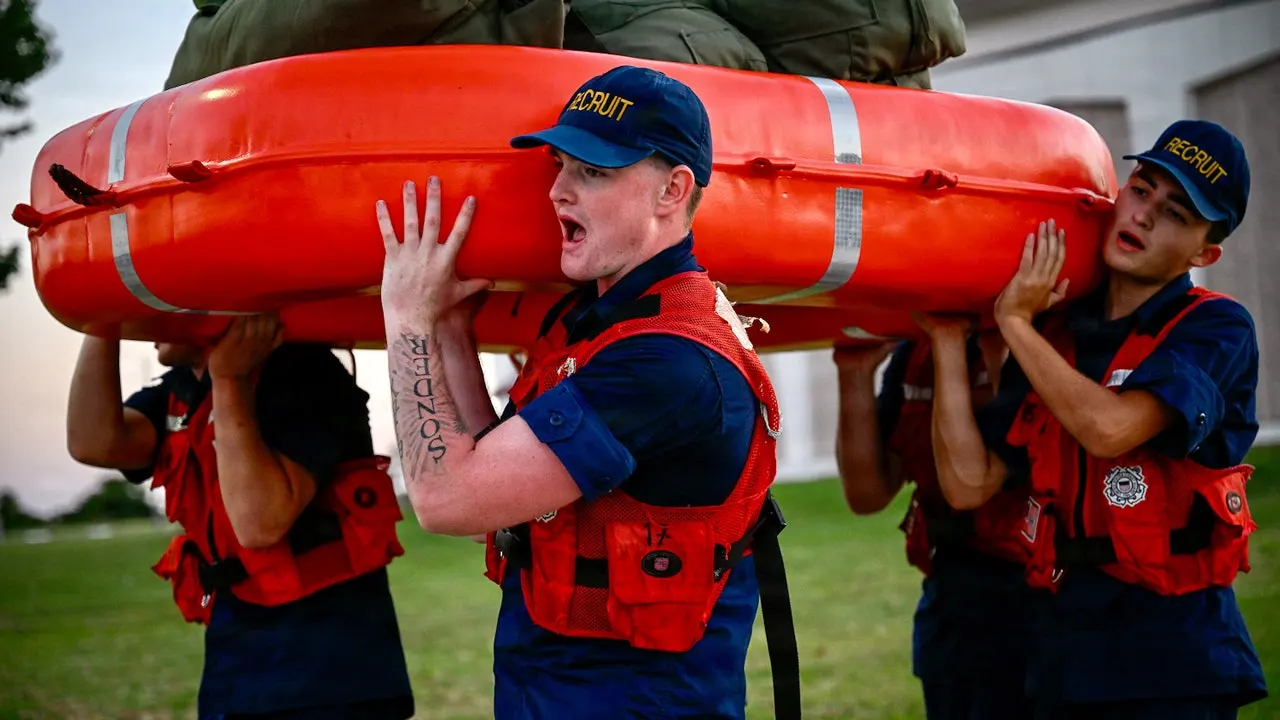
Across the United States, a quiet but powerful shift is taking place—one that speaks to a renewed sense of purpose and patriotism among young Americans. The U.S. Coast Guard has just announced its largest enlisted class in nearly four decades, a milestone that feels especially meaningful in an era when military recruiting has often been described as a struggle. During fiscal year 2026, 5,445 active-duty members raised their hands and enlisted, surpassing the service’s recruiting goals for the third year in a row. To understand how significant this is, consider the trajectory: just two years earlier, in 2024, the Coast Guard brought in 4,422 new enlisted members. In 2025, that number climbed to 5,204. Now, it has jumped again. This is not merely a numerical achievement; it represents thousands of individual decisions—ordinary people from all walks of life choosing to dedicate themselves to something larger than themselves. Homeland Security Secretary Markwayne Mullin captured the sentiment poignantly, describing the record-breaking recruitment numbers as proof that “the call to serve still resonates deeply across our country.” He spoke with visible pride about welcoming these new Coast Guard men and women, emphasizing that they represent “the very best of who we are” and vowing that they will receive the tools, training, and support they need to succeed. Behind the statistics are real stories: a recent graduate leaving a comfortable job, a parent seeking a stable and honorable career, an immigrant chasing the American dream through service. This infusion of new talent breathes life into the service and reinforces a timeless truth—that even in a rapidly changing world, the desire to protect home and country remains an inspiring and unifying force.
The service’s growth over these past three years tells a story of steady, deliberate momentum. In fiscal year 2024, the Coast Guard welcomed 4,422 enlisted members. The following year saw a substantial improvement to 5,204, and now the fiscal year 2026 figure of 5,445 marks the largest enlisted intake in decades. But the success is not limited to the enlisted ranks. The Coast Guard also commissioned 346 active-duty officers, the second-highest total in its entire history. This dual achievement—strong enlisted recruitment and exceptional officer commissioning—reveals a robust pipeline of talent at every level. It suggests that the organization is not only attracting people who want to serve, but also developing leaders who will guide the service through the complex challenges of the future. For the individual recruits, the journey is one of transformation: civilians arrive at training with nerves, hopes, and aspirations, and they leave as disciplined professionals ready to perform missions ranging from search-and-rescue to maritime law enforcement and national defense. For the Coast Guard, these numbers mean more capacity to fulfill its ever-expanding role. The service has long been described as one of America’s greatest but least-known assets, often doing dangerous and critical work in the background. Now, with a larger force, it can respond more effectively to hurricanes, interdict illegal drugs, rescue distressed mariners, protect the nation’s borders, and safeguard economic interests at sea. The significance of these numbers reaches far beyond the recruiting office; it touches every community along the coasts, the Great Lakes, and inland rivers, ensuring that help is there when needed.
To achieve such remarkable growth, the Coast Guard has been intentional about where and how it recruits. During fiscal year 2026, the service expanded its reach by opening four new recruiting offices in distinct and strategic locations: Miami, Florida; Long Island, New York; Austin, Texas; and the Netherlands. Each of these locations brings its own unique potential. Miami offers access to a vibrant, diverse community with deep maritime roots. Long Island, surrounded by water and home to many coastal residents, is a natural pipeline for sea-minded applicants. Austin, known for its young, tech-savvy population, represents a fresh frontier for attracting innovative and adaptable recruits. The Netherlands office, meanwhile, signals an international presence, likely targeting Americans living abroad and military-connected families stationed overseas. This expansion is about more than geography—it reflects a thoughtful effort to meet people where they are, in both physical and cultural terms. The Coast Guard recognizes that talent is not limited to traditional recruiting hotspots; it can be found everywhere, from bustling cities to quiet towns, and even overseas. Vice Commandant Adm. Tom Allan underscored this optimism, noting that the service surpassed its goals “because Americans are ready and willing to serve in the U.S. Coast Guard, conducting exciting missions that deliver results our Nation needs.” He framed the achievement as bigger than mere numbers, describing it as building “the world’s best Coast Guard” and creating the workforce America requires. That message appears to resonate with a new generation of servicemen and women who are looking not just for a paycheck, but for purpose, adventure, and a chance to make a tangible difference in the world.
Bringing in thousands of new members is one thing; training them properly is another. Recognizing this, the Coast Guard has made a substantial investment in its future infrastructure. The service awarded a $400 million contract to modernize Training Center Cape May in New Jersey, the largest shore construction award in Coast Guard history. Cape May is not just any facility—it is the sole basic training center for enlisted recruits, the place where every enlisted member begins their journey. For many, Cape May is a crucible: a place of early mornings, rigorous physical training, classroom instruction, and the forging of lifelong bonds. It is where civilians are transformed into Coast Guardsmen, learning the values of honor, respect, and devotion to duty. The modernization project is intended to accommodate a growing workforce, ensuring that the facilities match the quality and motivation of the people who pass through them. This investment sends a powerful message to the new recruits: their service matters, and the organization is willing to put its resources behind their development. It also improves the daily experience of training, from living quarters to training grounds, creating an environment where focus and morale can thrive. For the recruits, arriving at Cape May can be both intimidating and exhilarating. They come from different backgrounds—some straight out of high school, others with college degrees, many leaving behind civilian careers. They are united by a common decision to serve. The updated facilities will help ease the transition, providing a foundation that supports both physical and mental resilience. As the Coast Guard grows, Cape May will remain the beating heart of that expansion, a place where the future of the service is shaped one class at a time.
The broader context for this recruitment surge is an ambitious modernization initiative known as Force Design. At its core, Force Design is the Coast Guard’s plan to transform itself for the challenges of the 21st century. One of its most striking goals is to expand the military workforce by at least 15,000 members by the end of fiscal year 2028. Why does the service need so many more people? The answer lies in the expanding fleet and growing mission demands. The Coast Guard operates an increasingly complex inventory of cutters, boats, aircraft, and cyber systems, all of which require skilled personnel to operate and maintain. At the same time, the service’s missions continue to grow in scope and complexity—from countering transnational crime and illegal migration to responding to climate-driven disasters and asserting U.S. interests in the Arctic. Each new ship, each new mission, and each new strategic commitment requires more hands, more minds, and more hearts. Force Design is not just about adding bodies; it is about building a force with the right skills, the right capabilities, and the right posture for the future. The recruitment successes of 2024, 2025, and 2026 are foundational to this vision. Without a steady stream of talented recruits, modernization would stall. With it, the Coast Guard can confidently move forward, knowing that the people are there to crew the ships, fly the aircraft, and lead the missions. For the men and women currently at Cape May or just beginning their careers, this means they are entering an organization that is forward-looking, investing in the future, and genuinely committed to ensuring they have meaningful careers. They are not just filling positions; they are building a legacy.
In the end, these record-breaking numbers are about more than just meeting recruiting benchmarks. They are about hope, trust, and the enduring spirit of service. For the Coast Guard, the achievement is a validation of its values and a promise of its readiness. For the nation, it is a reminder that patriotism is alive and well in a new generation. Secretary Mullin’s words ring true: the call to serve still resonates, deeply and broadly. The new Coast Guard men and women come from every corner of the country and beyond, each one saying yes to a life of challenge and purpose. Their decision is an act of optimism—a belief that by serving, they can help make the world safer, better, and more secure. The Coast Guard, in turn, is rising to meet that commitment. Through expanded recruiting offices, transformative training infrastructure, and the forward-looking vision of Force Design, the service is preparing to welcome them, train them, and support them throughout their careers. It is a virtuous cycle: as the service becomes a more attractive place to serve, it draws in more talent; as more talent arrives, the service becomes stronger and more capable. For the families watching their loved ones ship off to Cape May, there is pride. For the recruiters who worked tirelessly, there is satisfaction. And for the American people, there is reassurance that the guardians of our coastline, our waterways, and our maritime interests are growing in both number and strength. This is not just a good news story for the military; it is a good news story for America—a reminder that, even amidst uncertainty, there are still thousands of people willing to stand up and say, “Send me.” And for that, every American can be grateful.