




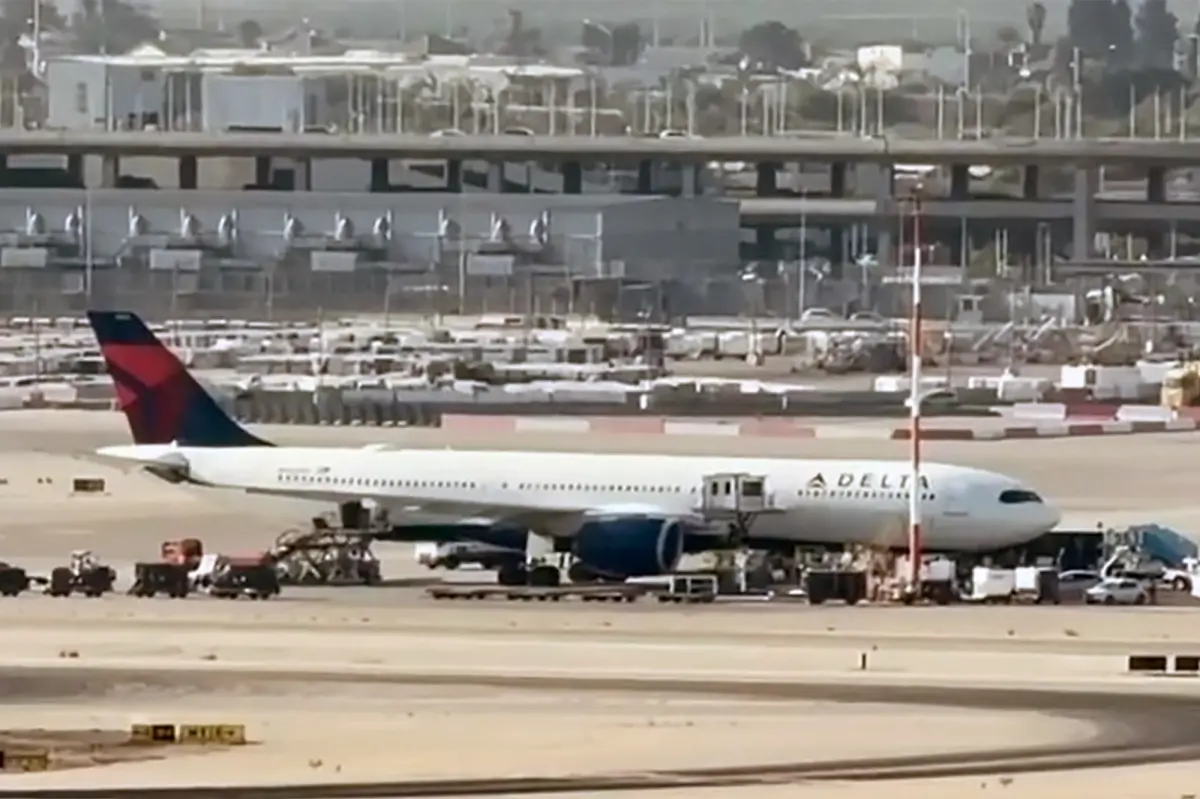
The Tuesday morning calm of Ben Gurion International Airport was broken in an instant. A Delta Air Lines flight from New York had just landed after an overnight journey across the Atlantic, and for the passengers onboard, the long-awaited moment of arrival was finally at hand. They had left John F. Kennedy International Airport shortly after 3:30 p.m. on Monday, and after hours of cramped seats, dimmed cabin lights, and restless sleep, the wheels of the Airbus A330 touched down on Israeli soil at around 8:30 a.m. local time. It should have been a routine ending to a long flight. Instead, according to the Jerusalem Post, the aircraft was met by security teams after authorities received a warning that an explosive device might be aboard. What followed was a scene of controlled urgency: passengers were rushed from the plane into the terminal, their carry-on bags and personal belongings left behind, while investigators began a painstaking search of the twin-jet aircraft. The normal choreography of disembarkation was replaced by confusion, fear, and a strange silence. There was no announcement explaining what was happening, only the urgent movement of uniformed personnel and the unmistakable feeling that something had gone very wrong. For the people onboard, the transition from routine to emergency was dizzying. One moment they were gathering their things, stretching their legs, preparing for customs; the next they were being hurried through corridors under the watchful eyes of armed guards. The morning sun outside the windows was bright and warm, but inside the terminal, a cold tension had settled over everyone.
The details of the scare emerged gradually, piece by piece, from Israeli media and airport officials. Authorities had received word of a possible explosive onboard the Delta flight, and after landing, the decision was made to evacuate the aircraft and treat the threat as real. Passengers were moved quickly and efficiently into the terminal, where they were held in a secure area while security forces scoured the plane. The search was thorough, as it always is in such cases. Investigators checked every seat, every compartment, every piece of luggage that remained in the cabin. Dogs were brought in, scanning the aircraft with their extraordinary senses, while bomb disposal units stood by. For a time, the uncertainty was total. But eventually, the search came to an end, and the verdict was clear. The threat had been false. “The incident has ended with no unusual findings. Operations have returned to normal,” an Israel Airports Authority spokesperson told Ynet. The statement was brief and clinical, but it carried a wave of relief. The plane was cleared, the terminal resumed its usual rhythm, and the airport opened itself once again to the steady flow of travelers. Yet for those who had lived through the evacuation, the end of the emergency did not immediately erase the fear. A bomb threat, even a false one, leaves an impression. It reminds people how quickly safety can be suspended, how ordinary moments can be overtaken by the extraordinary. The passengers were eventually allowed to continue on their way, but they carried with them the memory of that strange, suspended time when their plane became the focus of a security operation.
To humanize the incident is to imagine the scene from the perspective of the passengers. They had boarded the flight in New York with the usual mix of anticipation and exhaustion. Some were returning home to Israel after visiting family in the United States. Others were business travelers heading to meetings in Tel Aviv. Still others were tourists, eager to explore a country they had only read about. The flight had been long, but it had been unremarkable. There were no disturbances, no warnings, no moments that felt out of place. Then, after landing, everything changed. The evacuation would have been swift but disorienting, the kind of moment where people look to each other for reassurance and find only the same confusion they feel themselves. Passengers may have been asked to leave their belongings, a request that feels both necessary and terrifying. For some, the anxiety would have been overwhelming. For others, there would have been the odd, almost surreal calm that descends during emergencies, the sense that the mind is trying to catch up with what the body is experiencing. They waited, likely in a secure area of the terminal, not knowing whether the threat was real, not knowing whether they would hear news of a loved one or news of a tragedy. They watched as security personnel moved past them, their faces focused and unreadable. They checked their phones, sent messages to family, tried to reassure themselves and each other. And then, finally, the news came: no explosives, no unusual findings, nothing. The relief was immense, but so was the emotional toll. A false alarm is not a non-event for the people who live through it. It is a brush with the possibility of violence, a reminder of the fragility of life, and a story they will tell for years.
The scare took on an even deeper resonance because of what had happened in the region less than two weeks earlier. Reports had emerged of a flydubai co-pilot, Hamam al-Hammami, who allegedly attacked the pilot, Smit Machchhar, and tried to hijack a plane bound for Tel Aviv. The incident was described as the work of a “lone wolf,” a phrase that has become all too familiar in discussions of security threats. That a member of a flight crew, someone entrusted with the safety of everyone on board, could allegedly turn against his own passengers and colleagues sent a chill through the aviation world. It challenged the assumption that the greatest threats come from outside, from strangers with hidden weapons or carefully planned plots. It suggested instead that danger can emerge from within, from the very people who are supposed to be the guardians of the sky. The memory of that incident was still fresh when the Delta flight landed on Tuesday morning. It is impossible to know whether the bomb threat against the Delta flight was connected to the earlier hijacking attempt, and there is no evidence that it was. But the timing alone was enough to sharpen the alertness of security forces. In Israel, where airport security is among the most sophisticated and rigorous in the world, every threat is treated as real until proven otherwise. The cost of being wrong is too high to do anything else. This is why the evacuation was carried out so swiftly, why the search was so exhaustive, and why the authorities were unwilling to take any chances. The false alarm was, in a way, a testament to the system’s vigilance, a reminder that the price of safety is constant readiness.
For Delta Air Lines, the incident was both a logistical challenge and a public relations test. The airline operates a daily flight connecting JFK Airport and Tel Aviv, a route that is vital for travelers moving between the United States and Israel. The flight that landed on Tuesday morning had departed New York just after 3:30 p.m. the previous day, and its arrival in Tel Aviv at around 8:30 a.m. local time had been uneventful until the bomb threat was reported. It is unclear how many passengers and crew were on board the aircraft, and Delta was approached by the Post for comment, though no statement had been released at the time of reporting. In the aftermath of the scare, the airline would have been in close communication with Israeli authorities, working to ensure the safety of its passengers and crew and to understand what had prompted the threat. For the airline, the situation was a reminder of the unpredictable nature of international travel. A flight that crosses the Atlantic without incident can suddenly find itself at the center of a security alert the moment it lands. The passengers, scattered through the terminal during the search, would have had many questions. When would they be allowed to leave? What would happen to their luggage? Would they be compensated for the disruption? These are the practical concerns that follow a moment of crisis, and they are often the last things addressed in the chaos. But in the end, the airline and the airport managed the situation without harm. The flight was cleared, operations returned to normal, and the daily rhythm of travel resumed. For Delta, the incident was likely a moment of relief more than anything else, a reminder that in the world of aviation, the best outcome to a bomb threat is the one where nothing is found.
In the end, the story of Tuesday morning at Ben Gurion Airport is not a story of destruction or heroism, but of caution and uncertainty. A bomb threat was called in, a plane was evacuated, a search was conducted, and nothing was found. For the passengers, it was a frightening interruption to an ordinary journey. For the airport authorities, it was a procedure followed to the letter. For Delta, it was a disruption handled quietly and professionally. And for the rest of us, it was a glimpse into the reality of modern air travel, where security is never guaranteed and where even a false alarm can stop a plane in its tracks. There is a temptation to dismiss such incidents as overreactions, to wonder why so much effort is spent on threats that turn out to be empty. But the people who were on that plane understand why. They know that the difference between a false alarm and a real tragedy is often just a matter of timing, of luck, of the willingness of authorities to take every warning seriously. The passengers who left the airport on Tuesday morning may have been frustrated by the delay, shaken by the experience, or simply grateful to be on solid ground. They may have told their families about the strange morning, the armed guards, the long wait. They may have wondered, for days afterward, what would have happened if the threat had been real. But they walked away. They walked away because the system worked, because someone decided to check, because a plane full of people was treated as if it mattered. And in the end, that is the most human response of all: to be afraid, to be careful, to refuse to look away, and to hope that the worst never comes.