





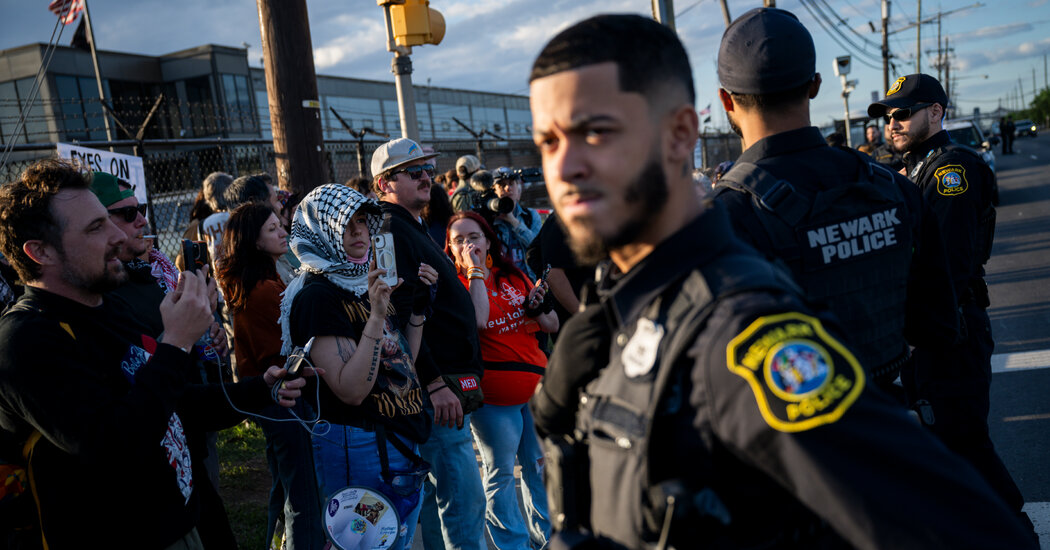
Behind the imposing, cold-gray walls of the Delaney Hall detention center in Newark, New Jersey, a quiet but deeply painful human tragedy has been unfolding for months, largely hidden from the public eye. Inside this privately run facility, immigrant detainees, stripped of their liberty and denied basic human dignity, have turned to the absolute last weapon they possess: their own bodies, launching a grueling hunger strike to protest uninhabitable living conditions, contaminated food, and a catastrophic lack of medical care. Outside physical fences, their families, local advocates, and concerned citizens have spent nearly a year holding peaceful, raw vigils in the rain and summer heat, pleading for basic human rights and transparency from the system. Over the weekend, however, this long-standing peaceful protest erupted into a terrifying, chaotic clash as the New Jersey State Police descended upon the crowd. Tempers flared, and the scene quickly devolved into violence, culminating in a dangerous roadway fire on the asphalt outside the building. Protesters found themselves physically shoved into oncoming traffic, while state troopers deployed batons against the crowd in a heavy-handed bid to restore order. In the immediate aftermath of this intense confrontation, local officials were forced to reckon with the fallout of an emergency weekend curfew that resulted in 61 arrests and left the community deeply traumatized, shining a harsh light on the profound disconnect between aggressive state-level law enforcement and the humanitarian crisis that ignited the outrage in the first place.
Recognizing that militarized force had failed to calm the waters and had only succeeded in escalating tensions, Newark Mayor Ras Baraka stepped forward on Tuesday morning to announce a dramatic pivot in strategy. During a press conference, Baraka, a lifelong community advocate and Democrat, articulated a governing philosophy grounded in empathy rather than physical intimidation, asserting that maintaining public order and protecting fundamental civil rights should never be mutually exclusive. He openly criticized the state police’s aggressive approach, noting with visible frustration that their intervention had severely inflamed relations between the demonstrators, federal immigration officers, and local residents. In a sharp and memorable condemnation, the mayor likened the state police to a “sword,” warning that if the state chooses to wield such a weapon against its own people, it must expect those citizens to get cut. To heal this self-inflicted wound, Baraka announced that the city would be taking back control of public safety operations around Delaney Hall, dismantling the highly restrictive, orange-barricaded “protest zones” that had penned in demonstrators like cattle, and instead deploying local street teams composed of clergy members and community activists to peacefully keep the peace.
This critical decision to shift control back to Newark city officials comes amid a storm of political backlash targeting Governor Mikie Sherrill, whose initial decision to authorize state police intervention on Friday set off this chain of explosive events. Sherrill, a Democrat who had built a national reputation on her opposition to the Trump administration’s aggressive immigration policies, found herself in a highly hypocritical position after sending in state troopers in response to federal threats of an immigration enforcement surge. To many of her progressive supporters, this defensive deployment felt like a profound betrayal of the values she championed on the campaign trail, as the tactics of the state police mirrored the hostile, militarized actions of federal Immigration and Customs Enforcement (ICE) agents. In response to the growing public outcry, the governor’s office redirected reporters to a brief social media statement emphasizing her desire to secure better conditions for the detainees while urging all sides to remain peaceful. However, for those who watched the state troopers use physical force against their own neighbors, the governor’s online platitudes felt empty, exposing the cynical reality of political posturing where vulnerable human lives are routinely caught in the crossfire of federal policy and state-level damage control.
Among those grappling with a deep sense of betrayal is Casey Ward, a 30-year-old hair salon owner from Garfield, New Jersey, who had spent countless hours volunteering for Sherrill’s campaign because she believed in the promise of compassionate leadership. For Ward, watching the state troopers she had indirectly helped put in power turn on peaceful protesters outside Delaney Hall was a devastating, radicalizing awakening. Ward, who had originally favored Baraka’s more progressive platform during the primary but ultimately threw her weight behind Sherrill for the general election, expressed an agonizing sense of regret, noting that the governor was now asking citizens to ignore the plain evidence of state-sponsored violence with the same dismissiveness often attributed to the Trump administration. Ward’s anger was directed not only at the political establishment that turned its back on vulnerable communities, but also inward, reflecting a widespread exhaustion among regular voters who feel their democratic participation has yielded little more than rubber bullets and batons in response to humanitarian crises. Her personal disillusionment serves as a poignant reminder that behind the political headlines are real individuals who invested their hope, sweat, and votes into a system that ultimately chose cold, bureaucratic obedience over human empathy.
While the political battle played out on the streets, a parallel legal war was being waged against the GEO Group, the multi-billion-dollar private prison company that operates Delaney Hall under a massive federal contract. The facility has long been criticized as a black box where profit is prioritized over human health, a sentiment echoed by New Jersey Attorney General Jennifer Davenport, who filed a lawsuit on Tuesday to force the private company to allow state health inspectors full, unhindered access to the building. This legal action was prompted by a disturbing incident on May 28, when state inspectors were barricaded from entering critical areas of Delaney Hall, including the medical unit, sleeping dormitories, and sanitation facilities, in direct defiance of state laws governing public hygiene. Mayor Baraka fiercely supported the lawsuit, comparing the facility to a nursing home that must remain open to public scrutiny, while also arguing that Delaney Hall was operating illegally because the GEO Group had never obtained local zoning approvals to convert the facility from a transitional halfway house for former prisoners into an immigrant detention camp.
As the curfew is finally lifted and the physical smoke clears from the roads outside Delaney Hall, the emotional and moral wounds of the community remain wide open, offering a stark reminder of the human cost of privatized, profit-driven human incarceration. The fragile, uneasy peace now maintained by local clergy and community street teams is a hopeful alternative to police batons, but it cannot cure the deep, systemic suffering that continues unabated inside the facility’s walls, where detainees face starvation, isolation, and medical neglect. The struggle in Newark has elevated a local zoning dispute and a political clash into a profound human rights issue that challenges the collective conscience of the entire state of New Jersey. It forces everyday citizens and political leaders alike to ask searching questions about the morality of profiting off human confinement, and the devastating consequences of using state power to silence those who speak for the voiceless. Ultimately, the lifting of the curfew is not a victory, but a temporary reprieve, and the quiet vigil outside Delaney Hall will continue, driven by families who refuse to let their loved ones be forgotten in the dark, and a community determined to prove that human dignity cannot be locked away behind concrete and steel.