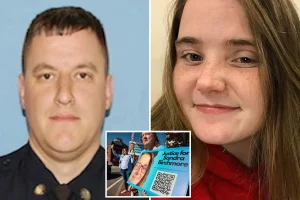


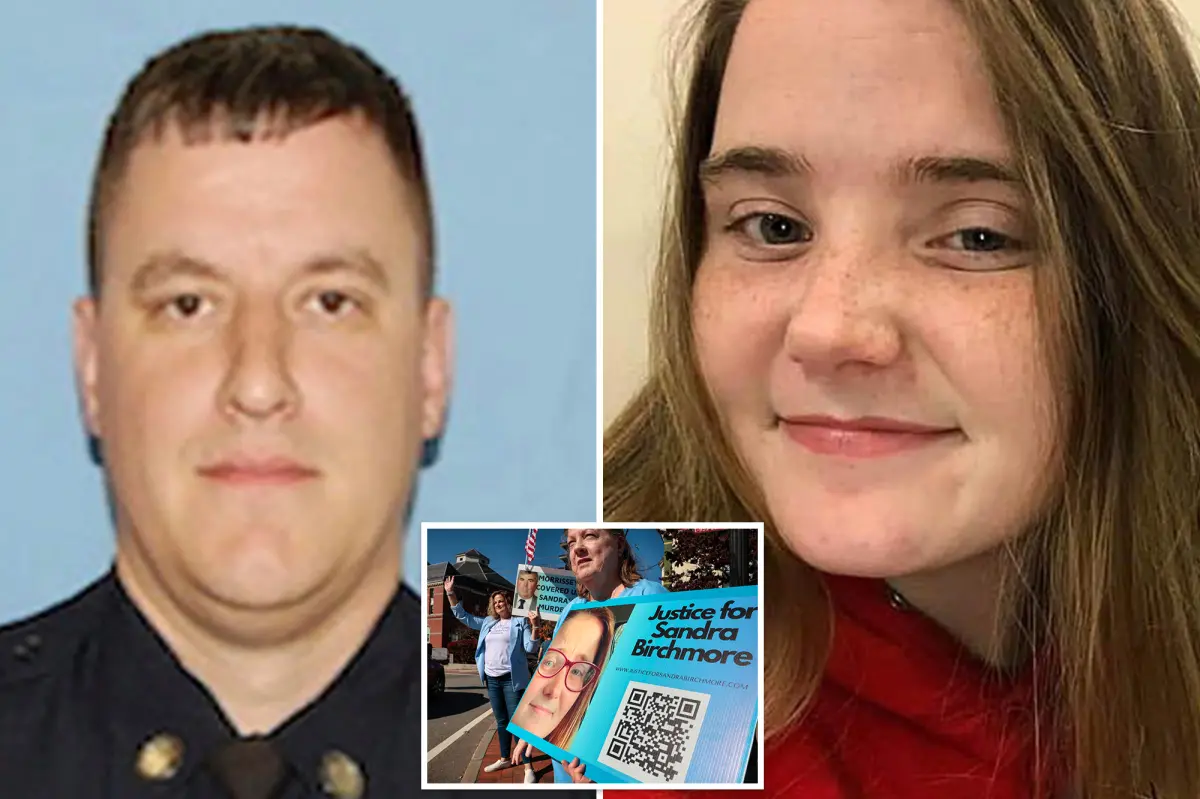
Inside a Boston federal courtroom, the opening moments of Matthew Farwell’s murder trial were never going to be easy. The prosecutor stood before the jury and painted a picture of a young woman with every reason to look forward, only to be betrayed by the very person she trusted most. Sandra Birchmore had just discovered she was pregnant. At 23, she was texting the man she believed was the father—Farwell, a married Stoughton police officer—and she was excited. Instead of warmth, she received a message of pure venom: “You are truly the worst person on the face of Earth.” The words hung in the air as the courtroom absorbed the cruelty. Prosecutor Torey Cummings argued that Farwell’s anger was not a passing moment but the beginning of a calculated plan. He claimed Farwell, a hulking 6-foot-4 cop, had spent years manipulating Birchmore, starting when she was barely a teenager. Now, with a pregnancy threatening to expose their secret, he had decided to end her life. Birchmore’s final messages, shown to jurors, revealed how completely she had been lulled into a false sense of safety. Nine days before her death, she texted a friend that Farwell had asked for a key to her apartment and had looked around her closet and bathroom—behavior she called “weird.” Yet when he texted on the night of Feb. 1, 2021, asking if he could come by, she said yes, asking if he was okay and telling him the doors were open. That trust, Cummings said, was Farwell’s weapon. He didn’t arrive as a friend; he arrived wearing a blue mask despite his public opposition to masks during COVID, perhaps to avoid being identified. He stayed about an hour, and when he left, Birchmore’s life was over. The court heard all this as Farwell, in a grey suit, stared straight ahead. It is a story of brutal power and broken trust, but it is also, for the jury, the beginning of a careful legal battle over what really happened that night.
To understand how a 23-year-old woman could leave her door open for the man accused of killing her, prosecutors say you have to go back more than a decade. Sandra Birchmore was fourteen years old when she joined the Stoughton Police Department’s Explorers program—a program designed for young people interested in law enforcement. Farwell, then a volunteer instructor in his twenties, was part of that world. To Birchmore, he represented something she dreamed of: a career in policing, mentorship, maybe even belonging. She was young and impressionable; he was older and in charge. The Facebook friend request he sent in 2012 seems small, but it was the first step of a pattern that prosecutors call grooming. Farwell offered to “tutor” her, meeting her at the library under the guise of helping with schoolwork. What should have been harmless guidance turned into something deeply sinister. Cummings told jurors that Farwell raped Birchmore on April 10, 2013, when she was fifteen years old. In Massachusetts, the age of consent is sixteen; the prosecution was blunt: “She was a 15-year-old child. That’s statutory rape and that’s a crime.” The jury saw text messages in which Farwell described that day as “the best day of my life” and wrote about wanting to “f–k” her again. He allegedly shared sexual fantasies involving domination, pain, and rape—fantasies that cast a disturbing shadow over everything that came later. For Birchmore, this was not a romance between equals. It was an abusive relationship that began when she was still a child, and it continued into her twenties. The power imbalance never went away. He was a police officer, a husband, a father; she was a young woman struggling with mental health and still carrying the weight of what he had done to her. The prosecution’s argument is that Farwell used that power repeatedly to control her, and then used it one final time to try to silence her forever. It is a devastating portrait of how grooming works: slowly, quietly, and often hidden in plain sight. To the jury, these early texts and relationships matter because they explain why Birchmore might have trusted him, and why her trust made her vulnerable.
By the time Birchmore learned she was pregnant in December 2020, she had been entangled with Farwell for years. The pregnancy, prosecutors say, changed everything. Birchmore was overjoyed. She sent Farwell a photo of a poster that read: “Congrats we are going to be parents.” She began planning for the future in small, concrete ways: buying a car seat, a stroller, a baby onesie. She started planning a gender reveal photo shoot. Even more telling, according to Cummings, she began taking her antidepressant medications again—a sign that she wanted to live, not only for herself but for the child she was carrying. It was as if the baby had given her a reason to hope. Farwell, however, was not hopeful. He was angry. The prosecutor said his initial reaction was vicious, declaring her “the worst person on the face of the Earth.” But then, in the days before her death, he made what Cummings called “a complete 180.” He stopped acting angry. He asked for a key to her apartment. He went into her closet and bathroom, surveying the private spaces of her home. Birchmore noticed the oddness and mentioned it to a friend in a text on Jan. 24, 2021—eight days before she died. Still, she didn’t see the danger. On the night of Feb. 1, 2021, Farwell texted at 9:07 p.m.: “Are you still up. Ok to come by for a second.” She replied, “Yeah you can come say hi. You ok? Doors open when you get here.” Those words, so eager and trusting, became the last messages she would ever send. Surveillance footage showed Farwell entering her Canton apartment building at 9:14 p.m., wearing a blue mask—a striking detail, because he had often spoken out against masking during the pandemic. Prosecutors believe he wore it to conceal his identity. He left about an hour later. In that hour, Cummings alleged, Farwell strangled Birchmore with the strap of a duffel bag, then arranged her body to appear as if she had taken her own life. The young woman who had been buying baby supplies and planning a gender reveal was gone. The poster she had proudly sent to Farwell, with its promise of parenthood, was no longer a celebration—it was evidence.
The manner of Sandra Birchmore’s death was as cruel as the betrayal that preceded it, prosecutors say. Cummings described Farwell as a “hulking” six-foot-four cop, physically towering over Birchmore, who stood just about five feet tall. He allegedly strangled her with the strap of a duffel bag, then staged the scene to make her death look like suicide. Her body was placed in a seated position near the closet door, with the strap around her neck and latched onto the doorknob. “Eight days later, her dead body would be hung from that closet doorknob,” the prosecutor told the jury. It took more than a week for anyone to find her. During those eight days, Farwell was living his normal life, preparing for the birth of his third child with his wife. In fact, prosecutors say, he killed Birchmore the day before his wife gave birth. The timing, they argue, was no coincidence. A woman who claimed to be carrying his child, who had threatened to reveal their affair, could not be allowed to expose him at such a moment. Even after her death, the case took a grim turn: DNA testing showed that Farwell was not the biological father of Birchmore’s unborn baby, although both of them believed he was. That detail does not change the prosecution’s theory. Farwell believed the pregnancy was his project to manage, a secret to be contained. The fact that the genetic paternity belonged to someone else makes the alleged murder even more senseless—a life erased over a misunderstanding created by fear and deceit. Cummings argued that Birchmore had always tried to protect herself, to manage her mental health, to build a future for her child. “There was one person Sandra couldn’t protect her baby from—the defendant,” she said. That line captures the tragedy of the prosecution’s case: a young mother, already struggling, unable to see that the man she trusted posed the greatest threat. The alleged staging of the suicide was, in the prosecution’s view, Farwell’s final act of control: not only deciding that Birchmore should die, but trying to decide how the world would remember her.
Farwell’s defense attorney, Kimberly Stevens, offered a very different picture of the case. She did not deny that Farwell had an affair, and she acknowledged that Birchmore had mental health struggles. But she insisted that Farwell did not kill her. “Matthew Farwell was a man who had an affair… Matthew Farwell did not kill Sandra Birchmore. He did not,” Stevens said. Instead, she pointed to Birchmore’s state of mind in the weeks before her death. Birchmore had a history of mental health challenges, and according to the defense, those challenges worsened as her pregnancy progressed. Stevens told jurors that Birchmore searched online for an image of a man being held back from jumping off a bridge, with text that read, “can I die just for a day, I just want to see who would cry when I was gone.” She also searched the phrase “what color is the suicide ribbon.” Those searches, the defense argued, are “a window into her mental state as this is all happening.” In Stevens’ telling, Birchmore killed herself, and Farwell was guilty of nothing more than being a dishonest husband. It is a powerful reminder that the trial is not just a story of a victim and an accuser; it is a legal proceeding where every allegation must be proven beyond a reasonable doubt. The prosecution’s narrative is loaded with emotional weight—grooming, betrayal, pregnancy, murder—but the defense is asking the jury to look at the evidence more skeptically. Could the same texts about the closet and the key simply be the actions of a man trying to hide the affair from his pregnant wife? Could the blue mask be a mundane choice rather than a disguise? Could Birchmore’s excitement about the baby coexist with deep depression? Mental illness is complicated, and the defense is leaning into that complexity. Farwell has been in custody since his arrest in 2024, and he has pleaded not guilty. If convicted on the federal charges—one count of killing a witness or victim and one count of causing the death of an unborn child—he faces life in prison. The defense is not just fighting for a verdict; it is fighting for Farwell’s freedom. The jury will have to decide whether the prosecution’s pieces fit into a picture of premeditated murder or whether the defense’s explanation leaves reasonable doubt.
For those following the case, the tragedy of Sandra Birchmore extends beyond the courtroom. She was, by many accounts, a young woman trying to find her footing in life. She dreamed of law enforcement, an ambition that drew her to the Explorer program and ultimately into Farwell’s orbit. What should have been a safe space for a teenager became the site of exploitation and abuse. Her journey from enthusiastic 14-year-old to frightened but hopeful expectant mother is a painful illustration of how easily predators can disguise themselves as mentors. The trial also raises difficult questions about institutions and the people we trust to protect us. Farwell was a police officer, sworn to serve and protect, and prosecutors say he used that authority to harm a child for years. Birchmore’s final text messages, so casual and open—“Doors open when you get here”—are heartbreaking because they show how completely she had let her guard down. She was not expecting an executioner; she was expecting someone she thought she knew. Whether the jury believes she was murdered or that she took her own life, the loss of a 23-year-old woman and her unborn child is undeniably tragic. Her friends, family, and everyone who knew the bright side of her personality will have to live with that loss forever. Meanwhile, the legal process will continue. The first witness in the case is scheduled to testify on Tuesday. Over the coming days, the jury will scrutinize text messages, surveillance footage, DNA evidence, and testimony from experts and loved ones. They will try to make sense of a relationship that began with a Facebook friend request and ended with a young woman’s body hanging from a closet doorknob. In a sense, the trial is not just about guilt or innocence. It is about whether the legal system can offer some measure of justice to someone who was failed by the very people meant to protect her. Sandra Birchmore is gone, but her story is being heard. That, at least, is a beginning.