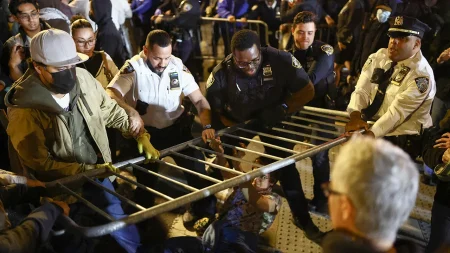



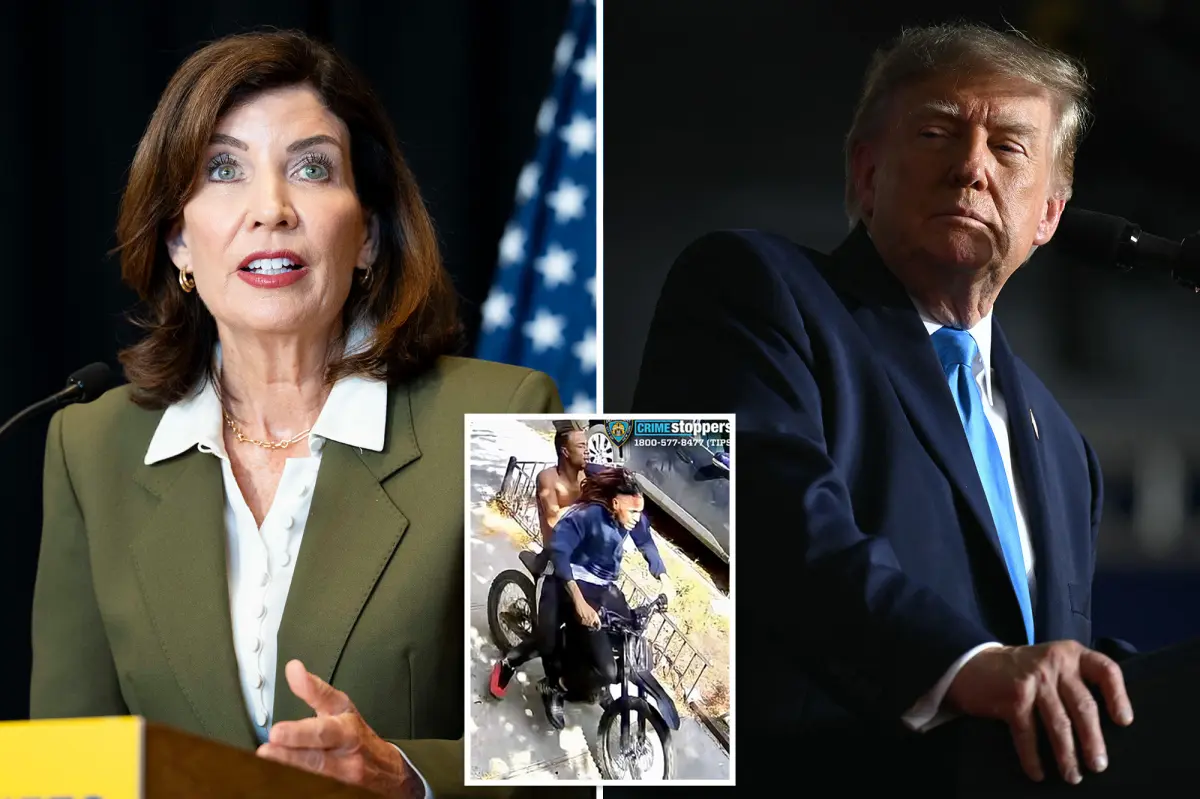
On a tense Friday in Syracuse, President Trump is stepping into one of the most explosive debates in American life: immigration, public safety, and the meaning of sanctuary. He is standing beside Bruce Blakeman, the Republican gubernatorial candidate, to attack New York’s sanctuary policies after a week that left raw wounds open across the state. The rally is more than a campaign event; it is a response to two violent incidents that have shaken people on all sides of the political divide. Days earlier, an off-duty NYPD detective was stabbed in the Bronx by two men who were in the country without legal status and who had criminal histories. The very next day, federal immigration agents shot and wounded a suspected gang member while his five-year-old son sat in the back seat of an SUV. These are not abstract policy disputes. They are stories about fear, trauma, and the fragile trust between communities and the institutions meant to protect them. For Trump and Blakeman, the Syracuse rally is a chance to turn that fear into political energy. For many New Yorkers, it is a moment of profound uncertainty, a time when questions about who belongs, who is protected, and who pays the price for broken systems become intensely personal. The debate over sanctuary is not just about laws and legal technicalities; it is about whether people feel safe in their neighborhoods, in their homes, and in their own skin.
The first incident began as an alleged robbery attempt and ended with a police officer fighting for his life. An off-duty NYPD detective was stabbed in the Bronx by two men, later identified as 25-year-old D’Angelo Caraballo and 24-year-old Sneider Mejia Bautista, both Dominican nationals. The suspects were arrested Wednesday after trying to hide in a basement in Lynn, Massachusetts. Their arrests might have been just another crime story, but their backgrounds ignited a firestorm. Caraballo had previously been jailed for reckless driving, unlawfully fleeing an officer, criminal possession of a loaded firearm, and more. Yet local police released him after his December 2024 arrest. Bautista had been arrested in October of the previous year on charges including grand larceny, criminal possession of a weapon, and stealing property. He was set free after the NYPD chose not to enforce ICE’s detainer, the federal request that asks local authorities to hold someone for immigration officials. For law enforcement officers, these cases are a maddening example of a system that seems to punish the people trying to keep the streets safe. The detective, a real human being with a family and a future, was allegedly attacked by men whose brushes with the law had not kept them off the streets. The officers who tracked down the suspects risked their own safety, and the community in Lynn is now shaken by the sudden presence of a manhunt in its midst. The suspects themselves are human beings with their own stories, but their alleged choices have made them symbols of a much larger crisis. For the victims, for the police, and for the families who live in neighborhoods where such violence erupts, this is not politics. It is life, and it is terrifying.
A day later, another incident tore open the same wounds. In the Marble Hill section of the Bronx, ICE officers shot and wounded 28-year-old Oscar Belgal, a suspected member of the violent Trinitarios gang. Belgal, who has a prior conviction for grand larceny and multiple arrests for assault, robbery, drug possession, and weapons possession, was in an SUV with a five-year-old boy believed to be his son when the shooting occurred. The Department of Homeland Security issued a stark statement: “This criminal illegal alien was arrested by the NYPD on December 7, 2023, but was released into the community a few days later by reckless Democrat sanctuary policies that put American lives at risk.” The statement was aimed directly at Governor Kathy Hochul and the laws she signed, including the Local Cops, Local Crimes Act, which limited cooperation between New York police and federal immigration authorities. But beyond the political accusations, there is a child who witnessed his father being shot. There is a boy who will carry that image for the rest of his life, whatever his father is accused of doing. There are immigrant families in the Bronx who watched the news and felt a cold dread, wondering if they could be next. And there are federal agents who made a split-second decision in a dangerous situation, knowing that their actions would be judged by millions. The shooting raised urgent and uncomfortable questions: Why was a child in the vehicle during an enforcement operation? Could the suspect have been apprehended differently? Where is the body camera footage that would show what actually happened? The answers have not come yet, but the questions themselves have become part of the national conversation, and they carry the weight of real human suffering.
Governor Hochul found herself in the impossible position of leading a state where every answer seems to anger someone. “New Yorkers are outraged tonight. Immigrant communities are terrified. And we are demanding answers,” she said in a statement after the Belgal shooting. On social media, she revealed that she had spoken with President Trump and DHS Secretary Mullin about the shooting. “I expressed outrage on behalf of New Yorkers and urged them to halt ICE enforcement operations in New York,” she wrote. “I also asked that any body camera footage of the shooting be released to the public so we can establish the facts and get to the truth.” Her words were carefully chosen, but the emotions behind them were not. Hochul is a Democrat who has supported measures to limit local police cooperation with federal immigration enforcement, and she is under siege from Republicans who say those policies are dangerous and even deadly. At the same time, she must answer to immigrant communities who feel hunted and hopeless, people who came to New York seeking safety and now fear that every routine encounter with authority could end in violence. Her request to pause ICE operations was a dramatic gesture, but it also revealed her limited power: federal immigration enforcement is not something a governor can simply stop. The result is a painful paradox. For an immigrant mother in the Bronx, Hochul’s words may feel hollow if her son is afraid to go to school. For a retired police officer, they may sound like excuses for policies that put officers in harm’s way. The governor is trying to hold together a state where the very definition of safety has become a battlefield.
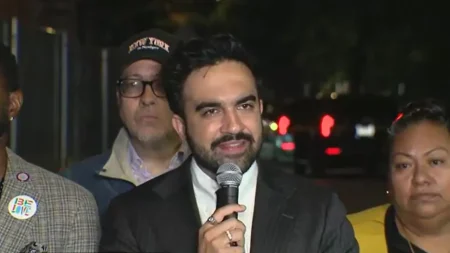
Into this charged atmosphere steps Bruce Blakeman, the Nassau County executive and Republican nominee for governor, who has made cooperation with ICE the centerpiece of his campaign. “The insanity is over, we’re putting New Yorkers first,” he said earlier this week, promising to sign an executive order on his first day in office that would require local law enforcement to work with federal immigration agents. Blakeman recalled that “one of the toughest days” of his tenure was “the day that I had to tell our police and our sheriffs that they could no longer cooperate with ICE because of Kathy Hochul.” His words are designed to tap into a deep well of frustration, and they resonate with voters who feel that the rule of law has been abandoned in favor of political correctness. But the political landscape in Syracuse is complicated. Syracuse and surrounding Onondaga County form a Democratic-leaning island in a sea of Republican red across central New York. Trump’s rally is meant not only to boost Blakeman but also to help Republican House candidate Kailee Buller, a former USDA official challenging first-term Democratic incumbent John Mannion. The combination of a governor’s race and a congressional race on the same stage shows how immigration has become the central issue in New York’s political future. For Blakeman, this is an opportunity to introduce himself to voters outside his home county, to convince them that he understands their fears and can do something about them. For Trump, it is a test of whether sanctuary policies can be used to rally voters in a region where Democrats still have an edge. But behind the speeches and slogans are real people: police officers who want clear rules and the freedom to do their jobs, immigrant families who want to live without constant fear, and voters who feel that their concerns have been ignored for too long. Blakeman’s promise sounds like a solution to some and a threat to others. The election will reveal which emotion is stronger.
In the days leading up to the rally, the Trump administration highlighted the cases of several immigrants arrested in Syracuse for appalling crimes. Among them were Hsa Mu Na, accused of sexual exploitation of a minor; Norberto Machado-Rodriguez, who faced accusations of sexual assault; Haikham Phimasone, accused of assault; and Said Ibrahim, accused of cruelty toward a child. These cases are meant to shock, and they do. Each one involves a victim, often a child, and each raises legitimate and painful questions about whether sanctuary policies allowed dangerous individuals to remain in the community. But the administration’s focus on these cases also reveals the limits of a debate that too often turns human beings into symbols. Immigrants are not a single story. They are doctors and farmworkers, teachers and parents, children and grandparents. The overwhelming majority commit no crimes at all, but the actions of a few have poisoned the conversation for everyone. As Trump stands in Syracuse, the ghosts of the week are everywhere: a stabbed detective recovering in a hospital, a five-year-old boy who watched his father shot, families in Massachusetts shaken by a raid, and immigrants across New York wondering if they will be next. There are no easy answers, and anyone who claims otherwise is not being honest. The desire for safety and the desire for compassion are both deeply human, and they are often in conflict. What is clear is that the old ways are not working. The challenge for leaders like Hochul and Blakeman, for police and federal agents, and for voters themselves is to find a way forward that acknowledges the pain on all sides without exploiting it. The rally in Syracuse is not the end of the conversation. It is just another chapter in a story that will be written by the choices New Yorkers make in the voting booth, in their neighborhoods, and in their daily lives.