


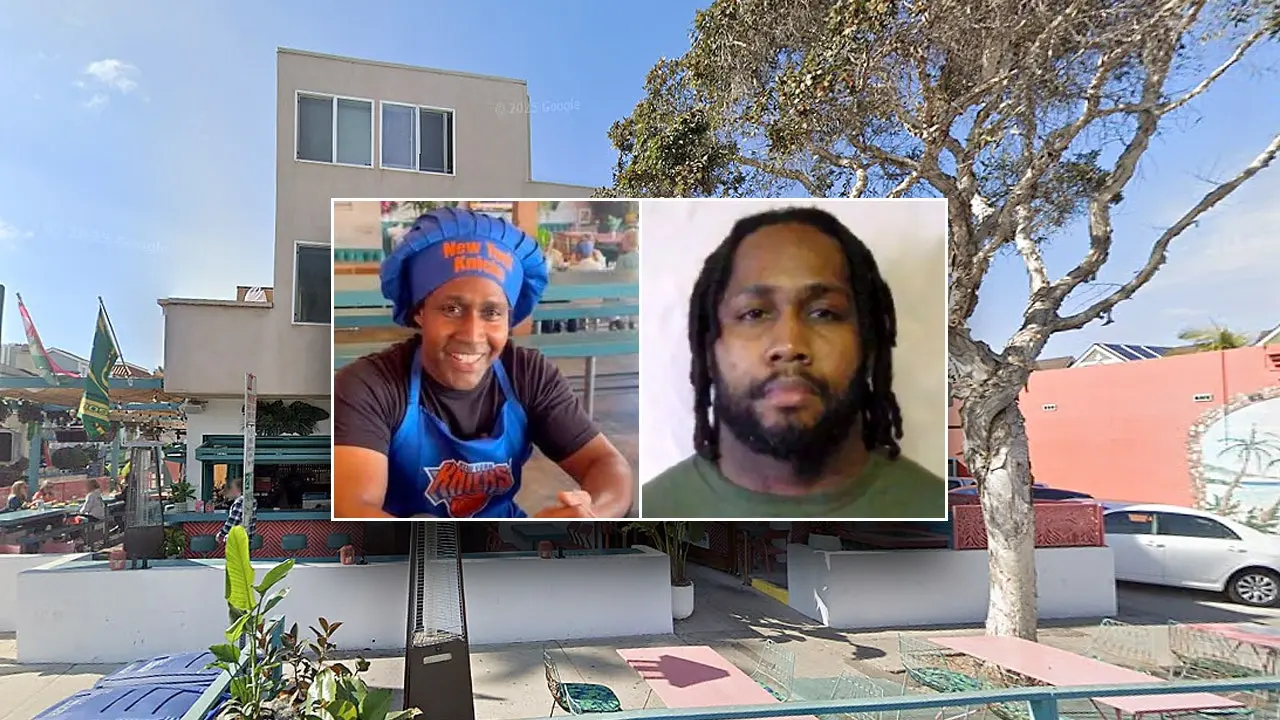
For nearly fourteen years, Brian Anthony Williams existed in two worlds. In one, he was a fugitive, wanted by law enforcement for a brutal crime that left a woman fighting for her life in an Iowa field. In the other, he was Troy Williams, a beloved chef with a warm smile and a kind word for everyone who walked into Miss B’s Coconut Club in San Diego’s sunny Mission Beach neighborhood. The two identities never seemed destined to collide—until a single moment of recognition, a tip to authorities, and an arrest that shattered the quiet life he had carefully constructed. When U.S. Marshals took him into custody on a Tuesday afternoon, the employees who had shared meals, shifts, and laughter with him were left staring into a stranger’s face, wondering if they had ever truly known the man they called family. The arrest was the culmination of a decades-long manhunt that spanned nearly 2,000 miles, connecting a violent 2012 attack in Davenport, Iowa, to a vibrant seaside restaurant where Williams had reportedly reinvented himself as a local culinary figure, complete with media appearances and a reputation for kindness.
The story began long before Williams ever set foot in California, back in the cold early months of 2012, when authorities say he and several other individuals kidnapped a woman in northwest Davenport, Iowa. According to charging documents, the woman was assaulted, shot, and then abandoned in a field, left alone and wounded in what must have been a terrifying ordeal. She survived, but the physical and emotional scars would last a lifetime. Law enforcement moved quickly to identify Williams as one of the suspects, and he was charged with first-degree kidnapping, assault causing serious injury, conspiracy to commit a felony, and first-degree arson. At the federal level, he was later charged with unlawful flight to avoid prosecution, a charge that reflected his apparent determination to disappear rather than face justice. For the victim and her loved ones, the arrest warrant offered a shred of hope, but the years stretched on with no sign of Williams. Leads went cold, and the case grew older, but investigators never closed it. They kept his file active, circulated his information, and waited for the moment when his carefully hidden past would catch up with him. That moment finally came in 2025, when the U.S. Marshals Service, acting on a tip, found him living and working openly under the name Troy Williams, a man so confident in his disguise that he had allowed himself to be featured in local news stories.
The double life Williams led in San Diego was remarkably ordinary on the surface. He arrived at Miss B’s Coconut Club more than eight years ago and started at the bottom, working as a line cook before earning his way up to head chef. In the kitchen, he was known for his dedication, his skill, and his philosophy that kindness was the most important ingredient in any dish. General manager Eddie Jurado, who was also Williams’ roommate for a time, described him as a good guy who was loved by everyone at the restaurant. Coworkers celebrated birthdays together, shared late-night shifts, and trusted each other with their personal stories. Williams, however, had edited his own story carefully. He told people he was from New York and spoke vaguely about overcoming adversity, but he never mentioned the warrant out for his arrest, the victim in Iowa, or the charges that had forced him to flee. In February, he even sat down for a profile with the Times of San Diego, where he discussed his rise from humble beginnings and offered a simple message: “Togetherness is how we get better. Kindness does win.” The irony was painful for those who later learned the truth. The same man who preached kindness in a published interview was, according to investigators, a key figure in a violent kidnapping and shooting that left a woman wounded and abandoned. His public persona was not just a disguise; it was a performance so convincing that even those closest to him never suspected a thing.
What ultimately unraveled Williams’ carefully woven cover was not a forensic breakthrough or a routine traffic stop, but the very publicity he had embraced. A U.S. Marshals spokesperson said that someone who saw one of Williams’ media interviews recognized him and alerted authorities, giving investigators the thread they needed to pull. Federal agents had already developed information in September suggesting that Williams was living in San Diego under an assumed identity, but the tip helped narrow their search. They tracked him to a business in the 3700 block of Mission Boulevard, which turned out to be Miss B’s Coconut Club, and moved in for the arrest on Tuesday. The arrest itself was uneventful; Williams offered no resistance and was taken into custody without incident. U.S. Marshal Ted Kamatchus emphasized the significance of the capture, saying, “This arrest is a perfect example of those who think they have bested law enforcement and evaded arrest.” Williams was placed in federal custody pending extradition to Iowa, where he will face prosecution in connection with the 2012 attack. For the Marshals Service, the case was a reminder that time does not erase justice, and that even the most convincing new identity cannot hide a person forever. The same community that had embraced Williams as a beloved chef was now the site of his downfall, his face suddenly everywhere in connection with a crime nearly 1,800 miles away.
The reaction at Miss B’s Coconut Club was one of shock, grief, and a painful sense of betrayal. Eddie Jurado spoke for many when he admitted that employees were struggling to reconcile the man they had known with the allegations against him. “Like, who is he? He was a good guy here, loved by everybody,” he told FOX 5. But the feelings were not simple. Alongside the anger at being deceived, there was also gratitude for the kindness Williams had shown them, and a strange, unsettling awareness that they had welcomed a fugitive into their lives without knowing it. “It’s a mixed emotion,” Jurado said. “One minute I’m mad that he lied to us. Next minute, he was good to us … It’s actually kind of scary.” The fear he described was not just about the lies, but about the unknowable depths of another person, the idea that someone can share your home, your meals, and your trust while hiding a violent past. Yet even in that confusion, Jurado expressed compassion for the woman in Iowa who had been attacked nearly fourteen years ago. The victim’s long wait for justice was finally ending, and for her, the arrest of Brian Anthony Williams was not just a headline, but the close of a painful chapter that had shaped her life for more than a decade. The restaurant community, meanwhile, was left to mourn the loss of the man they thought they knew, while also confronting the reality that the chef who had inspired them was, in the eyes of the law, a completely different person.
In the end, this story is more than just another tale of a fugitive caught. It is a meditation on identity, trust, and the possibility of change, as well as the limits of that possibility. Brian Williams spent years building a new life, earning respect and affection from coworkers who saw him as a mentor and friend. He contributed to his community, spoke openly about kindness, and seemed to have left his past behind. But the past does not disappear simply because we stop looking at it. The woman he allegedly helped to abduct and shoot never got to walk away from that night; she carried it with her, even as Williams built his new identity. Her courage in surviving, and the persistence of investigators who refused to give up, are the quiet heroes of this narrative. The arrest may have ended Williams’ run, but it also raises questions about redemption, forgiveness, and whether a person who commits a terrible act can ever truly become someone else. For the coworkers who loved him, there is no easy answer. For the victim, there is at least the knowledge that the man accused of hurting her will finally face a judge. And for the rest of us, there is a reminder that the people we meet are not always who they appear to be. The masks we wear, whether made of kindness or lies, can only hide so much for so long. Eventually, the truth comes calling—often in the most unexpected way, and always with consequences. Brian Williams is now in federal custody, waiting to be taken back to Iowa, where the scales of justice will finally weigh the deeds of 2012 against the man he became in San Diego. No matter how many meals he cooked, how many friends he made, or how many times he told the world that kindness wins, the past had other plans.