





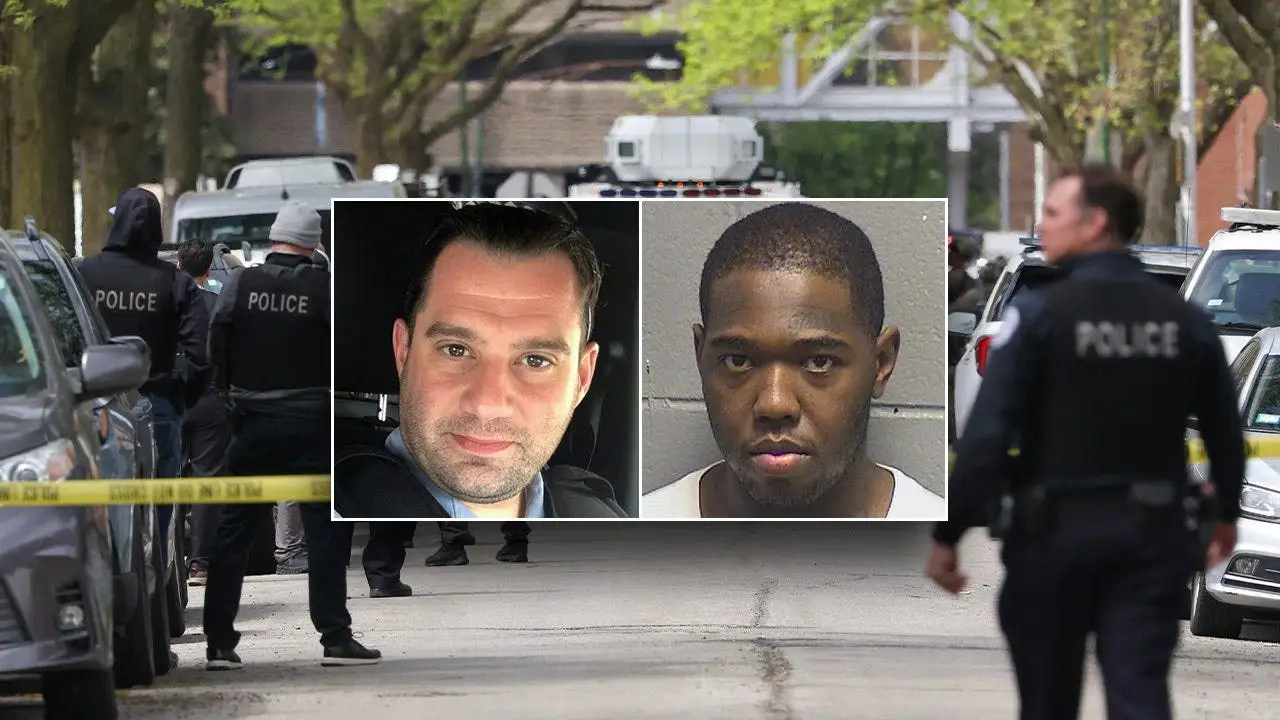
The devastating loss of twenty-eight-year-old Chicago Police Officer John Bartholomew has cast a profound shadow over the city, serving as a heartbreaking reminder of the human cost when the criminal justice system fails to protect both its citizens and its law enforcement officers. Officer Bartholomew was a young man who dedicated his life to safeguarding his community, only to have that life violently stolen in a senseless act of violence at Swedish Hospital. Alongside him, his fellow partner was left fighting for his life, suffering from grave injuries that have shattered yet another family’s sense of peace. The immediate aftermath of this tragedy has left the Chicago Police Department and the broader community wrapped in a blanket of grief, anger, and deep-seated frustration. At its core, this tragedy is not just a statistical anomaly or a point of political debate; it is the story of a young protector whose willingness to serve put him directly in the path of a violent, habitual offender who should never have been free to walk the streets.
The horrifying sequence of events that led to Officer Bartholomew’s death began with a chilling display of manipulation that exploited the very compassion of the officers who arrested twenty-seven-year-old Alphanso Talley. Just hours before the shooting, Talley was apprehended in connection with a brutal armed robbery at a local Family Dollar, where he allegedly pistol-whipped a female employee before fleeing with her keys and personal belongings. Once in police custody, Talley devised a deceptive escape plan by claiming he had swallowed lethal amounts of narcotics, prompting the arresting officers to prioritize his medical well-being. Driven by their duty of care, the officers escorted him to Swedish Hospital for treatment, where they uncuffed him to allow medical staff to perform their duties. Seizing this moment of vulnerability, Talley retrieved a concealed firearm he had hidden underneath a hospital blanket, opening fire on the unsuspecting officers in a desperate, calculated bid to escape, resulting in the fatal shooting of Officer Bartholomew and the critical wounding of his partner.
To understand the intense public outrage surrounding this case, one must examine the extensive criminal history of Alphanso Talley, a seven-time convicted felon whose interactions with the law span nearly a decade. At twenty-seven years old, Talley’s rap sheet reads like a catalog of persistent violence and disregard for public safety, including convictions for four counts of aggravated robbery with a firearm in 2017, unlawful possession of a weapon by a felon in 2021, battery on a peace officer in 2023, and aiding and abetting a stolen motor vehicle. Despite this clear pattern of recurring, escalating violence, Talley was free on electronic monitoring at the time of the shooting, awaiting trial for a separate 2025 armed robbery and carjacking case. The realization that a violent felon with a history of attacking law enforcement was permitted back into the community has ignited a fierce public backlash, leaving citizens asking why a man with such a volatile past was repeatedly granted the benefit of the doubt by the legal system.
The controversy directly targets the policy frameworks and judicial decisions that allowed Talley to remain outside of a jail cell, specifically pointing to Illinois’ disputed SAFE-T Act, a 2021 law that abolished cash bail. Transcripts from previous hearings reveal that Cook County Circuit Court Judge John Lyke Jr. explicitly referenced the legislature’s mandate when he decided to release Talley on electronic monitoring instead of setting a high cash bail, which likely would have kept him detained. Lyke noted to the court that under the old system, Talley would have faced a massive bail requirement, but argued that the state legislature had forced judges to shift away from financial detentions to electronic tracking systems. This decision proved fatal when Talley managed to slip off the electronic grid entirely, becoming completely unaccounted for in the GPS monitoring system during the precise hours he went on a violent crime spree, exposing critical vulnerabilities in the technology and oversight meant to keep the public safe.
The fallout from the tragedy culminated in a tense and emotionally charged courtroom scene on Tuesday, where a shackled Talley stood in a green jail jumpsuit before the very same judge who had previously authorized his release. In a sharp pivot, Judge Lyke formally revoked Talley’s pretrial release on the original carjacking charges, yielding to the intense scrutiny and the prosecution’s urgent appeals to keep the defendant detained. Meanwhile, the legal handling of the first-degree murder charges has been taken over by Judge D’Anthony Thedford, who took a decisively uncompromising stance against Talley’s release. Emphasizing the blatant danger Talley poses to society, Judge Thedford declared that no amount of court conditions or electronic monitoring could possibly guarantee public safety, stating flatly, “If you’re out—you’re dangerous.” This stark contrast in judicial approaches has only highlighted the deep systemic divisions regarding offender rehabilitation versus immediate community protection.
As Chicago mourns, the tragic death of Officer Bartholomew has transcended local headlines to become a central focus of the national debate over progressive criminal justice reform and the real-world consequences of “soft-on-crime” policies. A massive “sea of blue” flooded the streets of Chicago for the fallen officer’s funeral, a silent but powerful testament to the solidarity, grief, and simmering anger felt by law enforcement officers across the country who feel increasingly vulnerable under current legislative trends. This tragic case has forced a necessary and painful conversation about accountability, the limits of judicial leniency, and the fundamental right of communities and police officers to be protected from predatory individuals. Ultimately, Officer Bartholomew’s legacy demands more than just tears; it calls for a rigorous reevaluation of the policies that govern electronic monitoring, pretrial release, and the legal guardrails designed to prevent known dangers from ever repeating their crimes.