





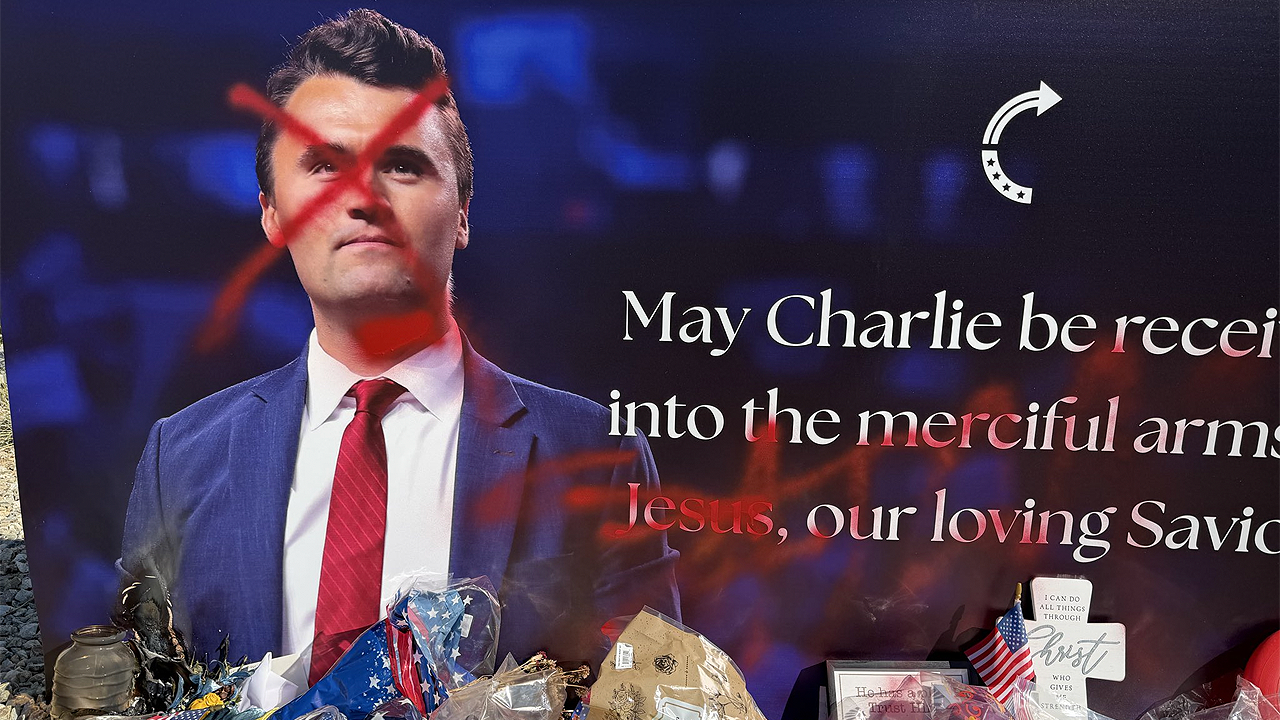
The bronze figure stood eight feet tall, a tribute frozen in time to a young man who had poured his life into building a movement. The sculptor had captured Charlie Kirk exactly as his followers remembered him—wearing his signature “Freedom” T-shirt, a cross resting against his chest, his wedding ring molded in careful detail. It was meant to be a place of reflection, a monument to a life cut brutally short at thirty-one years old. But sometime in the darkness before Sunday morning, that sacred space was violated. Vandals descended on the headquarters of Turning Point USA in Phoenix and smeared bright red paint across the statue’s face and neck, dragging their contempt across the bronze like a wound that would not clot. As if the desecration itself were not enough, they drew a crude, frowning face across the figure’s chest—a juvenile mockery of a man they apparently could not stand to see honored. The scene was made even more grotesque by what they did to the sign at the statue’s base. Bearing Kirk’s image and the words “Jesus defeated death so you can live,” the display was defaced with deliberate malice: the name of Jesus scratched out, the image of the cross crossed over, and the word “Satan” scrawled across the tribute like a signature. This was no random act of late-night mischief. This was a calculated assault on faith, on memory, and on the very idea that a conservative voice deserved to be remembered at all.
The timing made the attack feel all the more cruel. The statue had been unveiled only three days earlier, on the anniversary of the day Kirk was assassinated while speaking at Utah Valley University on September 10, 2025. For his followers, the unveiling had been a moment of bittersweet triumph—a way to transform grief into granite, to declare that the man they loved would not be erased by a bullet. The sculptor, Quintin McCann, had begun working on a portrait of Kirk the very evening the conservative activist was killed, unable to process the loss of a man he had never met but whose death had shaken him to his core. He stayed at work that night, sculpting from a place of raw emotion, and the finished statue was a labor of love that captured not just Kirk’s likeness but his spirit. The memorial was placed outside the headquarters near 48th Street and Beverly Road, where supporters could visit and pay their respects. There were plans to move it indoors by the end of the week for security reasons, but the vandals struck before that protection could be arranged. In the span of one night, a monument to courage became a canvas for hatred. The red paint pooling on the statue’s face served as a grim reminder that even in death, even in bronze, Kirk could not escape the fury of those who despised everything he stood for.
Erika Kirk, Charlie’s widow and the woman now tasked with carrying his legacy forward as CEO of Turning Point USA, woke to the news with a grief-stricken but unbroken heart. Her response was not one of despair but of defiance. She recalled the way her husband had lived—the instinct to create rather than destroy, the conviction that the forces of darkness could never be matched by those who only knew how to tear down. “Charlie once said we should be building two statues for every statue that they tear down,” she wrote, and in those words was the truth of who he was. She spoke of the bullet that killed him, insisting that it had only amplified his voice, and she predicted that the spray paint would do the same—that every act of vandalism would only spread his legacy further. She vowed to restore the statue, to replace the name of Jesus Christ on the damaged sign, and to continue building the movement her husband had founded. “God will not be mocked,” she wrote, and the words carried the weight of a woman who had buried her husband too young, who had shouldered the burden of his life’s work, and who refused to let hatred have the final word. Her response was not born of naivety; it was born of faith. She knew that the vandals had achieved the opposite of their intention. They had united her supporters, drawn attention to her husband’s story, and proven that the movement Charlie Kirk built was strong enough to withstand even this.
The official machinery of response moved quickly on that Sunday morning. Phoenix police confirmed that calls began flooding in around 8:09 a.m. reporting vandalism to the memorial at 4900 East Beverly Road. Officers responded and launched an investigation, though as of Sunday afternoon no arrests had been made and no suspect descriptions were available. Turning Point USA’s Chief Operating Officer, Tyler Bowyer, arrived at the scene as police investigated, his fury evident in every word he posted on social media. “This morning we woke up to radical criminals vandalizing our headquarters,” he wrote, describing the crossing out of Charlie’s face, the scratching out of Jesus and the Cross, the red paint on the statue’s neck. “This isn’t the country we want to live in. Arizona is not Gotham.” The organization announced that it would restore the statue, replace the damaged signs, review security footage, and work with law enforcement to identify those responsible. In a follow-up statement, they framed the vandalism not as a prank but as something darker. “Vandalism like this is not funny, it’s diabolical,” they wrote. “The incident happened in the middle of the night because evil never sleeps.” They ended their response with a verse from the Gospel of John: “If the world hates you, keep in mind that it hated me first.” And they used the moment to issue a call to action, reminding their supporters that the radical Left was showing up to vote in the upcoming midterm elections and asking what they were doing to save the country from a politics of destruction.
Across the conservative movement, the response was immediate and visceral. Elected officials and commentators who had known and admired Kirk poured out their outrage. Representative Abe Hamadeh of Arizona condemned the attack as truly abhorrent, pointing out that the young people who work at Turning Point USA, Charlie’s family, and his friends did not deserve this. “The left is intolerant and militant,” he wrote. “Evil exists and must be confronted continuously.” Representative Andy Biggs was even more blunt: “This is absolute evil.” Conservative commentator Benny Johnson accused the vandals of trying to intimidate Kirk’s supporters, insisting that these people were incapable of building anything and that all they knew was destruction. “Keep these demons out of power,” he wrote. TPUSA contributor Alex Clark said the damage brought her to tears before issuing a warning that pulsed with urgency: “The left wants to tap dance in your blood and throw confetti at your gravestone. Vote red in midterms like your life depends on it because it actually does as a conservative.” But perhaps the most striking response came from Turning Point USA Chief of Staff Mikey McCoy, who urged conservatives not to meet hatred with hatred but to answer vandalism with faith. He invoked Kirk’s willingness to return to hostile campuses, and the biblical examples of Stephen and Christ praying for those who persecuted them. “Then I can surrender all the anger, and pure disgust that I feel at seeing this to a just and holy God,” he wrote, adding that he would pray for the repentance and salvation of those responsible. “Lord, help our Country. Open their eyes. Break their hearts. Save them.”
The attack on Kirk’s statue was never just about bronze and paint. It was about the legacy of a man who represented something larger than himself. Kirk was only thirty-one when Tyler Robinson, then twenty-three, allegedly shot and killed him during a Turning Point USA event at Utah Valley University. Robinson has pleaded not guilty to aggravated murder and other charges, and prosecutors are seeking the death penalty. In the year since her husband’s death, Erika Kirk has taken over the organization he co-founded in 2012, and the network of high school and college chapters has continued to expand across the country. The political battles have continued as well—Tyler Bowyer blasted Democratic Arizona Governor Katie Hobbs for vetoing legislation that would have named Loop 202 in Kirk’s honor, a decision Hobbs defended by arguing that highway-naming decisions should remain nonpartisan and be handled by the state board responsible for such designations. But for those who loved Charlie Kirk, the vandalism of his statue was another painful reminder that the hatred that killed him is still alive. It was a reminder that there are people in this country who would cross out the name of Jesus and scrawl “Satan” on a tribute to a murdered young man. And yet, even in the face of such darkness, the response from his movement was one of resolve. They would clean the paint, restore the statue, and continue the work. They would not be silenced, and they would not be mocked. As the investigation continues and the search for the vandals goes on, one thing is certain: Charlie Kirk’s voice, amplified by the bullet and now by the spray paint, is not going anywhere. The vandals thought they were defacing a monument. In truth, they were adding fuel to a fire that shows no signs of going out.