






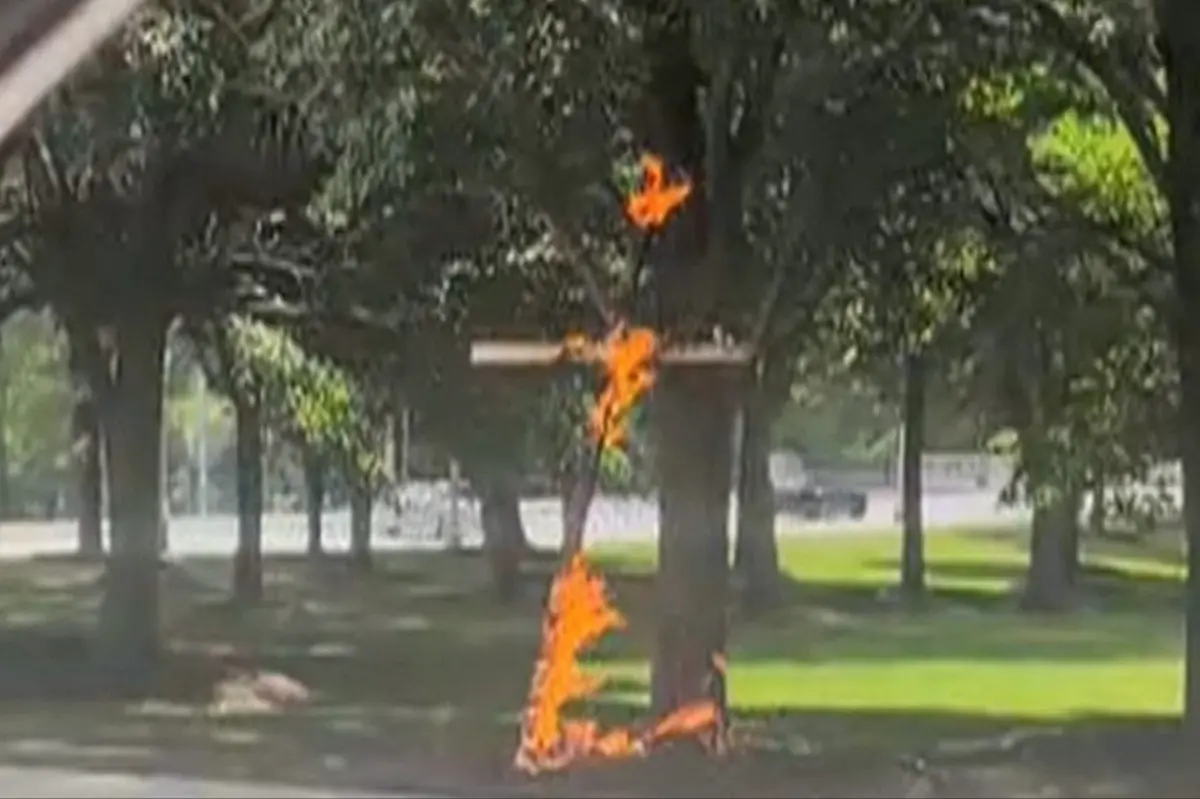
On an otherwise unremarkable Tuesday afternoon, the peaceful routine of Chicago’s iconic Grant Park was abruptly shattered by a sight that seemed directly discarded from a dark and painful chapter of the nation’s past. Welcomed as “Chicago’s front yard,” Grant Park represents a vibrant, expansive haven of green space nestled alongside the sprawling blue shores of Lake Michigan, typically filled with active joggers, curious tourists, and local families enjoying the dramatic city skyline. However, the comforting rhythm of everyday metropolitan life was violently interrupted when a large, wooden cross, estimated to stand at least six feet tall, was discovered leaning against a tree, engulfed in fierce, bright orange flames that licked against the bark. As the fire consumed the wood, the jarring juxtaposition of this natural city oasis with a blazing instrument of historical terror created a surreal and deeply disturbing tableau that demanded immediate attention. Passersby and motorists navigating the adjacent roadways were forced to confront a sudden, visceral intrusion of hostility in a public space dedicated to community, leisure, and recreation. When the Chicago Fire Department arrived swiftly on the scene to extinguish the blaze, they confirmed that the object of the fire was indeed a constructed wooden cross, leaving both the local authorities and the public to grapple with the haunting questions of how such an artifact of hatred came to be erected in the heart of the city, who put it there, and what malicious message they intended to broadcast to the diverse residents of Chicago.
For forty-three-year-old Keinika Carlton, what began as a routine day of running mundane errands with her family ended in a moment of profound psychological weight that she and her loved ones will not soon forget. Driving home through the familiar, bustling streets of Chicago with her twenty-two-year-old daughter, Alyna, and her mother-in-law, Keinika’s focus was suddenly pulled toward the park’s tree line, where the bright orange flames danced menacingly in the afternoon light. In an instant, the normal rhythm of a family car ride dissolved into a complex wave of overwhelming emotions—ranging from initial disbelief and shock to a deep, nauseating disgust, coupled with an intense, survival-driven curiosity. As Black women, the sight of a burning cross did not register to them as a mere random act of juvenile vandalism or an accidental brush fire; rather, it struck a sensitive, historical cord of inherited ancestral trauma and immediate danger. The three generations of women sitting inside that vehicle represented a living bridge of American history: from the grandmother who grew up amidst the overt, state-sanctioned racial tensions of the American South in Kentucky, to the young Alyna navigating the complex social landscape of the twenty-first century. Confronted with the blazing wood, they were united in a singular, heavy question that immediately pierced the safety of their afternoon: was this an explicit act of racial hostility designed to terrify them, or a targeted religious provocation meant to violate the sanctity of their shared urban home?
To fully understand why the Carlton family’s thoughts immediately turned to racial terror is to understand the deeply scarred historical landscape of the United States, where the burning cross has long served as a potent, non-verbal threat of violence and exclusion. Historically, this devastating ritual has been inexorably linked to the rise and targeted terror campaigns of the Ku Klux Klan, particularly throughout the Reconstruction era and the twentieth-century Civil Rights movement. During these dark eras of American history, a cross illuminated by fire in the dead of night was not merely a display of religious perversion, but a terrifying harbinger of physical violence, displacement, and death directed toward Black Americans who dared to seek equality, education, voting rights, or economic independence. By burning these massive wooden structures in public areas or directly on the private lawns of targeted families, perpetrators sought to enforce a rigid, white supremacist caste system through psychological warfare. For Black citizens, the sight of the burning cross holds a unique, lingering power to inflict emotional distress because it signals that the safety of one’s home and community has been breached by an anonymous, hostile force. When Keinika Carlton looked out her car window in a progressive, northern metropolitan center like Chicago, she was acutely aware that the fiery display was an attempt to resurrect these exact historical demons, dragging a painful legacy of Southern white custody into a modern, integrated urban sanctuary.
The physical environment around the burning cross quickly transformed into a scene of shared, silent apprehension as the gravity of the image registered with the surrounding public. As Keinika slowed her vehicle to capture a video of the active flames—a digital record of an event that seemed too horrifyingly archaic to be real—she noticed that the atmosphere around Grant Park had grown thick with a collective, stunned stillness. Other motorists began to decelerate, their brake lights illuminating the roadway as drivers stared out their windows in disbelief, while pedestrians walking along the park paths froze in their tracks, their eyes locked on the consuming fire. In this modern age, where digital documentation is instantaneous, the act of filming the incident was not merely about capturing news, but about preserving evidence of an indignity that many would otherwise find hard to believe occurred in the heart of a major, diverse American city on a Tuesday afternoon. Though the Chicago Fire Department acted swiftly to put out the physical flames, preventing any bodily injuries and securing the physical area, the damp, charred remains of the wooden cross left behind a much larger, invisible cloud of anxiety. The rapid response of the first responders could douse the heat of the fire, but it could not easily extinguish the chill of vulnerability that settled over the onlookers, who were left to wonder about the unidentified individuals who had planned, constructed, transported, and ignited such a massive symbol of division in their shared public space.
The legal and social treatment of cross burning in American jurisprudence reflects the gravity and unique malice associated with the act, proving that society views the gesture as far more than simple property arson or standard free expression. In a landmark 2003 ruling, the United States Supreme Court sought to define the boundaries of the First Amendment in relation to this specific act of terror, with the late Justice Sandra Day O’Connor writing the majority opinion. The nation’s highest court determined that while the Constitution broadly protects offensive and controversial speech, states are legally permitted to ban cross burnings when they are executed with the specific intent to intimidate. Justice O’Connor wrote that the burning cross is a “particularly virulent form of intimidation” because of its historical function as a precursor to physical violence and systemic oppression. By codifying this distinction, the legal system acknowledged that a burning cross is essentially a weapon composed of light and wood, designed to silence, threaten, and dehumanize marginalized communities. This legal reality directly validates the instinctive fear and disgust felt by the Carlton family and other witnesses in Grant Park; the law itself recognizes that the act is inherently linked to a legacy of terror, meaning that any instance of a burning cross must be treated with the utmost seriousness by law enforcement officers investigating the motive behind the incident.
Ultimately, the presence of the burning cross in a contemporary Chicago park served as a stark, sobering reminder of the persistent undercurrents of racial tension that continue to shape the lives of modern Americans. For twenty-two-year-old Alyna Carlton, the sight was a transformative experience that shattered any comforting illusions of generational progress, forcing her to realize that she is not nearly as far removed from the painful struggles of her ancestors as she had once believed. Her poignant observation underscores a vital truth about the nature of historical trauma: that the progress of civil rights is not a linear, guaranteed trajectory, but a continuous effort that remains vulnerable to sudden disruptions of hate. As the Chicago Police Department continues its rigorous investigation into the motives and circumstances surrounding the “object on fire,” the incident calls for a renewed commitment to community solidarity, mutual protection, and open dialogue about systemic racism. By humanizing the experiences of those who witnessed this display, society is reminded that behind every headline about a symbol of hate are real human beings—mothers, daughters, and grandmothers—who must carry the emotional burden of these acts. Confronting the ashes of the burnt cross in Grant Park requires not only finding those responsible but also collectively reaffirming that parks, cities, and communities must remain spaces of safety, dignity, and inclusion for all people, regardless of their race, background, or identity.