





July Inflation Report Keeps Fed Rate-Hike Bets Largely Unchanged as Markets Weigh Mixed Signals
U.S. inflation held steady in July, delivering a reading that matched Wall Street’s expectations almost to the decimal point and leaving the door open for another Federal Reserve rate hike at the upcoming September meeting. The latest Consumer Price Index data, released Wednesday morning, offered few surprises to a market already wrestling with a complex cocktail of cooling price pressures, a suddenly fragile labor market, and a bond market still nursing losses from a rocky summer.
The headline consumer price index rose 0.1% in July from the previous month, a figure that aligned precisely with the forecasts of economists surveyed in the run-up to the release. That modest uptick—which followed a 0.4% decline in June—translates to a year-over-year inflation rate of 3.4%. While that annualized pace remains well above the Fed’s 2% target, it also represents a slight but welcome cooldown from the 3.5% recorded a month earlier, offering fresh evidence that the disinflationary process, though uneven, has not stalled. For policymakers gathering in Jackson Hole later this month, the data provides a measure of reassurance that the aggressive tightening campaign of the past year and a half is gradually working its way through the system. Yet the bigger question swirling around financial markets is what this means for the central bank’s next move: whether officials will pause again to assess the damage from higher borrowing costs, or press forward with another quarter-point increase that would push the federal funds rate into even more restrictive territory.
Core inflation, which strips out the volatile food and energy components and serves as the Fed’s preferred gauge of underlying price pressures, rose 0.2% in July on a month-over-month basis, in line with analyst expectations and a tick above the flat reading seen in June. On an annualized basis, core prices advanced 2.5%, edging lower from June’s 2.6% print and providing further confirmation that the most stubborn pockets of inflation—particularly in services and shelter—are finally beginning to soften. Economists had widely anticipated the cooling trend, but the confirmation mattered. For much of 2024, the Fed’s battle against inflation has been a story of slow, grinding progress, punctuated by occasional setbacks that rattled investor confidence and forced traders to continuously recalibrate their expectations for rate policy. The July numbers, while not exactly a breakthrough, reinforce the prevailing narrative that inflation is heading in the right direction, even if the final leg back to 2% proves to be the most difficult. Within the details, categories like used cars, airline fares, and medical care showed measurable declines, helping to offset persistent increases in shelter costs—a key component that has kept core services inflation sticky. The report also offered some relief on the energy front, where prices fell for a second consecutive month, and food inflation remained benign.
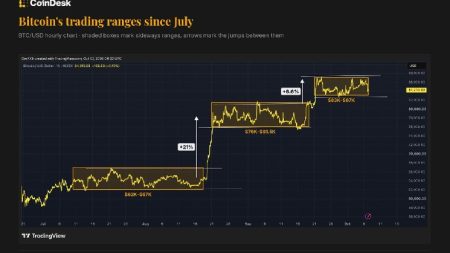
Financial markets absorbed the CPI release with a mixture of pragmatism and relief, with immediate reactions less dramatic than the report’s headline might have suggested. Bitcoin, the world’s largest cryptocurrency, dipped briefly from $64,400 to $64,080 in a knee-jerk response before quickly stabilizing, and by mid-morning trading had returned to its previously flat trajectory over the past 24 hours. The muted reaction in the crypto market, which has historically been highly sensitive to shifts in liquidity expectations and Fed policy, signaled that traders saw nothing in the inflation data to fundamentally change their outlook. Meanwhile, equities showed more enthusiasm, with Nasdaq 100 futures trading 0.7% higher on the day as investors bet that cooling inflation—combined with a weakening jobs market—would keep the Fed on the sidelines. Technology and growth stocks, whose valuations are most sensitive to changes in interest rates, led the advance, reflecting the market’s growing conviction that the central bank’s next move is more likely to be a cut than a hike. The bond market, however, told a slightly more complicated story. Treasury yields remained under pressure, holding onto the losses they had accumulated before the CPI report was even released. The two-year yield—a proxy for market expectations of near-term Fed policy—hovered at 4.19%, down 3.6 basis points on the day, while the benchmark 10-year yield stood at 4.66%, also down roughly three basis points. That decline in yields, particularly at the short end of the curve, suggests that bond investors are increasingly inclined to believe the Fed’s tightening cycle has reached its peak.
What gave this particular inflation report its added weight was the context of a labor market that is showing unmistakable signs of weakening. Just days before the CPI release, the government reported that the U.S. economy unexpectedly shed 23,000 jobs in July, a staggering reversal from months of steady, if unspectacular, employment gains. The negative print—which caught nearly all forecasters off guard and marked the first monthly decline in nonfarm payrolls in years—reshaped the conversation around monetary policy almost overnight. For the better part of two years, Fed officials had justified their aggressive interest rate hikes by pointing to an overheating labor market and wage pressures they believed would keep inflation elevated. That rationale has now eroded considerably. With unemployment ticking higher and job creation turning negative, the Fed’s dual mandate—to maintain price stability and maximum employment—has suddenly become a delicate balancing act. The July CPI data, in this light, seemed to give the Fed cover to avoid pulling the trigger in September. If inflation is cooling and the jobs market is cracking, the argument goes, why risk further damage to the economy with another knee-jerk hike? Yet the central bank has repeatedly cautioned that it would rather overtighten than risk a resurgence of inflation, and several officials have publicly stated that they need to see sustained evidence of cooling prices before they can confidently declare victory.
Even at a headline level, Wednesday’s report displayed signs that market participants noticed the subtle shifts in policy expectations. According to the CME FedWatch Tool, which tracks probabilities based on futures market pricing, traders now assign roughly a 44% probability that the Federal Reserve will raise interest rates at its upcoming September meeting. That reflects a notable downward revision from the 48% odds seen just before the inflation figures hit the wires, and represents a sharp retreat from the 54% probability priced in a week ago—before the unexpectedly weak jobs report complicated the picture. In other words, the market is now hedging its bets, with a relatively narrow majority of participants expecting the Fed to hold rates steady next month and the remainder anticipating a final, farewell hike. The movement in these probabilities encapsulates the bind the Fed finds itself in. On one hand, inflation—while improving—remains uncomfortably above target, and the Fed has been burned before by prematurely declaring the end of the battle. On the other hand, every incremental piece of data pointing to economic weakness makes the case for continued tightening harder to justify. Analysts at major desks spent much of the morning parsing the CPI report for any indication of a hawkish lean, but the consensus read was decidedly ambiguous: the report was mild enough to allow the Fed to stay on hold, but not so weak that it would force an immediate pivot toward easing. For the central bank, that ambiguity is likely to mean a data-driven approach for the coming weeks, with the August jobs report and a fresh round of inflation data due before the September meeting serving as the final arbiters.
Looking ahead, the broader picture for the U.S. economy is one of cautious optimism tempered by real and persistent risks. The combination of cooling inflation and a softening labor market has revived hopes that the Fed can achieve the elusive “soft landing”—a scenario in which the central bank manages to bring prices under control without triggering a full-blown recession. Wednesday’s data lends some credence to that narrative, but the margin for error remains razor-thin. If inflation stalls and the economy continues to shed jobs, the Fed could find itself facing the one scenario it most fears: stagflation, with prices rising and unemployment climbing simultaneously. For now, the market is mostly choosing to interpret the glass as half full. Stock futures are higher, Treasury yields are easing, and even Bitcoin—always the barometer of speculative risk appetite—has managed to hold its ground. But the next six weeks will be pivotal. Fed Chairman Jerome Powell’s keynote address at the Jackson Hole symposium in late August will offer the most explicit guidance yet on the direction of policy, and investors will be parsing every word for clarity. The September FOMC meeting, meanwhile, will provide a definitive answer on whether the central bank believes its work is done—or whether another hike is still in the cards. What Wednesday’s CPI report ultimately delivered was not a decisive turning point, but rather a steady-as-she-goes signal: inflation is behaving, the job market is wobbling, and the Fed, like the market itself, is hedging its bets. In a year that has been defined by volatility and surprises, that sense of stability—however fragile—was, and remains, a welcome reprieve.