




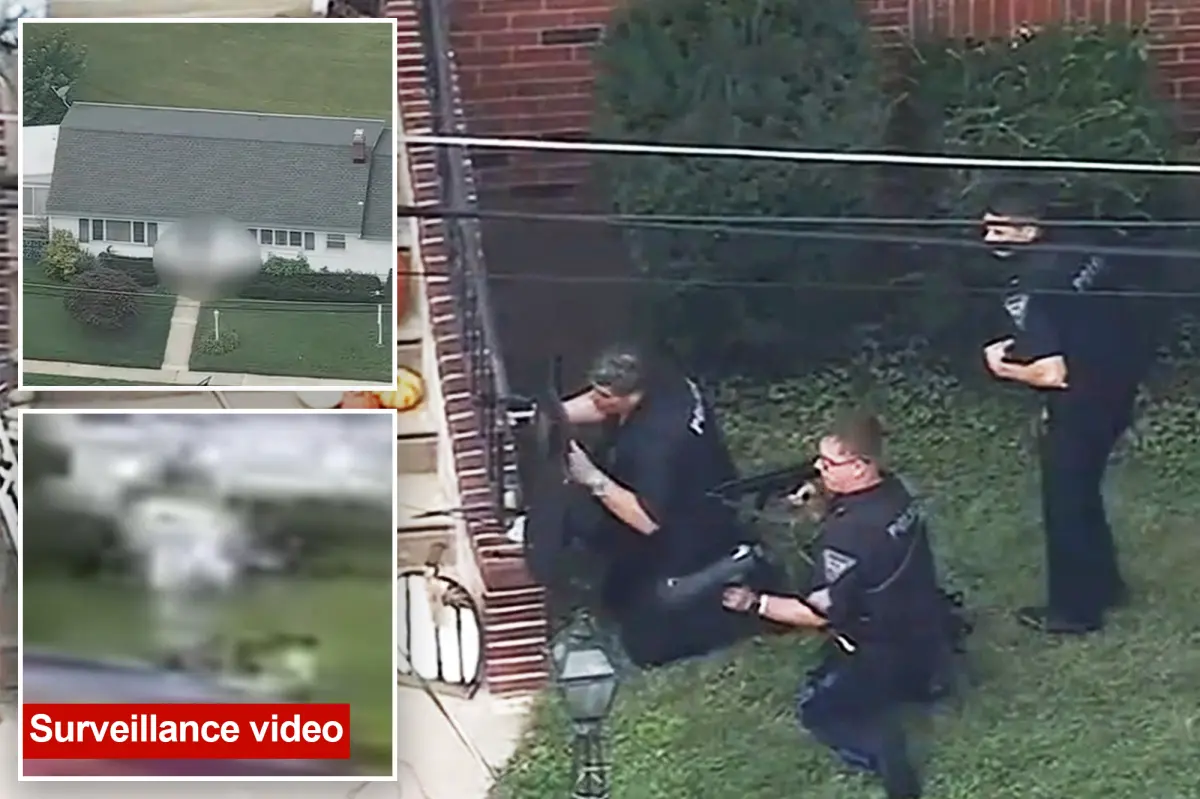
In the quiet, everyday familiarity of a suburban Pennsylvania neighborhood just outside Philadelphia, the morning of Wednesday began like any other. But by 9 a.m., the peace was shattered by the sound of gunfire on Bethel Avenue in Pennsauken, New Jersey. Authorities were dispatched to the scene of a reported shooting, their radios crackling with the urgent description of a man armed with a handgun. What they found upon arrival was a tableau that would haunt even seasoned first responders: a woman, later identified as 60-year-old Janet Camacho, collapsed on the front steps of a home, gravely wounded. She was rushed to Cooper University Hospital, where the tragedy assumed its permanent shape—the declaration of her death, just moments after the frantic attempt to save her. The initial call, the frantic response, and the ultimate loss were only the beginning of a story that would unfold with a horrible, confusing intimacy over the next 90 minutes: a murder-suicide, a brother and sister, and a community left to reconcile the violence with the man they thought they knew.
The scene on Bethel Avenue quickly morphed from a medical emergency to a tactical standoff. With a shooter reportedly still at large, law enforcement established a tight perimeter around the residence, cordoning off the block and shutting down the morning commute. Neighbors, roused from their kitchens and bedrooms, were escorted from their homes, their hands empty, their expressions dazed. The usual awkwardness of a police presence turned into a genuine sense of dread as the next hour ticked by. In a striking example of modern police work, the authorities deployed a robotic dog—a piece of machinery more often seen in science fiction than on a residential street—to enter the home and locate the source of the threat. The mechanical scout, with its unblinking sensors and four-legged design, moved into the house to deliver the grim news: Daniel Lopez, also 60, the brother of the slain woman, was found dead inside, a self-inflicted gunshot wound confirming the darkest possibilities of the moment. The standoff was over, the safety of the public restored, but the emotional wreckage had only just been scattered. Officials would later confirm that the incident had been a murder-suicide, but the motive remained an open question, a wound that would not heal easily.
In the immediate aftermath, the tearful and disbelieving voice of a neighbor named Michelle Jimenez became the human face of the tragedy. Jimenez, who had grown up across the street from Janet and Daniel, shared a remarkably different portrait of the man with the gun than the one suggested by the police tape and flashing lights. “We used to invite him a lot for family parties,” she told local reporters, her voice catching. “He would always be our guest. He was really close to our family. He was always nice. He would bake stuff for me and my siblings.” These are not the words used to describe a cold-blooded killer. They are the words of a beloved family friend, a man who brought homemade treats for children, who was a fixture at celebratory gatherings, who laughed and joked and seemed far removed from the capacity for such irrevocable violence. Jimenez’s shock, echoed across the street and throughout the neighborhood, is a classic, painful refrain in the aftermath of such crimes: the profound disconnect between the public persona and the private despair. The man who was “always nice” and who “would bake stuff” was also a man who could shoot his sister, leave her to die, and then turn the gun on himself. It is a jarring juxtaposition that forces everyone who knew him to recalibrate their own memories, wondering what signs they missed, what pain they failed to see.
The relationship between Daniel and Janet, and the events that led to that Wednesday morning, remain murky, with investigators carefully peeling back the layers of family history, financial strain, mental illness, or perhaps a simmering grievance that never surfaced in polite company. There is no official word on what triggered the argument, if there was one, nor on the nature of their bond, which, by all appearances, may have been frayed or strained but was not publicly identified as dangerous. In cases like this, the question of motive is often buried with the perpetrator, leaving the living to sort through the wreckage. The surveillance footage obtained by WPVI, which the outlet deemed too graphic to air, reportedly captured the shooting, followed by the image of a man pacing outside the home—a man who, in the minutes after his catastrophic decision, was still physically present, perhaps experiencing the dawning, horrifying reality of what he had just done. That footage, though unseen by the public, likely revealed a man in emotional freefall, transitioning from rage to shock to the final, fatal act of self-harm. It is a sequence that suggests not a cold, calculated act, but an eruption of something deep and long-burning, a failure of resolution that escalated in a way that no one, least of all his family, could have predicted.
The community’s response to this tragedy has gone beyond simple shock; it has become a canvas for larger, more uncomfortable conversations about domestic violence, gun access, and the hidden lives we lead. While domestic violence is often framed strictly as intimate partner abuse, this incident is a stark reminder that familial violence can take many forms—a brother against a sister, a sibling relationship that turns lethal. Experts and advocates will point out that such incidents are not random; they are often the end point of a pattern of control, anger, or untreated mental health struggles. The fact that Lopez was known as a sweet, baking family friend does not negate the possibility that he was also struggling with demons that no one saw. The human brain is adept at compartmentalization, and individuals can present one face to the world while being consumed by another. This case underscores the importance of not dismissing red flags, however small they may seem, and the critical need for accessible mental health services, particularly for older adults who may be isolated, and for families to have the tools to recognize when a loved one is slipping into a crisis. The robotic dog that searched the home is a symbol of our technological advancements, but the human heart remains a notoriously complex and sometimes opaque terrain.
Ultimately, the story of Daniel Lopez and Janet Camacho is not just a crime summary; it is the story of a community left to mourn a woman who died on her own doorstep, and a man whose memory is now irrevocably tarnished by his actions. For Michelle Jimenez, and for all who knew them, the tragedy is compounded by the loss of a life that was once full of warmth and the sudden, violent erasure of both individuals. There will be no easy answers, no comforting narratives. There will only be the question that haunts every such tragedy: Why? And in the absence of an answer, the community must find a way to heal, to remember Janet Camacho not just as the victim of a brutal act, but as a person who lived and was loved, and to acknowledge the profound sadness of a brother who, in his final, broken moments, chose a path of destruction. As investigators continue their work and the police tape comes down, the front steps of that home remain a place where a family spent a lifetime creating memories, and where, one Wednesday morning, that family history was eternally rewritten. The grief will be long, the questions persistent, but the story—humanized by the very ordinariness of its details—stands as a solemn reminder of the thin line we all walk between the lives we lead and the shadows we keep at bay.