





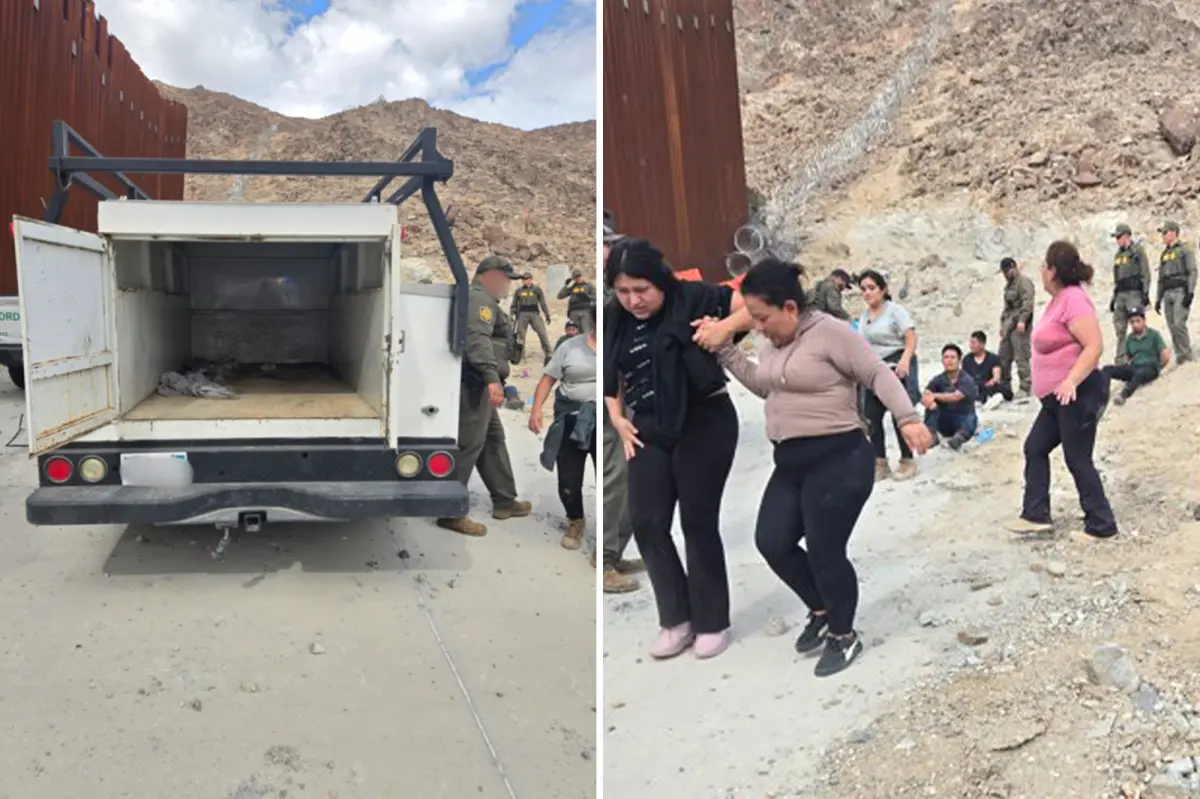
It was the kind of sight that stops even hardened agents in their tracks: a seemingly ordinary utility truck baking under the relentless Southern California sun, its modified cargo area packed with human beings. Near the tiny desert community of Ocotillo, just miles from the U.S.-Mexico border, U.S. Border Patrol agents from the El Centro Sector came upon the vehicle and discovered 31 migrants allegedly crammed inside. There was no room to sit, no space to move, no relief from the crushing heat. The truck had been altered to hide its occupants, transforming a vehicle meant for tools and equipment into a rolling trap. In the stark language of Border Patrol, these were 31 people treated like cargo, hauled through dangerous desert temperatures by smugglers who cared only about the payout. For the agents, it was another stark reminder of what their work truly involves: not just processing crossings, but confronting the extremes of human desperation and exploitation.
The suspected driver, however, had no intention of explaining himself. As agents moved in to secure the group, the man slipped away, weaving across the border back into Mexico, apparently convinced that once he was on the other side, he was beyond reach. But his escape was brief. Mexican law enforcement quickly tracked him down and placed him under arrest. Border Patrol could not resist a wry observation: “Apparently thinking the border doubled as a finish line,” the agency noted, “Mexican law enforcement arrested him too, leaving the getaway driver to trade the steering wheel for a jail cell.” The comment carries an edge of dark humor, but beneath it lies a serious reality. Smuggling networks treat human life as a disposable commodity, and when things go wrong, the most vulnerable pay the price while organizers and drivers often disappear. In this case, the chain briefly held. But the image of that man sprinting away, leaving behind 31 terrified people in the desert, is a haunting one.
The location itself tells an important part of the story. The El Centro Sector patrols roughly 70 miles of international border through the Imperial Valley, a landscape of sprawling deserts, jagged mountain ranges, and vast agricultural fields. It is one of the most unforgiving environments in the United States, where summer temperatures can rocket past 120 degrees. For migrants, there is no gentle introduction to this terrain. The sun pounds down from a cloudless sky, the heat radiates up from the ground, and water becomes the difference between life and death. Smugglers often drop their clients in remote areas with little guidance, knowing that border agents will feel compelled to rescue those who become lost or dehydrated. This is not accidental cruelty; it is strategy. The hotter and more isolated the route, the less likely it is to be patrolled. But the cost is measured in human suffering. Agents in this sector are as much first responders as law enforcement officers, performing rescues, administering water, and racing against time in a country where an ordinary day can turn fatal within hours.
This discovery comes at a strange and shifting moment in border history. Overall apprehensions along the southern border have plunged compared with the record highs of previous years. Daily apprehensions along the southwest border have averaged roughly 258, according to the Department of Homeland Security. Those numbers are far from the enormous crowds that once overwhelmed border facilities. Yet the dramatic decline has not ended smuggling attempts, nor has it softened the calculation of people who still feel they have no choice but to flee their homes. The smuggling industry is resilient, adapting quickly to enforcement changes, adapting its routes, its vehicles, its timing. This latest incident near Ocotillo shows that even when crossings drop, the desperate remain willing to take unimaginable risks. And the smugglers remain willing to put them in harm’s way, packing them into sealed spaces, sending them into the mountains, or pushing them out to sea, all in the name of profit.
Consider the events of just a few weeks earlier. On July 29, authorities intercepted a small vessel roughly 14 miles west of San Clemente Island, off the Southern California coast, and found 21 migrants crowded aboard. There was little protection from the ocean, no guarantee of reaching shore, and no room for comfort. The sea, like the desert, becomes a graveyard for those who underestimate its power. Then in August, Border Patrol agents in the El Centro Sector raced to rescue a 25-year-old Mexican man who had become stranded for two days after crossing the border and losing his way in the remote Jacumba Mountains. He had run out of water and was running out of time when his distress call reached authorities. Agents obtained his GPS coordinates and scrambled response teams into the rugged terrain while requesting aerial assistance from multiple agencies. The boulder fields were so vast and treacherous that even aircraft struggled to find openings. The man was found alive, but the episode was a close call, one of countless reminders that behind every statistic is a human heart still beating or one that has stopped too soon.
These stories are easy to reduce to policy debates, to numbers in a briefing, to the dry language of agency reports. But they deserve a more human reading. The 31 people discovered in that truck were not abstract concepts; they were individuals fleeing hardship, violence, or the grinding weight of poverty. They trusted smugglers who betrayed them. They survived a journey that could have killed them. They were then taken into custody, their futures uncertain. The agents who found them were doing their jobs, but also facing a moral paradox: they are the enforcers of a system that treats these people as illegal entrants, and the rescuers who keep them alive so they can face that system. The suspected driver sits in a jail cell in Mexico, but the networks that sent him will simply recruit another. The desert remains silent and scorching, the mountains remain full of hidden dangers, and the sea remains unreadable. There are no easy answers, only hard choices and fragile lives. In the end, perhaps the most honest takeaway is not about policy or politics, but about the enduring truth that human beings will always seek safety, and that a society is measured by how it responds to them, with walls or with mercy, with indifference or with care. For now, in the heat of the California desert, the only thing certain is that the work continues, one rescue at a time, one tragedy narrowly avoided, one life changed forever.