



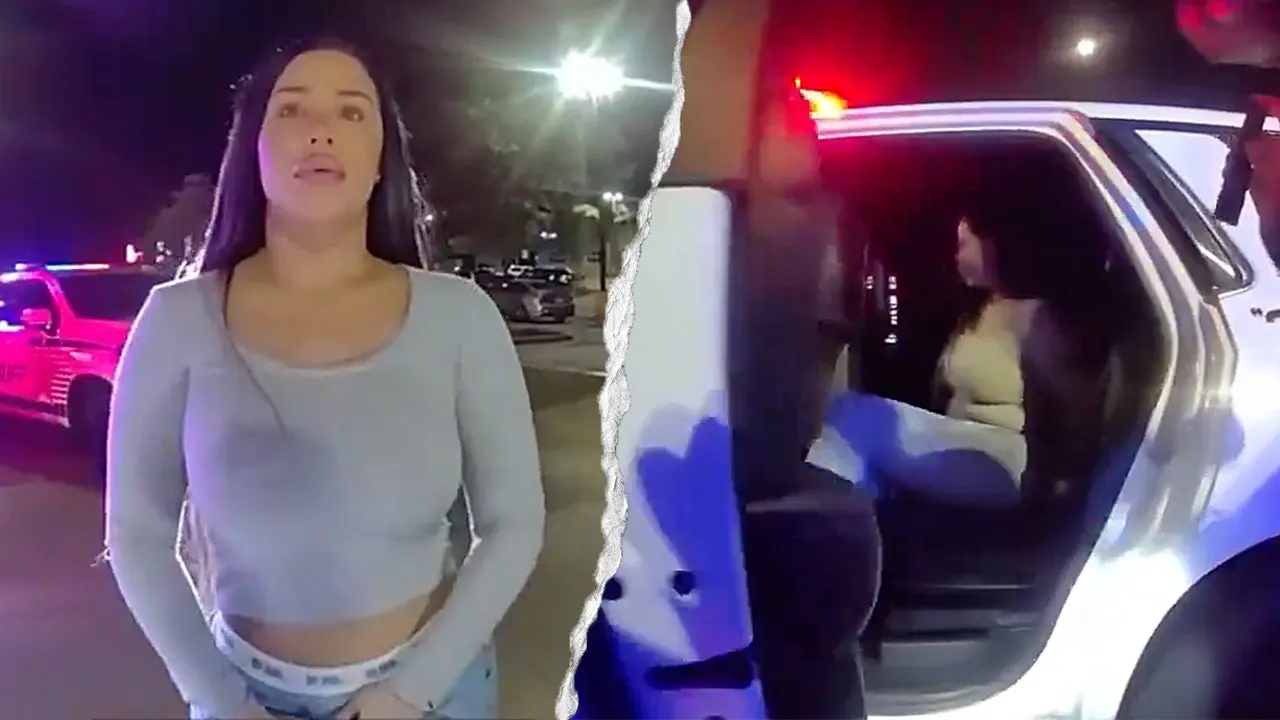
On a warm, heavy summer evening on July 29, under the humid skies of Tampa, Florida, a routine patrol by local law enforcement quickly escalated into a complex investigation that would systematically unravel the secret life of a young woman. Hillsborough County Sheriff’s deputies were navigating the city’s streets when they spotted a vehicle operating with malfunctioning taillights and tag lights. To the average observer, this was a minor, everyday traffic infraction—the kind of routine occurrence that usually ends with a polite warning, a standard fix-it ticket, or a brief conversation by the roadside. However, in the unpredictable world of law enforcement, these mundane stops are frequently the unexpected gateway to much deeper, more volatile discoveries. As the deputies activated their flashing red and blue emergency lights, casting a sudden strobe-like glow across the dark Florida asphalt, the driver pulled over to the side of the road, likely feeling that sudden, icy knot of dread that accompanies a police encounter when one has something major to hide. Inside the vehicle sat 28-year-old Bryce Swanson, a Canadian national whose quiet, undocumented existence in the United States was about to come to a sudden and dramatic halt. What began as an ordinary, low-stakes traffic stop for a minor equipment violation would soon expose a complex web of deception, identity fraud, and immigration violations that would permanently alter the course of her life. The officers approached the driver’s side window with standard caution, their flashlights cutting through the humid night air, entirely unaware that the seemingly cooperative woman behind the steering wheel was harboring a secret portfolio of alternative lives, all waiting to be discovered. This initial contact represented the fragile, everyday intersection between routine public safety enforcement and the deeply stressful, hidden realities of individuals living on the margins of legal status, waiting for the one mistake that would bring their fragile worlds crashing down around them.
When the deputy began his routine questioning, asking the driver for her license and registration, the psychological chess match of the traffic stop truly commenced. Bryce Swanson, attempting to maintain her composure under the glaring beam of the officer’s flashlight, initially identified herself as “Brianna Valenzuela.” She confidently claimed she possessed a valid driver’s license but had simply left it behind, a common excuse used by drivers hoping to avoid a ticket. Lying to law enforcement is a desperate gamble, a frantic attempt to buy time and preserve one’s freedom, but it is a strategy that almost always crumbles under the weight of professional scrutiny. As the deputy pressed for further details, her narrative began to rapidly fracture. She explained to the officer that she was a resident of New York, currently visiting friends in sunny Florida, and driving a rental vehicle to get around. However, when the officer naturally asked for any form of New York identification, transit cards, or official documentation to verify her story, Swanson had absolutely nothing to offer. The deputy, sensing the growing inconsistencies, pointed out the logical fallacies in her explanation, noting how incredibly unusual it was for someone to live in a bustling metropolis like New York without possessing a single piece of government-issued identification. Under the weight of persistent, quiet questioning, Swanson’s story shifted dramatically; she backtracked, admitting that she had never actually possessed a valid driver’s license in her life. This rapid, clumsy transition from claiming to have a forgotten license to admitting she had never owned one at all immediately set off major alarm bells for the deputies on the scene. The human element of this exchange was a palpable mix of nervous desperation on Swanson’s part and seasoned skepticism on the part of the officer, illustrating how quickly a web of untruths can collapse when subjected to the cold, logical light of professional police work.
With the driver’s identity heavily in question and her initial story thoroughly unraveled, the deputies proceeded to conduct a search of the vehicle, a move that would yield the most damning evidence of her clandestine activities. Inside the passenger compartment of the car, investigators discovered what can only be described as a portable identity kit: twelve separate, highly realistic fraudulent driver’s licenses. The surreal nature of this discovery was captured vividly on the deputy’s body camera, providing a fascinating look at the tools of modern identity evasion. Each of the twelve cards featured Swanson’s actual photograph, yet each one was printed with entirely different names, birthdates, and state origins. It was as if she had created a diverse catalog of alter egos, allowing her to seamlessly step into a new persona whenever her current situation or geographic location demanded it. As the deputy inspected the cards, flipping through the stack of laminated identities in the dim light of his cruiser, the reality of the situation became undeniably clear. The bodycam video captures the moment the officer states with flat, undeniable certainty, “All these are fake,” a simple, quiet phrase that instantly sealed Swanson’s fate on that dark Tampa roadside. The metallic click of handcuffs soon followed, echoing through the night air and signaling the definitive end of her journey through the shadows of society. For Swanson, the physical arrest was not just a legal setback, but the sudden, shocking termination of a complex double life she had painstakingly constructed to survive and navigate the country undetected. Watching her stand quietly by the side of the road as her collection of false identities was systematically cataloged by deputies highlighted the dramatic finality of the moment, where the illusion of safety evaporated in an instant, replaced by the cold, hard reality of criminal charges and immediate physical detention.
Beyond the immediate criminal charges of identity fraud and driving infractions, the arrest of Bryce Swanson reveals a deeply human story of survival, fear, and the extreme measures individuals take when living outside the boundaries of the law. Investigators later revealed that Swanson is a Canadian national who had overstayed her tourist visa, a common but highly precarious situation that places thousands of individuals in a state of constant, low-level panic. Once a visa expires, the legal clock begins to tick, and the constant threat of deportation looms large over every single daily activity, turning ordinary tasks into high-stakes risks. For someone in Swanson’s position, performing basic life tasks—such as renting an apartment, driving a car, opening a bank account, or securing employment—becomes an agonizing logistical nightmare without valid, government-issued identification. The twelve fraudulent driver’s licenses found in her possession were likely not just tools of criminal deception, but survival mechanisms designed to bypass the systemic barriers that exclude undocumented individuals from participating in everyday society. While the legal system views these fake IDs strictly as a serious criminal offense and a threat to public security, from a human perspective, they represent the desperate lengths to which someone will go to maintain a semblance of normalcy and avoid being sent back to their country of origin. This duality highlights the tragic, exhausting complexity of the modern immigration crisis, where a twenty-eight-year-old woman, perhaps seeking a better life or simply trying to stay in a place she had grown to love, felt compelled to completely erase her true identity and live a fragmented existence under twelve different names, constantly looking over her shoulder, waiting for the inevitable day her true status would be exposed.
Following her roadside arrest, the heavy machinery of the American legal and immigration systems immediately ground into motion, rapidly shifting Swanson from the freedom of the open road to the stark, sterile confines of a jail cell. She was transported to the Orient Road Jail in Hillsborough County, where she was officially booked on charges of driving without a valid license and providing a false name to a law enforcement officer. In many standard cases involving citizens, these relatively minor offenses would allow an individual to quickly secure their release through a modest cash bond, enabling them to return home and prepare for their legal battles from the outside. However, Swanson’s situation was vastly complicated by her undocumented immigration status, leading to a much more severe and restrictive outcome: she is currently being held without any bond. This indefinite detention is the direct result of an Immigration and Customs Enforcement (ICE) detainer placed on her immediately following her booking. An ICE detainer is a powerful administrative tool used by federal immigration authorities to request that local law enforcement agencies hold an individual for up to 48 hours beyond their scheduled release date, allowing federal agents ample time to take custody of the person for potential deportation proceedings. For Swanson, this means that even if she were to successfully resolve her local traffic and identity charges in a Florida court, she would not be set free; instead, she faces the terrifying prospect of being transferred directly into federal immigration custody. This system highlights the rigid, unyielding nature of modern immigration enforcement, where a single broken light bulb on a vehicle can rapidly escalate into a life-altering federal case, placing an individual on a fast track toward deportation.
The arrest of Bryce Swanson also serves as a poignant commentary on the modern era of surveillance, public accountability, and the immense power of digital media in shaping public perception of crime and justice. Sheriff Chad Chronister’s decision to release the highly detailed body camera footage on social media platforms, including X, transformed what would have once been a quiet, private legal crisis into a highly public, viral event analyzed by onlookers worldwide. In the digital age, police work is no longer confined to the streets or courtroom dockets; it is broadcast directly to millions of screens, effectively turning real-life arrests into cautionary tales and public spectacles. While this level of transparency serves to validate the diligent work of the deputies, showcase the professionalism of the department, and demonstrate the effectiveness of local law enforcement, it also has a profound, lasting human impact on the accused individual. For Swanson, her face, her visible panic, and the embarrassing, slow-motion unraveling of her lies are now permanently archived on the internet for the world to see, adding an inescapable layer of public shame to her already severe legal troubles. The public reaction to such videos often ranges from harsh condemnation of identity theft and illegal immigration to deep empathy for the desperate plight of undocumented immigrants who feel forced to live double lives just to survive. In the end, this case is about much more than just a traffic stop or a collection of fake plastic cards; it is a stark, sobering reminder of the fragile boundaries of identity in our highly monitored, interconnected world, where a single moment of exposure can completely dissolve a life built on carefully crafted illusions, leaving a vulnerable human being to face the full, unyielding force of a legal system that leaves very little room for error or second chances.