


The Thread Between Culture and Commerce: Inside the Storm Over Adidas’s Embroidered Mexican World Cup Jerseys
It began as the quintessential modern marketing dream, a shining example of corporate social responsibility bridging the profound traditions of Mexico’s past with the high-stakes, fast-paced world of global sports merchandising. Someone Somewhere, a socially conscious Mexican apparel brand certified as a B-Corp, posted a simple yet provocative question on social media: Why couldn’t Mexico’s iconic World Cup jerseys, worn by millions on the global stage, be hand-embroidered by the nation’s incredibly skilled, historically marginalized Indigenous artisans? It was a vision of socioeconomic justice designed to lift some of the country’s most vulnerable rural communities out of systemic poverty while presenting a stunning display of cultural pride. Within twenty-four hours of the post going viral, corporate athletic wear giant Adidas made the call that set a massive collaboration in motion. Two years of meticulous planning, complex logistics, and intense training culminated in the release of special-edition Mexican national team jerseys, featuring three classic shoulder stripes hand-stitched in green, white, and red by 150 Nahua women residing in the remote, mist-shrouded mountain town of Naupan, Puebla. To celebrate the product launch, Adidas flew two of the local craftswomen to its corporate headquarters in Germany to forever enshrine their handiwork in the company’s historical archive, while Someone Somewhere brought others directly onto the pitch in Mexico for a celebratory pre-tournament friendly match. The jerseys, which retailed at a luxury price point of upwards of $200, sold out almost immediately to fans eager to own a piece of authentic cultural heritage. However, this heartwarming narrative was abruptly derailed when a wave of vocal Mexican activists and digital creators took to social media to allege that the campaign was hiding a much darker reality. Prominent indigenous rights advocate and influencer Luz Valdez, who commands an audience of over 1.3 million followers across TikTok and Instagram, posted a scathing video exposing what she labeled the “murky details” of the high-profile partnership. Valdez accused both companies of systemic corporate exploitation, claiming they were using the images and ancestral heritage of the Nahua women to build progressive brand equity while paying them a meager 36 pesos (about $2.06 USD) per hour—a figure that sits roughly nine percent below Mexico’s legal minimum wage. As her videos amassed millions of views, sparked intense national media coverage, and pressured federal politicians into action, the public space was flooded with outrage, leaving the actual human beings at the center of the controversy—the Nahua artisans themselves—completely unheard.
Climbing the Sierra Norte: What the Artisans of Naupan Actually Say About Corporate Partnerships
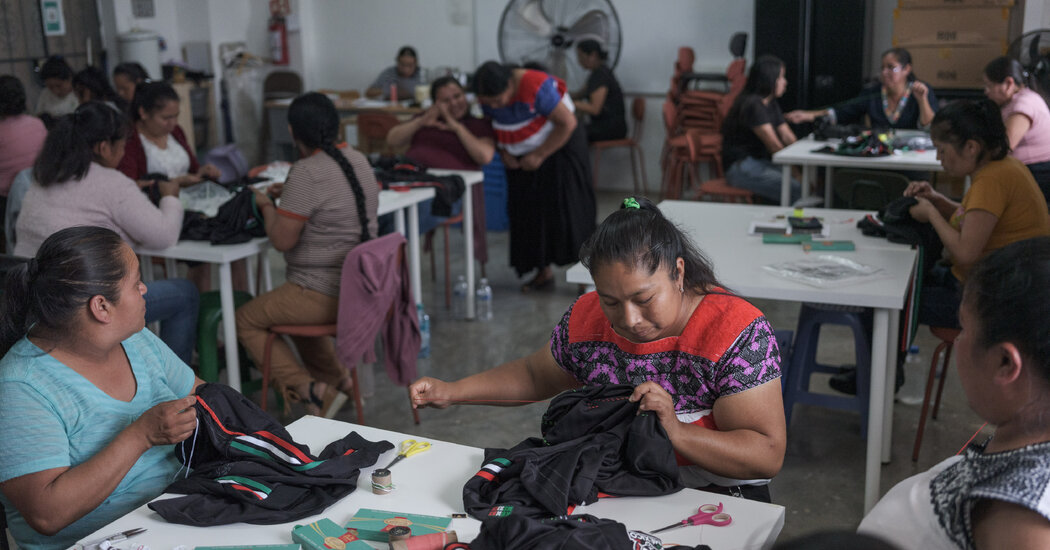
To discover the ground truth behind this complex intersection of sustainable fashion ethics in Mexico and corporate capitalism, we traveled high into the Sierra Norte mountains to the isolated, high-altitude municipality of Naupan, home to a close-knit community of roughly 2,000 Indigenous residents. Upon our arrival, the town’s cultural center was in a state of visible upheaval, with groups of Nahua women in heavily embroidered, brightly colored traditional dresses walking up the steep, winding hills alongside a team of sharply dressed federal government representatives climbing out of late-model SUVs. This modest, mountain-bound enclave, sitting more than a mile above sea level, had suddenly found itself thrust onto the front lines of an ideological culture war, prompting an emergency visit from Marina Núñez Bespalova, a high-ranking cultural official within Mexico’s left-leaning federal administration. Speaking directly to dozens of assembled local artisans, Núñez Bespalova offered immediate government-funded textile training workshops designed to teach the women how to eliminate corporate go-betweens, manage supply chains, and sell their intricate goods directly to consumers. She delivered a passionate critique of global capitalism, telling the crowd that multinational corporations enrich themselves by appropriating the unique aesthetic values of Indigenous creations without paying the women the compensation they are rightfully owed. Yet, as soon as the official state presentation concluded and the government vehicles departed, the political rhetoric faded, and many of the local women quietly returned to their daily reality, walking back to their workshop to continue hand-stitching the very Adidas jerseys that had caused the national uproar. We followed them directly to their place of work, stepping into a modest, single-room workshop where we were met with unexpected warmth. Despite the hundreds of sensationalized news articles and viral videos circulating across the Mexican internet, the woman who opened the door noted with a mix of exhaustion and relief which we were the very first journalists to actually travel to their remote town of Naupan to ask for their perspective. Inside the workspace, more than two dozen craftswomen sat cooperatively around long folding tables, chatting comfortably in Nahuatl—an ancient Mesoamerican language spoken by roughly 1.5 million people—while carefully pulling vibrant threads through the green athletic fabric of the Adidas shirts.
A Different Truth from the Sewing Tables: Autonomy, Fair Wages, and the Fear of Lost Opportunity
When we began asking questions about the allegations of corporate abuse, the women transitioned fluidly into Spanish, and one by one, they systematically dismantled the prevailing national media narrative, painting a starkly different picture of their employment experience. “Honestly, this job is much better than anything else we could hope to find around here,” explained 45-year-old Monica Marin, gesturing to her sewing space with pride, while her colleague, 41-year-old Micaela Perez, nodded in firm agreement. Perez, a widowed mother of two children, emphasized that the flexible hours associated with the Someone Somewhere community impact model were a lifeline, allowing her to earn a steady wage while remaining present to raise her children in a rural region where formal job opportunities for women are virtually non-existent. A third artisan, 35-year-old Anabel Guzmán, expressed deep frustration with the urban-centric activists who claimed to speak on their behalf, pointing out that before this project, she struggled to secure any source of personal income to support her household. The consensus among the working women in the room was absolute: the compensation they received was fair for their local economy, the work schedule was highly adjustable, the safe communal workshop was far superior to working alone at home, and the project provided them with a consistent, predictable income that they had never experienced before. Their primary concern was not that they were being actively exploited by Adidas or Someone Somewhere, but rather that the precious economic contract would inevitably end once the World Cup hype dissipated. For the vast majority of these women, the termination of this commercial partnership meant an unwelcome return to grueling, low-paying manual agricultural labor—tilling rocky fields of black beans, serrano chiles, and peanuts under a scorching sun for long hours and far less pay. “If all those people typing angry comments on their phones took the time to actually make the journey up these mountains to talk to us directly, they would realize that we are not victims, and we are not being exploited,” stated 28-year-old Betty Alonso, her voice tinged with frustration. In fact, many of the artisans expressed deep anxiety that the hostile social media backlash generated by urban activists would ultimately backfire, scaring away future multinational brands and leaving their community completely economically isolated. “I feel an enormous amount of anger toward these online influencers,” said 38-year-old Edith Carballo, who had joined the weaving collective after suddenly losing her previous job at a regional pharmacy. “In their own minds, they believe they are helping us, but they aren’t listening to us at all—they are just using our lives to build their own online platforms.”
Dissecting the Math of Ethical Production: Pay Slips, Global Economic Benchmarks, and the Labor Debate
The prominent activist behind the digital campaign, 28-year-old Luz Valdez, has earned a reputation across Mexico as an uncompromising defender of Indigenous heritage, frequently calling out major international brands for unauthorized cultural appropriation and deceptive labor practices. Her persistent activism has yielded tangible results in the past, including forcing a public apology from Adidas after she accused the brand of copying the traditional pre-Columbian design of the Mexican huarache sandal. In her fierce public campaign regarding the World Cup jersey collaboration, Valdez leveled a series of serious operational charges against Someone Somewhere, alleging that the workers in Naupan were subjected to harsh, sweatshop-like conditions, including wage deductions for minor embroidery mistakes, lack of basic ergonomic chairs, highly restrictive one-hour lunch breaks, and a total absence of fundamental workplace necessities, such as toilet paper. While corporate giant Adidas responded to the controversy with a standardized corporate statement emphasizing that they had worked closely with their local partner to ensure all production adhered strictly to global workplace standards, the actual artisans inside the Naupan workshop vehemently denied Valdez’s claims of poor treatment during our interviews. Although the women politely requested that we withhold their specific take-home pay figures from publication to prevent them from becoming targets for armed robbery in their impoverished municipality, they insisted their hourly earnings were significantly higher than the 36 pesos reported by the media. Furthermore, they clarified that while an intricately embroidered jersey took roughly seven hours of hand-stitching to complete, they were never forced to work at an exhausting, unsustainable pace, and they frequently received lucrative speed bonuses for completing their quotas ahead of schedule. Antonio Nuño, the 34-year-old co-founder and chief executive officer of Someone Somewhere, also contested the activist accusations, sharing the artisans’ concerns regarding safety and privacy but agreed to show us verified digital pay slips for nine active Naupan artisans under the strict condition that specific financial data remain private. The payroll documents clearly demonstrated that the women earned hourly wages well above the 36-peso mark, bolstered by regular bonuses for high efficiency, quality control, peer training, and administrative responsibilities. When factoring in these performance bonuses, overtime pay, and potential profit-sharing, the financial documents indicated that a woman working a standard 40-hour week would earn well above the regional “living wage” threshold calculated for rural Mexico by the Anker Research Institute, a globally respected institution that establishes rigorous benchmarks for fair compensation. When presented with this financial evidence, Valdez remained highly skeptical, arguing during an interview that economically vulnerable Indigenous artisans are frequently too intimidated by corporate power to publicly criticize their employers. “Just because struggling workers feel content with their current conditions does not mean those conditions are not exploitative,” Valdez argued, holding firm to her position even after the craftswomen posted a self-produced video on Instagram expressing their love for their job, which Valdez quickly dismissed as a corporate-scripted public relations stunt using a philosophical quote from Simone de Beauvoir about marginalized people acting as accomplices to their own oppression.
The Structural Challenge of Social Enterprise: When Traditional Indigenous Art Meets Global Market Demands
Understanding this deep ideological divide requires looking back at the origins of Someone Somewhere, which Nuño and two of his childhood friends founded after first visiting the remote community of Naupan at age fifteen as volunteer Catholic missionaries. After returning to the region for three consecutive summers during their college years to study the traditional backstrap weaving and hand-embroidery techniques passed down through generations of Nahua women, the trio decided to launch a social enterprise designed to turn traditional craftsmanship into a viable path out of generational poverty. They structured the young apparel company as a certified B-Corp, an internationally recognized designation for businesses that balance profit-making with explicitly measured social and environmental goals. However, translating this idealistic vision into a sustainable business model in the highly competitive global fashion marketplace has proven to be an incredibly complex endeavor. In the traditional local market, Nahua women create incredibly complex, time-consuming garments that take up to fifteen days of painstaking labor to complete, yet they are rarely able to sell these masterpieces locally for more than 1,500 Mexican pesos (roughly $86 USD)—a return that amounts to a fraction of a sustainable hourly wage. To solve this economic bottleneck and create a scalable product, Someone Somewhere opted for a hybrid compromise: the company designs mass-market consumer goods, such as basic T-shirts, hoodies, and backpacks, and then pays localized networks of Indigenous artisans to add hand-embroidered details to these pre-made items. While Nuño insists this hybrid approach is the only viable way to generate steady, reliable, and volume-based work for hundreds of artisans, indigenous rights advocates argue that this model reduces highly skilled master craftspeople to low-wage assembly-line workers who execute basic corporate designs, all while the brand continues to heavily market their indigenous identity to land lucrative, highly publicized partnerships with global brands like Delta Air Lines, IKEA, and Lacoste. This critique of inconsistent work and low pay was echoed by three former employees of Someone Somewhere, who spoke on the condition of anonymity for fear of professional retaliation in the Mexican fashion industry, alleging that the startup rarely achieves its lofty goal of permanent poverty alleviation because production contracts fluctuate dramatically. Our review of an internal company spreadsheet from early 2024 revealed that while the average hourly rate paid to thirty-five artisans in Naupan was indeed 15 percent higher than the national minimum wage, their monthly earnings swung wildly from a meager $35 USD to a substantial $350 USD depending entirely on seasonal corporate order volumes. Furthermore, some individual weavers working on smaller projects have privately complained about their compensation; one anonymous artisan revealed she was paid a flat rate of $6 to $8 USD per embroidered T-shirt, which occasionally took up to eight hours of slow, detailed work to complete, resulting in an effective wage of less than a dollar an hour. While Nuño defended the pricing structure by stating that internal company testing showed most experienced artisans could easily complete those specific designs in under three hours, the wage disparity highlights the persistent friction between the demands of global corporate supply chains and the human realities of traditional handmade production.
Paternalism vs. Self-Determination: Who Decides the Value of Indigenous Labor?
Ultimately, the fierce controversy surrounding the Adidas artisan collaboration exposes a profound, unresolved philosophical debate within the global movement for sustainable fashion ethics in Mexico: Who has the right to decide what constitutes a fair economic opportunity for marginalized Indigenous communities? Activists like Luz Valdez argue that because multinational corporations like Adidas heavily feature the smiling faces and cultural stories of the Nahua weavers in their global marketing campaigns to build highly valuable brand equity, the compensation of those artisans should be tied directly to the immense marketing value they bring to the project, rather than standard local minimum-wage laws. Valdez maintains that capitalizing on the unique cultural identity of these communities without paying them a direct share of the corporate marketing profits amounts to a modern, sanitized form of colonial exploitation. However, Marina Núñez Bespalova, the federal cultural representative who initially arrived in Naupan to offer government oversight, offered a surprisingly nuanced, self-reflective take on the situation, cautioning against the passionate digital campaigns of well-meaning urban activists. While she strongly believes that multinational brands must be held to the highest ethical and financial standards, she emphasized that the global community must ultimately respect the self-determination, intelligence, and agency of the Indigenous groups themselves. “These women are not children; they are highly capable adults who are entirely competent to make their own economic and community-based decisions,” Núñez Bespalova noted thoughtfully. “To help them, we must learn to set aside the well-meaning paternalism that we are so accustomed to in Mexico, and trust that these communities are fully capable of negotiating, analyzing, and deciding what is truly best for their own families and their own future.” As the World Cup tournament approaches and the controversial hand-embroidered jerseys continue to circulate on the backs of soccer fans around the world, the Nahua women of Naupan remain at their sewing tables, balancing the fragile preservation of their ancestors’ art with the immediate, uncompromising necessity of daily survival in the modern Mexican economy.