




The devastating transition from a cherished family vacation to an unimaginable nightmare is a reality that no parent is ever prepared to face, yet it is the precise crucible in which Nancy Higginbotham and her husband currently find themselves. What was supposed to be a journey of cultural discovery and shared memories in the historic landscapes of Japan collapsed into a state of sheer panic on May 29, when their twenty-year-old son, James “Weston” Higginbotham, vanished without a trace. Weston, a bright and passionate environmental engineering student from Auburn University in Alabama, was exploring the region when all communication abruptly ceased, leaving his family stranded in a foreign land, grappling with a terrifying silence. Describing their existence as a “living hell,” Nancy has taken to social media not to sensationalize her family’s private grief, but to plead with the global community for basic human kindness, empathy, and active assistance in locating her beloved son. In her heartbreaking updates, she made a point to clarify that Weston’s absence is not the result of a reckless night of partying or a typical college misadventure; rather, his disappearance is a deeply concerning crisis that has mobilized international attention and local emergency services alike. The sheer emotional weight of a mother begging strangers to show compassion while she navigates the darkest pockets of her life speaks to the universal vulnerability of parenthood. The agonizing reality of having a child missing in an unfamiliar territory, separated by vast oceans and profound language barriers from their support network back home in Alabama, has transformed a standard tourist excursion into a desperate, hour-by-hour race against time, terrain, and the elements. As the hours stretched into days, the psychological toll on the family grew exponentially, but their resolve to find Weston remained entirely unbroken, anchored by a fierce maternal love that refuses to let despair win.
To search for a missing person in a sprawling metropolis or a dense woodland requires piecing together a fragile trail of digital breadcrumbs and physical checkpoints, a painful puzzle that Japanese authorities and Weston’s family have spent days trying to solve. Investigators painstakingly reviewing closed-circuit television footage managed to trace Weston’s last confirmed location to Yamashina Station, a transit hub situated just east of the historic city of Kyoto. This geographic marker is particularly significant, as Yamashina serves as a major gateway where urban infrastructure abruptly gives way to the rugged, steep topography of Mount Otowa and the extensive, densely forested Kyoto Trail network. According to Nancy, the last electronic sign of life from Weston occurred when his mobile phone registered activity shortly after he arrived at the bustling Kyoto Station around 8:15 p.m., only for the device to lose network service mere minutes later, plunging his digital footprint into absolute darkness. Family members believe that Weston, driven by his lifelong love for the outdoors, boarded a local train heading east toward Yamashina, seeking the quiet sanctuary of the mountain paths that wind through ancient temples and thick bamboo groves. The transition from the bright, highly structured environment of a Japanese train terminal to the shadow-drenched, labyrinthine trails of the surrounding wilderness represents a terrifyingly brief window of time in which a young man simply slipped from the view of the modern world. For his parents, visualizing those final recorded moments on security cameras is both a source of comfort and torment, offering a tangible glimpse of their son while highlighting the sudden, silent boundary where his physical presence vanished from human sight, leaving behind only the vast, whispering quiet of the forest.
Understanding who Weston is beyond his status as a headline or a missing person case is vital to understanding the profound tragedy of his current absence and the urgency of the search. Far from a reckless traveler, Weston is characterized by his family and peers as a deeply thoughtful, environmentally conscious individual whose academic pursuits in environmental engineering reflected his genuine reverent love for the natural world. He is an experienced, capable hiker who often found solace, inspiration, and a sense of profound peace when surrounded by the quiet canopy of trees and the grounding stability of earth beneath his boots. However, this affinity for the wild was accompanied by a delicate internal struggle, as Nancy gently shared that Weston may have been experiencing a period of significant emotional distress around the time he went missing. This vulnerability adds a layer of heart-wrenching complexity to the search, suggesting that his venture into the isolated trails of Yamashina may have been a deeply personal quest for quietude, a way to escape the overwhelming pressures of his internal world by immersing himself in the restorative silence of nature. The intersection of his outdoor expertise with his emotional vulnerability paints a portrait of a young man who was perhaps seeking healing but instead found himself lost within a beautiful, yet thoroughly unforgiving, wilderness. His struggle resonates deeply with anyone who has ever felt the overwhelming urge to run toward the quiet places of the earth to heal, reminding the public that behind the search grids and police reports is a sensitive human soul who simply needed peace, and whose family is now desperately trying to bring him back to the safety of their embrace.
The physical campaign to find Weston escalated dramatically as the Japanese police authorities threw their full operational weight into the search, organizing a highly coordinated effort that highlights both the severity of the situation and the international goodwill of the local community. On a Wednesday marked by deteriorating weather conditions, fifty dedicated Japanese police officers, specialized canine tracking units, and aerial search helicopters were deployed to scour the formidable, emerald-canopied slopes and ravine-carved terrains surrounding the Yamashina region. These professional efforts were mirrored by the raw, grassroots desperation of Weston’s parents, who refused to sit idly by in their hotel rooms, choosing instead to plunge directly into the dark, unfamiliar woods of Kyoto armed only with hand-held flashlights and their prayers. Their physical search was a grueling testament to parental devotion, characterized by slipping on wet leaves, shouting their son’s name into the unresponsive vastness of the mountain, and confronting the terrifying foreign wildlife of the Japanese highlands. This desperate search occurred under the looming shadow of a severe tropical storm system, as a powerful typhoon swept through the region, bringing with it torrential rains, winds that whipped through the ancient cedars, and treacherous mudslides. Ultimately, the extreme weather and the sheer, precipitous verticality of the mountain paths forced the exhausted parents to turn back for their own safety, a painful retreat that went against every instinct of a mother and father who wanted nothing more than to push forward through the darkness. Despite the physical setback, Nancy’s gratitude toward the local Japanese emergency responders remained boundless, as she publicly commended the officers who continued to search through the blinding rain and howling winds, demonstrating a cross-cultural solidarity bound by the shared human value of saving a young life.
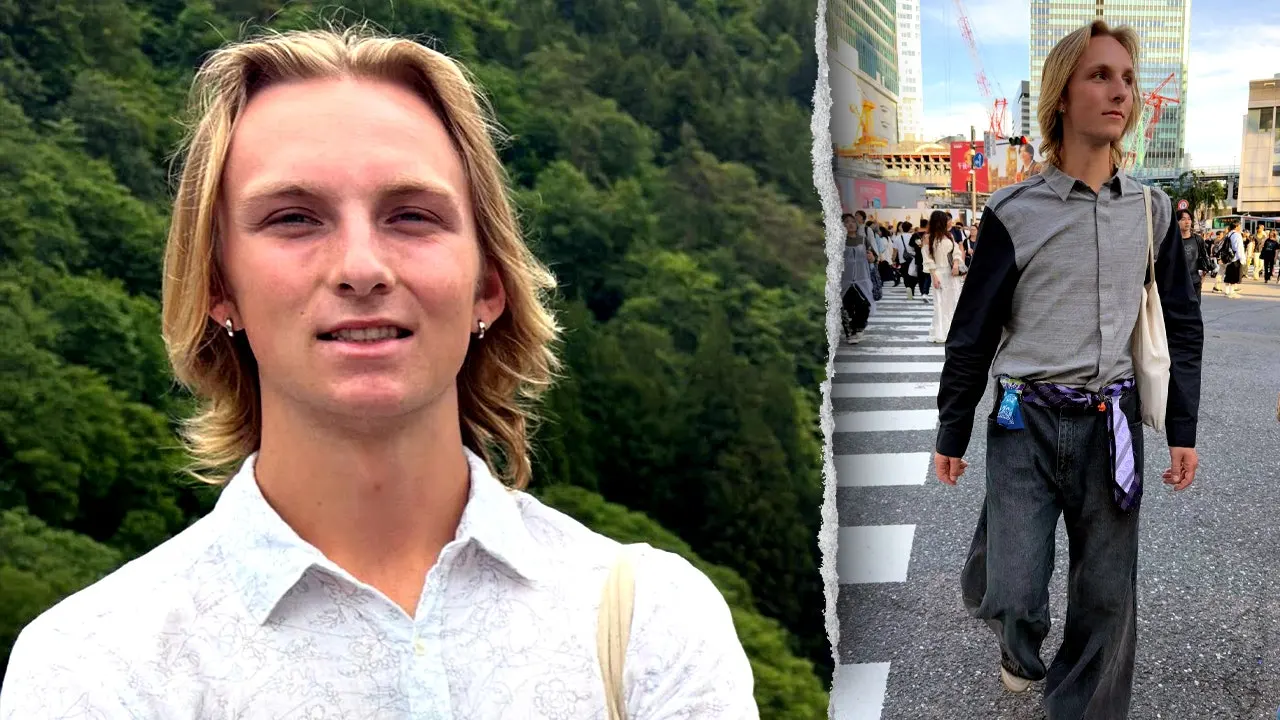
Every detail of Weston’s physical appearance and personal belongings has become a crucial beacon of hope, shared by his family in the hope that a single observant eye might recognize him amidst the flow of daily life or along the quiet outskirts of the hiking trails. Standing at an easily recognizable six feet, one inch tall, Weston possesses striking blue eyes and long, flowing blond hair that naturally sets him apart, particularly in Japan where his physical profile is distinctly unique. The clothing he wore on the day he disappeared carries a poignant irony, speaking volumes about his gentle disposition and deeply rooted connection to environmental causes. He was last seen wearing a casual t-shirt bearing the phrase “Save the Bees” printed across the back, a simple garment that captured his eco-conscious spirit, paired with distinct lavender corduroy trousers and classic white Adidas sneakers highlighted by their signature black stripes. Perhaps the most heartbreakingly personal item he carried was a small shoulder bag emblazoned with the distinctive outline of his home state of Alabama—a tangible, comforting piece of his southern roots carried thousands of miles across the Pacific Ocean, now lost somewhere in the misty highlands of Kyoto. These meticulously detailed descriptions are not merely clinical data points for a police investigation; they are the visual fragments of a life, a unique style, and a beloved identity that his family clings to,hoping that these specific, colorful markers will catch the attention of a local villager, a fellow hiker, or a transit passenger, bridging the gap between his disappearance and his safe return home.
In the face of overwhelming odds, a raging typhoon, and the heavy silence that has persisted since late May, the Higginbotham family has made a conscious, courageous choice to anchor themselves in unyielding hope. Nancy’s public messages are infused with a profound sense of gratitude for the global outpouring of love, prayers, and support that has reached them from their tight-knit community at Auburn University, across the state of Alabama, and from compassionate strangers worldwide. With a protective mother’s instinct, she has implored the public to handle any potential sightings of Weston with the utmost sensitivity, requesting that well-meaning individuals refrain from publishing his exact, real-time location online to shield her vulnerable son from public spectacle and chaotic crowds. Instead, she urges anyone who believes they have seen him to contact local law enforcement immediately and to reach out to her directly, ensuring a coordinated, gentle path to his recovery. The narrative of Weston’s disappearance is not merely a story of a tragic event in a faraway country; it is a profound testament to the endurance of family bonds, the cross-border compassion of rescue teams, and the global community’s capacity to unite in support of a family standing on the edge of an abyss. As the search continues through the rugged forests of Mount Otowa, the prayers of thousands remain focused on a singular, urgent goal: finding Weston, bringing him out of the shadows of the Kyoto trails, and restoring him safely to the arms of the mother and father who refuse to stop searching until he is home.