



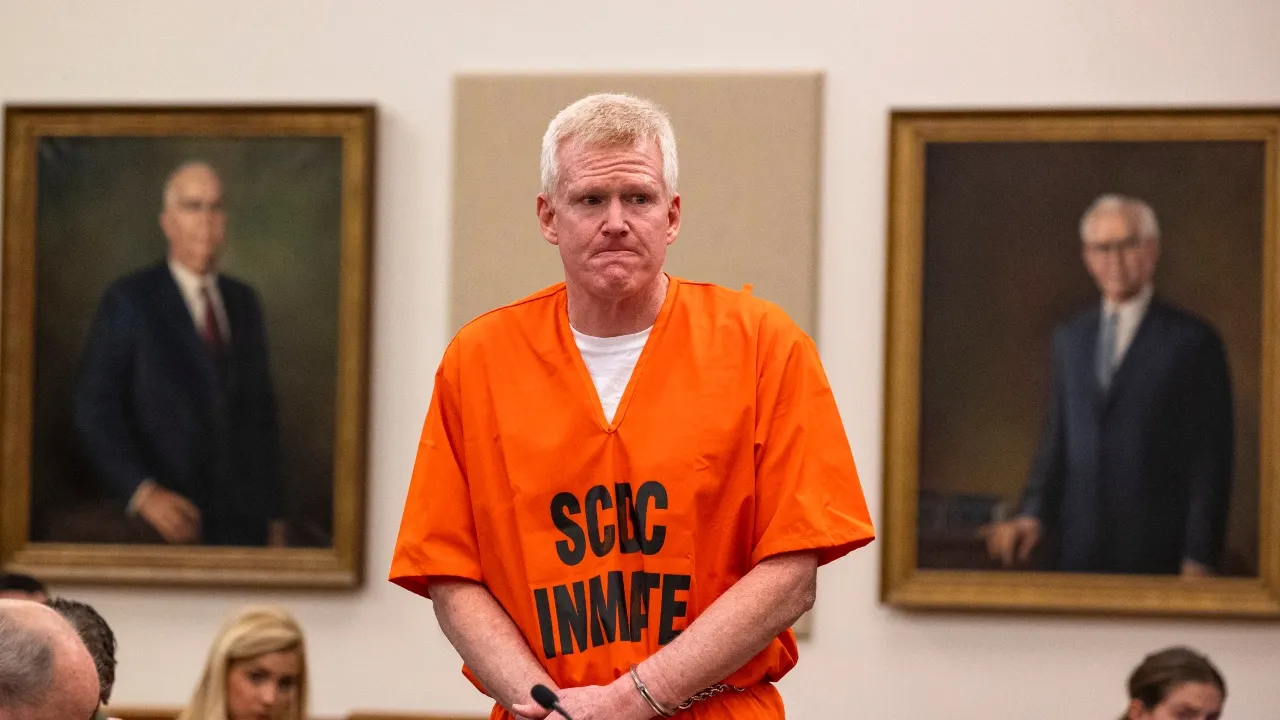
In a moment that would have once been unthinkable for the man who had been both a prominent prosecutor and the center of a scandalous South Carolina dynasty, Alex Murdaugh is scheduled to walk back into a Lexington County courtroom this Friday, not as a protector of the law but as a man fighting for his very life. The occasion is a pre-trial hearing before Circuit Judge Debra McCaslin, and at stake is nothing less than the shape of his second jury trial, slated for that far-off month of April 2027. The defense has arrived with a meticulously crafted stack of motions aimed at blowing up the proceedings before they can even begin. Their most ambitious gambit asks the judge to completely toss out the murder indictments against Murdaugh, while other filings seek to keep out evidence of his long-hidden financial sand, and even lock away the testimony he gave in his own defense the first time. To the outside world it may seem like another curious twist in a case that has become a national obsession, but to those who understand the relentless mechanics of a retrial, this is the moment where the strategy of a man facing a second murder trial either pivots or collapses. The whole scene is set against the backdrop of a weird Southern tragedy, one that has seen the Murdaugh family of lawyers lose their grip on both their wealth and their sanity, and where a drunken double murder in the ethereally haunted Lowcountry now has a ghost of a second act. And pending before the judge in a clear, market-day fashion is a stack of legal skirmishes that has already brought a former US attorney to a single, unnerving conclusion: the defense and old strategy has used up every trick in its bag.
That blunt observation came from Nathan S. Williams, a South Carolina federal criminal defense attorney who once served as criminal chief for the District of South Carolina. Williams understands the brutal arithmetic of a retrial, and he minced no words about what Murdaugh’s team now faces. “There is no surprising the government or the state at trial,” he said, staring at a reality that has become painfully clear to the defense since the state and travel truck swamped the first trial. Because Murdaugh took control and voluntarily testified in his own defense in 2023, the prosecutors now have an irreplaceable treasure: a sworn statement, under oath, from the man himself, one that can be analyzed, fact-checked, and shredded on cross-examination in ways the state couldn’t imagine the first time around. The entire testimony has been duly transcribed, logged, and will be parsed sentence by sentence to find any human crevice they can unhide. In a first trial, the defense could throw a thousand theories into the wind and blindside the state with a new narrative, but in a second, the state’s team can prepare an infinite wall of rebuttal witnesses, expert lines, and devastating contradictions. Williams says this minimizes the shrinkage of their chances: “They usually have a better chance at the second stage.” Yet, while that makes the first setback feel permanent, the state and her colleagues also have to hope the judge will knee-lean on the prosecution’s previous abuses—especially the question of how deep into Murdaugh’s orchestrated theft they can go. The system has already been scorched for improper influence from a corrupted clerk, and a nervous state is aware that any additional bias will be taken to the high court and used to place them on the plank. The defense is counting on that anxiety, using a flood of filings to chip away at the evidence pool, hoping that a single abusive crack will be enough to water the entire pillar of the prosecution.
The most elemental piece of the Friday argument is a brute, almost instinctive motion: the defense wants the judge to vacate the whole murder indictment itself, on the new claim that a SLED investigator, David Owen, floated false physical evidence before the grand jury that handed up the original charge. That allegation sounds like a dramatic fireball in a case that has already seen a hundred twists, but legal minds like Williams are careful not to view it as a guaranteed landing arc. The motion, they said, is a tremendous ask, the explosive one, frankly, at this point, since a judge is rarely eager to relitigate grand jury machinations through yet another round of testimony and be told that an officer suborned someone to lie. The claim would require an orgy of new evidence that could theoretically obliterate the indictment itself, a catastrophic event for the state. Williams said he’d be “a little surprised if that gets taken up on Friday,” believing instead that the judge will defer a ruling, schedule an evidentiary hearing and order briefing, thus putting the otherwise dramatic issue on the back burner until after the probabilistic DNA heat is resolved. Owing to the fact that a determination of that size has to be grounded in testimony, a block of evidence, and a trial, not a mere robed declaration. A pretrial ruling of that nature threatens the entire prosecution and is the singular underlying reason the defense raises it now: they want to stain the whole foundation, not just a few puzzle pieces.
Beside the indictment quest, the defense is also fighting a grinding war over DNA and forensic evidence. Murdaugh’s own lawyers, led by garnish silver-tip lawyer Dick Harpootlian, want a fresh round of testing using newer techniques, particularly on material scraped from beneath Maggie Murdaugh’s fingernails. They say the evidence needs a more sophisticated analysis to turn up, what is in their view, a missing foreign profile that might have belonged to an unnamed killer or another suspect. The state hasn’t dismissed outright but they want to encircle the request with safeguards, to protect chain of custody, analysis protocol, and the timing of the results. Williams offers a neutral view, saying independent testing might be tolerable, and added that “it wouldn’t shock me if she lets them have a separate new test by the defense, to me that strikes me as being fair, assuming they have the evidence available to be retested.” The courtroom now waits to see whether a syphoned sample is still present, and whether the defense can launch a bid to rule out or implicate their own theory of a different shadowy individual. Ultimately, they also request moving the trial out of Colleton County, from the local media circus that devour the first trial. They propose Charleston as a plausible alternate, and Williams says the battle is not if the judge will change venue—which he says, “powerfully likely”—but where. It is a “tactical chess move” not exactly a slam-dunk drama. This kind of lesser venue scuffle, though, could be resolved on Friday, setting the trial orientation for the whole upcoming second act.
However, the defendant’s own, immediate, human text also comes into play. Murdaugh was convicted in 2023 in the deaths of his wife Maggie, 52, and son Paul, 22, at what was once his own private deerland, a creek-side strip of the Moselle estate in Colleton County, on the night of June 7, 2021. The family’s story—Murdaugh’s self-having inherit from a line of powerful South Carolina prosecutors, the opioid addiction, the boat accident, and the strange double murders that people thought were a shakedown in the cobweb of an ongoing power dynasty—has become a fixture of American true crime. The state supreme court slammed the prior conviction when it decided that the Colleton County clerk of court, Becky Stewart at, while using a private text chain and spilling pep talk to a jury, had intruded the internal process, creating an impossible chance of unfairness. In overturning the conviction, they sent the case back to the rack with the order for a retrial, but with a lingering caveat: the murder trial must be free of whatever Rebecca did. Now McCasel, as the new pilot, is tasked with sorting out how much anyone can see about Murdaugh’s web of embezzlement, mule making and fraudulent yacht trips to me, and whether that financial tide can engulf the jury’s recollection of the actual events at the estate. Already, the justices of the state Supreme Court had thrown a mildly slender door for the wider narrative of what they call “financial motive,” yet they said it had been a bit broad.
There remains one major looming question of what happens if Murdaugh refuses to take the stand once more. The state wants to be able to use his previous every testimony, if he chooses instead to remain silent and hide behind a different quick-and-tirm peanut-butter sandwich. The defense is obviously fighting back, arguing that the constitutional right against self-incrimination should in a new trial shield him from hearing his own christ ringing in the empty hall of a second court. But whether or not McCaslin allows the use of the prior sword will have a massive ripple in how both the judge shapes the jury questionnaires, how the witnesses are often used, and the very tone of Murd’s transparent representation—whether he plays the silent survivor or dare to risk the same crossway that so ravaged him in the first trial. Williams observes that on retrial the most useful for the state is the fact they have already seen the defense tactics; but also that old evidence could shrink and a shrinking is possible “there will definitely be less” of the financial finagling, though “how much less” is still a mystery. The day will be filled with argument about polygraphs, pretrial, exclusion of footage, if he were allowed to use the demotion, what “third-party guilt” witnesses—who has pulled, phones, and protective orders. On the whole, this may feel like the penultimate, anguished, and procedural bus that moves a second time, but it depends on the state. In the larger story of this man, this family, and that piece of blackened earth in the turpentine woods, the retrial will be a robust an vendetta to walk out on a verdict that survived, but instead that neither the ghost of a processed regime will ever leave this American Gothic story alone.