





The Bering Sea is a place of hard, unforgiving beauty, a vast gray expanse where the horizon dissolves into the sky and survival is never guaranteed. It was there, on a Monday morning, that a tiny speck of life appeared against the endless water: a fifteen-year-old boy, perched atop an overturned fishing skiff, his body shivering violently, his teeth chattering in the cold. Derek Parker Aghnaanga had been missing for nearly two days, along with his older brother Sidney Kulowiyi and their cousin, after a simple fishing trip from the remote Alaska Native village of Savoonga turned into a nightmare. When the crew of the fishing vessel Northwest Explorer finally reached him, guided by a Coast Guard aircraft and flares dropped from the sky, they found a boy who had somehow held on to life against impossible odds. His first words, stammered through uncontrollable shaking, were not for himself. He told the captain that his brother was still beneath the capsized vessel. And then, with a grief that must have been as cold and deep as the sea around him, he said that during the previous night, his cousin had slipped away into the darkness. The rescuers realized they were not just pulling a survivor from the water; they were pulling a witness to an unspeakable tragedy, a child who had watched his family members die one by one while clinging to the wreckage of their boat.
The story began days earlier, on Friday, when the three men and boys left Savoonga for a fishing trip. Savoonga is a small, close-knit community of roughly eight hundred people on St. Lawrence Island, a windswept landmass in the Bering Sea near the Russian border. For generations, the sea has been both a source of life and a force of death, providing food and livelihood through halibut and other fish, but demanding respect and offering no mercy to those who make mistakes or fall victim to sudden storms. The trio planned to return early Sunday, but when they did not come back, their families grew anxious. By Sunday night, with still no sign of them, the family reported them missing. Immediately, a large search was launched, involving the U.S. Coast Guard, Alaska State Troopers, the Alaska Rescue Coordination Center, the Alaska Air National Guard’s 176th Wing, and local authorities from Savoonga. The search stretched across the cold, choppy waters east of St. Lawrence Island, with aircraft scanning the surface and vessels combing the waves. For the families waiting at home, the hours must have dragged by with agonizing slowness, each radio transmission carrying the weight of hope or dread. They knew the conditions were brutal, the water frigid, and the chances of survival after two nights were slim. Yet they also knew the resilience of their people, and they refused to give up hope until the sea gave up its secrets.
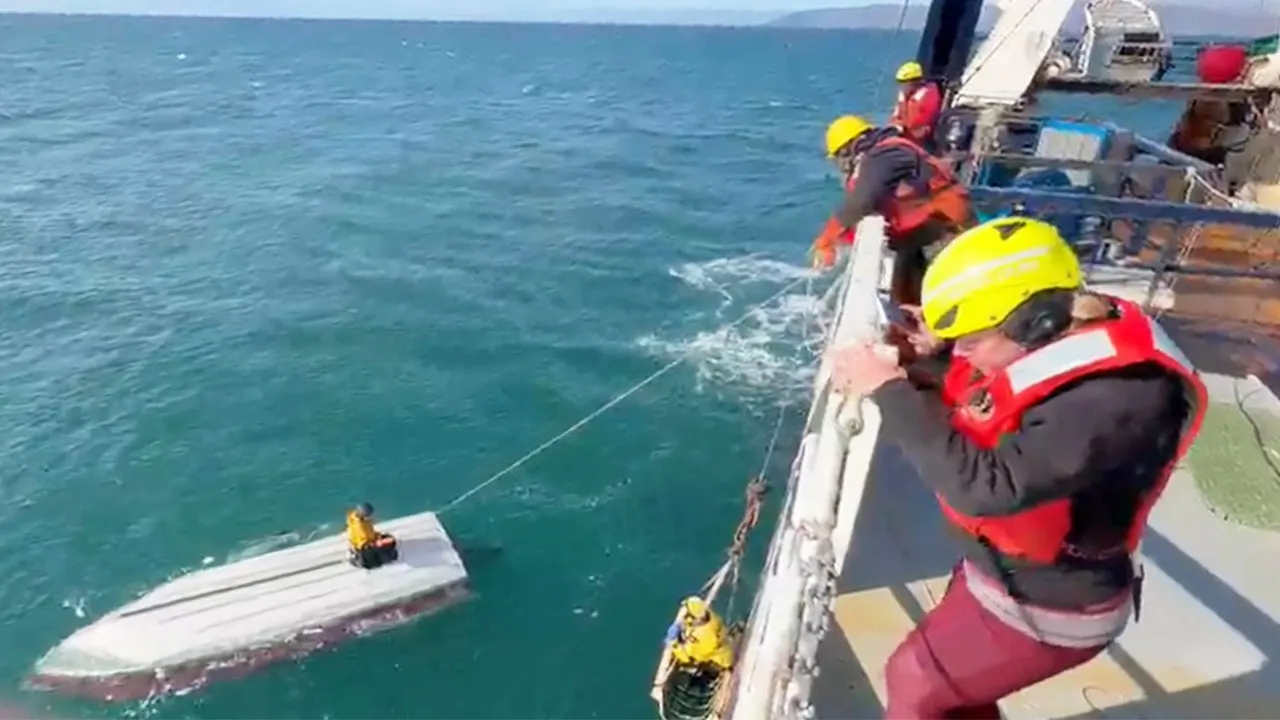
The rescue itself was a masterpiece of coordination and luck. A U.S. Coast Guard HC-130 Hercules aircrew from Air Station Kodiak spotted Aghnaanga Monday morning, roughly four miles east of St. Lawrence Island, sitting atop the overturned skiff. The sight of that small human figure against the immense water must have been almost impossible to believe. The aircrew immediately dropped a survival raft and emergency equipment to the boy, trying to give him a better chance while help arrived. Then they deployed flares to guide the Northwest Explorer, a commercial fishing vessel that was nearby, to his exact location. Adam White, the captain of the Northwest Explorer, later described the moment they reached him. Through the boy’s chattering teeth, he managed to convey the horror of what had happened: his brother was still under the skiff, and his cousin had slipped away during the night. It is difficult to imagine the emotional weight of those words. For the crew, this was no longer just a rescue; it was a recovery mission and a human story of loss. They pulled Aghnaanga aboard, wrapped him in blankets, and used hot packs to warm his hypothermic body. He was alive, but barely, and the physical and psychological scars of his ordeal would take far longer to heal. As the Northwest Explorer turned toward Nome, the crew knew they were carrying not only a survivor but also the memory of two men who had been part of that tiny village, men who would never return home.
The full extent of the tragedy began to emerge in the hours after the rescue. Aghnaanga had been on the overturned skiff for nearly two days, exposed to wind, cold, and the relentless motion of the sea. At some point, all three of them had been thrown into the water when the skiff capsized. Aghnaanga managed to get back onto the hull, but his brother and cousin could not, or perhaps they did and then slipped away. According to a GoFundMe page organized by relatives, Aghnaanga tried to hold onto his brother and cousin after they died, before their bodies were recovered. That detail is almost too painful to contemplate: a fifteen-year-old boy, alone in the dark, his body numb with cold and exhaustion, desperately clinging to the lifeless forms of the people he loved, refusing to let them go, until the sea and exhaustion forced him to release them. The crew of the Northwest Explorer recovered the bodies of Sidney Kulowiyi and the cousin from the water near the overturned vessel, bringing them aboard so that at least they could be returned to their families. Aghnaanga was treated for hypothermia, but physically he was expected to survive. The emotional damage, however, is something that no hot pack or blanket can fix. He will carry this night with him for the rest of his life, the memory of his brother’s presence beneath him and his cousin slipping away into the black water.
Back in Savoonga, the community reacted with a mixture of overwhelming relief and profound sorrow. Colleen Walker, an aunt of the brothers, described the moment the news came. “We all cried and jumped for joy when the captain announced on the radio, ‘We found a kid, he’s alive, he’s alive,’” she told the Associated Press. Family members had been listening to the rescue effort, hanging on every transmission, and that moment of joy was real and visceral. But it was quickly tempered by the knowledge that two of their own were gone. Sidney Kulowiyi, 35, was described by Walker as a humble commercial fishing captain and a provider for Savoonga. He left behind children, and his loss will be felt not only by his family but by the entire community, where everyone knows everyone and the bonds of kinship run deep. The GoFundMe page set up by relatives to support the family had already raised more than $42,000 toward a $45,000 goal, a testament to the reach of this tragedy and the generosity of people who understand that a village cannot lose two of its members without stepping up to help those left behind. The money will likely go toward funeral costs, support for the children, and the long, difficult process of healing. But no amount of money can replace the presence of a father, a brother, a cousin, a friend. The village of Savoonga, already accustomed to the harsh realities of life in the Arctic, now faces the even harsher reality of grief.
As the investigation into the capsizing continues, questions remain. Neither the Coast Guard nor Alaska State Troopers have said what caused the skiff to overturn. It could have been a sudden wave, a shift in weight, a mechanical failure, or any of the countless dangers that lurk in the Bering Sea. Rear Adm. Bob Little, commander of the Coast Guard Arctic District, offered a statement of condolence: “Our hearts go out to the families, friends, and communities affected by the tragic loss of these two mariners.” But words, however sincere, cannot undo what happened. What can be done is to remember the strength of the human spirit shown by Derek Parker Aghnaanga, a boy who survived two days on an overturned boat in freezing waters, who watched his loved ones die, and who still had the presence of mind to tell his rescuers where they could find his brother. His survival is a miracle, but it is also a reminder of the fragility of life and the power of the natural world. In the remote villages of Alaska, the sea is not a backdrop; it is a living presence, a provider and a destroyer. The people who live there know this better than anyone. They go out on the water because they must, because it feeds their families and sustains their culture, but they go with the knowledge that each trip could be their last. For the families of Sidney Kulowiyi and the young cousin, the sea has taken two of its own. For Aghnaanga, the sea has given him back, but it will never let him go.