





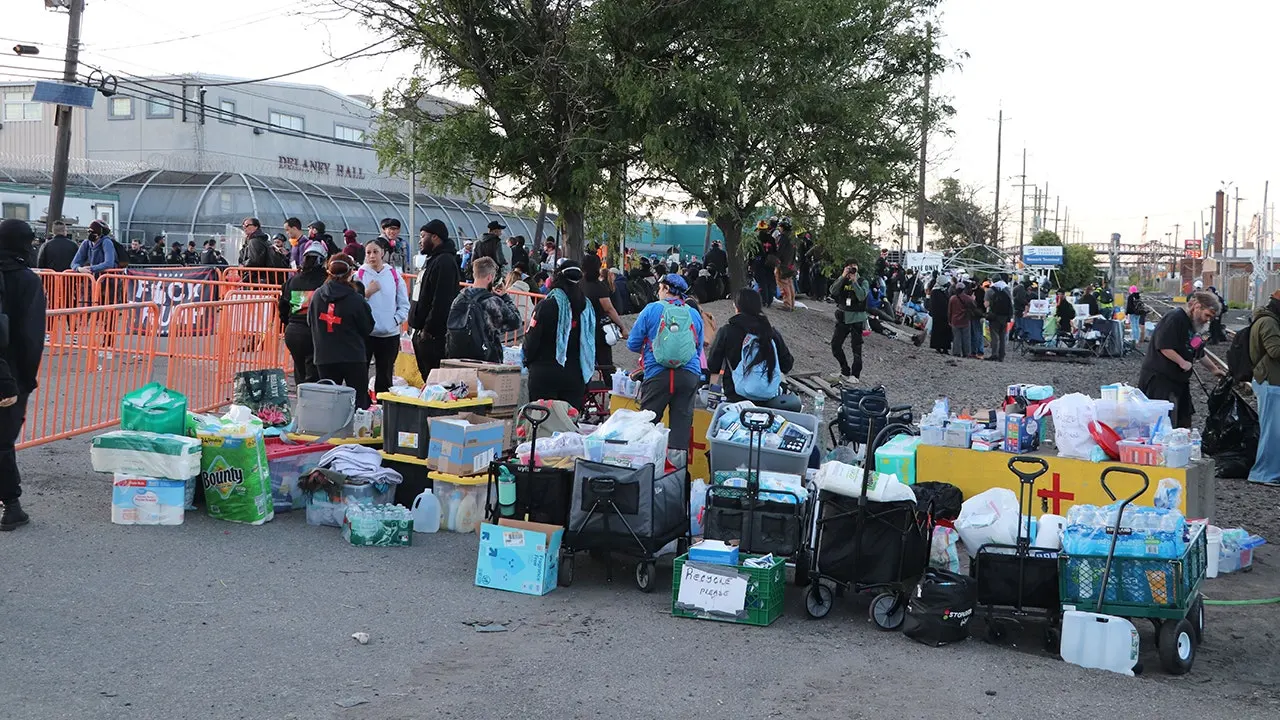
The crisp morning air in Newark, New Jersey, did little to cool the simmering tension outside the Delaney Hall detention facility on Saturday, as the surrounding streets were systematically transformed into a heavily fortified zone of ideological conflict. Long before the main body of demonstrators arrived, an eerie quiet on the pavement was broken by the highly organized arrival of advance teams who began converting the public space into a sophisticated tactical staging ground. Observers on the ground watched in real-time as these organizers established complex logistics stations, unloading heavy plastic bins and spreading out specialized equipment across improvised folding tables that lined the sidewalk. This was no ordinary grassroots gathering of concerned local citizens; the extensive inventory laid out was meticulous, practical, and highly defensive, featuring massive stockpiles of protective face masks, heavy-duty duct tape, emergency medical supplies, sunscreen, industrial hard hats, shatterproof goggles, and specialized respirators. Many of the early arrivals were already fully suited in helmets and high-quality protective gear, their faces obscured from view, creating an atmosphere of intense, militarized anticipation. The sheer volume of tactical gear suggested that these individuals were not merely hoping to stand and chant peaceful slogans, but were actively preparing for a sustained physical confrontation with opposing forces or federal law enforcement. Surrounding this brewing political storm, the physical architecture of Delaney Hall itself had been radically altered overnight, wrapped in towering metal security fencing and surrounded by interlocking, bright orange plastic concrete-barrier walls designed to keep the gathering crowds at bay. This stark, imposing boundary served as a physical manifestation of the deep divisions within the community, transforming a local municipal detention center into a high-stakes, heavily guarded stage for a bitter national debate. The visual juxtaposition of colorful activist flags against the cold steel of containment barriers proved that the weekend would not pass quietly.
As the morning progressed, the cordoned-off streets quickly filled with an estimated 200 anti-ICE demonstrators, a crowd heavily intertwined with and mobilized by prominent far-left and socialist organizations who brought a highly coordinated presence to the scene. The physical layout of the protest soon became a crucible of competing American ideologies, as supporters of Immigration and Customs Enforcement (ICE) began to arrive on the opposite side of the barricades. Among these countering groups were individuals who openly identified themselves as members of the far-right Proud Boys, adding an explosive layer of political volatility to an already dry-powder atmosphere. The human element of this confrontation was defined by mutual suspicion, intense anger, and an overwhelming unwillingness to engage in constructive dialogue. Representing this deep-seated hostility was an immediate, defensive reaction toward any outside observation or media documentation of the scene. When a reporting crew from Fox News Digital approached a cluster of masked, helmeted activists to ask a straightforward, human question about whether their extensive tactical preparations and heavy gear indicated they expected serious violence to break out, the response was a wall of stony, defiant silence. This tense standoff of words quickly turned physical when an unidentified individual suddenly lunged forward. In a raw display of hostility that underscored the volatile and unpredictable nature of the event, the person ran directly at the reporter, aggressively grabbing the mobile phone being used to document the scene in an attempt to halt the recording. This sudden flash of street-level aggression served as an immediate reminder of how quickly intellectual disputes over federal immigration policy can deteriorate into direct physical confrontations when opposing factions meet face-to-face on the pavement, turning the freedom of the press into another casualty of partisan warfare and demonstrating that both sides viewed the media not as neutral observers, but as active combatants.
While the battle raged on the streets outside, the true heart of this intense conflict lay within the sterile concrete walls of Delaney Hall itself, where the human beings whose lives hung in the balance of this geopolitical struggle were housed. The entire crisis had been sparked more than a week prior, when a group of undocumented immigrant detainees managed to smuggle out a harrowing, desperately penned open letter pleading for external intervention. In the letter, the detainees alleged that they were being subjected to systematic physical and psychological torture behind closed doors, painted a grim picture of a facility rife with abuse, and claimed they were regularly denied essential medical care and basic sustenance. This raw, emotional cry for help served as the primary catalyst for the massive demonstrations, humanizing the abstract debate over immigration enforcement for the activists who gathered to protest. However, this alarming narrative was quickly and aggressively challenged by federal authorities. The Department of Homeland Security (DHS) issued a swift and absolute denial of all allegations of abuse, attempting to firmly counter the public outrage by shifting the focus to administrative transparency. In a public relations counter-offensive, DHS officials went so far as to release the facility’s official weekly menus to the media, seeking to prove that the detainees were treated humanely and provided with three nutritious daily meals, including options like chicken fajitas and Salisbury steak. This stark contrast between agonizing claims of psychological torment and cold, bureaucratic menu lists illustrated the profound disconnect at the center of the immigration debate, where human suffering and official policy are constantly at war, leaving citizens to decide which version of reality to believe, and proving that the battle for public opinion is fought just as fiercely with paper menus as it is with bricks and shields on the street.
The tension of this ideological struggle was not confined to rhetoric and peaceful assembly; rather, it had already escalated into severe physical violence earlier in the week, marking a dangerous turning point in the standoff at the facility. Violent skirmishes had erupted between demonstrators and federal ICE agents, resulting in chaotic, close-quarters combat where agents were subjected to physical assaults, including biting, kicking, and punching by aggressive agitators. Appalled by the descent into chaos and looking to drastically alter the operational dynamics of the security response, state political leadership decided to step in. Democratic Governor Mikie Sherrill intervened in the standoff by issuing a direct executive order for the New Jersey State Police to take complete command of security operations surrounding the Delaney Hall perimeter. Sherrill publicly justified this major transition of authority as an essential measure to protect civilian demonstrators and de-escalate the volatile situation, expressing grave concerns over what she characterized as an aggressive, destabilizing “ICE surge” that threatened to ignite even greater unrest in the city. By replacing the federal law enforcement presence on the front lines with state troopers, her administration hoped to establish a neutral buffer zone between the passionate protesters and the federal agency they were targeting. However, this strategic intervention also highlighted the deep political friction that frequently complicates regional immigration enforcement, as state leaders find themselves forced to navigate the delicate line between protecting public safety, upholding the constitutional rights of protesters, and managing the aggressive enforcement actions of federal agencies on state soil, turning a local security dispute into a constitutional tug-of-war that exposes the systemic fractures within the American governing apparatus. With the state police acting as an uneasy buffer, the physical safety of everyone involved became a fragile balancing act that relied on thin blue lines to prevent a catastrophic blowout.
Amid the escalating physical clashes and the mounting safety concerns, state law enforcement officials began to point out a highly revealing trend regarding the actual identity of the individuals driving the street-level unrest. State Attorney General Jennifer Davenport moved quickly to clarify the demographics of those involved in the physical altercations, announcing that five out of the six individuals arrested by state police during the mid-week violence were not residents of Newark, nor did they even hail from the state of New Jersey. This revelation significantly shifted the public narrative, providing concrete evidence to support claims by municipal and state officials that “outside agitators” were responsible for hijacking what might have otherwise been a localized, peaceable demonstration focused on the immediate welfare of the detainees. This “outside agitator” dynamic introduces a complex, frustrating human element to the protest, as local communities often find their neighborhoods abruptly co-opted and transformed into physical battlegrounds by national activist networks who travel across state lines to engage in high-stakes ideological warfare. For the longtime residents of Newark, the sudden influx of heavily geared, masked, out-of-state activists willing to engage in high-risk tactics creates a deep sense of vulnerability and civic frustration, because local citizens are the ones who must live with the physical damage, heavy policing, and lingering negative reputation long after the traveling protesters have packed up their gear and returned home. This dynamic ultimately demonstrates how local humanitarian concerns can easily be co-opted by broader national proxy wars, which often leave vulnerable local communities paying the price for conflicts they did not start, while the true voices of local residents who are seeking genuine reform get completely drowned out in the deafening roar of partisan street clashes that prioritize national optics over local community healing.
The intense standoff at Delaney Hall serves as a powerful microcosm of the deeply fractured, highly polarized state of modern America, where even a municipal detention facility can become the epicenter of a fierce national struggle. What began as a local labor and human rights dispute, sparked by a desperate, handwritten plea from a group of terrified immigrant detainees, rapidly snowballed into a complex, multi-layered conflict involving federal agencies, state authorities, national activist networks, and opposing ideological factions. The physical fortification of the facility with metal fencing and orange barricades stands as a stark visual metaphor for the walls of misunderstanding, fear, and hostility that separate different segments of the American public today, making compromise seem almost impossible. As the protests outside Delaney Hall persist, the fundamental human questions at the center of the debate—how we treat the most vulnerable within our borders, how we define national security, and how we balance peaceful expression with law and order—remain tragically unanswered, buried beneath the noise of political theater and physical skirmishes. Ultimately, the turbulent events in Newark demonstrate that behind the tactical gear, the official menus, and the political finger-pointing, there are human beings on all sides of the barricades—be they detainees, law enforcement officers, or passionate citizens—who are deeply affected by these systemic conflicts. Until the nation can find a way to address these deep-seated humanitarian issues with empathy and dialogue, rather than barricades and violence, the streets outside facilities like Delaney Hall will likely continue to serve as the battlegrounds for America’s unresolved soul, illustrating a country still searching for its moral compass in a time of profound division and highlighting the desperate need for a return to basic human decency in our public discourse.