





For over a week, a heavy, suffocating blanket of suspense hung over the city of Kyiv, leaving its citizens to endure a psychological war of nerves. High-ranking officials in Moscow had issued severe, public warnings of a retaliatory strike so devastating that foreign diplomats and international visitors were explicitly advised to flee the capital for their own safety. Rather than executing an immediate assault, the Russian military chose to extend this agonizing wait, engaging in a cruel orchestration of false alarms. Day after day, Russian bomber fleets took off from remote airbases, executing mock maneuvers that triggered air raid sirens across Ukraine before turning back. This tactical manipulation forced millions of exhausted civilians to survive on edge, their schedules ruled by the unpredictable shrieks of sirens and the absolute terror of the unknown. Defying Moscow’s intimidation, Western diplomats stood their ground, refusing to evacuate and expressing solidarity with the Ukrainian government. Yet, the burden of this psychological wear fell squarely on the shoulders of the ordinary citizens who had nowhere else to go. When the actual bombardment finally commenced early Tuesday morning, the agonizing week-long countdown dissolved into a chaotic, loud reality of falling metal and structural ruin.
This prolonged period of stress drove thousands of families down into the belly of the city, transforming Kyiv’s subway stations and underground parking garages into crowded, subterranean sanctuaries. For multiple nights, these cold, concrete spaces became packed to their absolute capacity, reflecting a level of desperation and fear not seen since the earliest, most precarious weeks of the invasion. Families laid down yoga mats, pitched small tents, and stretched out on thin blankets across the dirty concrete platforms, trying to carve out small zones of comfort. The air underground was thick with the scent of damp garments, human sweat, and instant coffee, filled with the echoes of barking family dogs and the soft, restless crying of children who found sleep impossible under the flickering fluorescent light. When the early morning sirens finally signaled a temporary all-clear, exhausted parents gathered their sleepy children and walked toward the surface, blinking in the pale dawn as thick plumes of black smoke began to rise over the skyline. But the relief was tragically brief. Shortly after 7:00 a.m., as commuters stepped onto the streets to head to work, a sudden second wave of hypersonic ballistic missiles screamed toward the capital. Traversing the sky at multiple times the speed of sound, these advanced weapons struck almost instantly, offering no time for sirens to blow or for civilians to scramble back to safety.
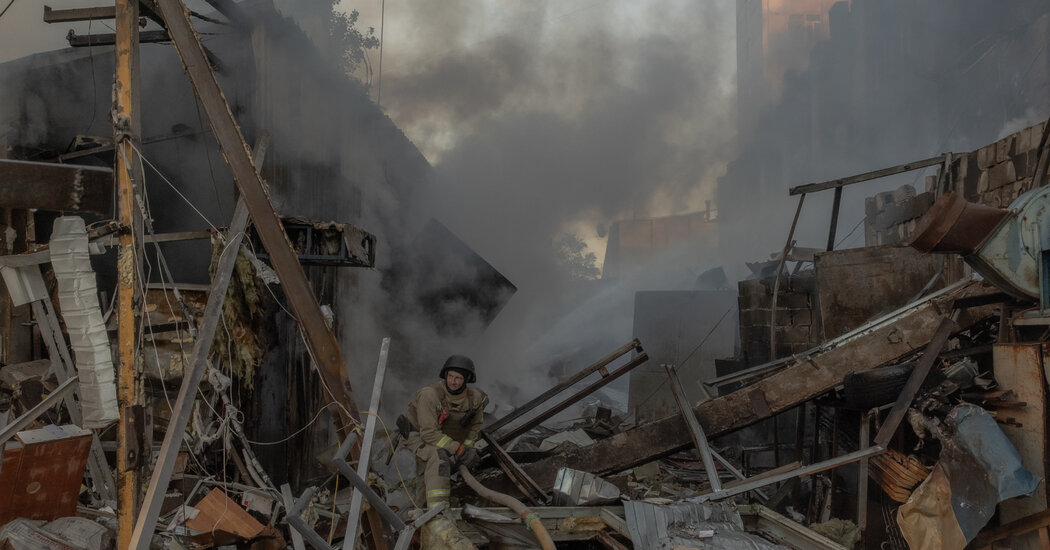
The physical devastation left in the wake of the Tuesday morning bombardment was catastrophic, cutting a path of ruin across several Ukrainian cities. Throughout the night and into the early morning, Russian forces launched an enormous wave of 656 drones and 73 missiles across the country, a volume of aerial fire that overwhelmed local defense networks. While Ukrainian forces managed to shoot down a significant portion of the incoming barrage, at least 33 missiles breached the defensive umbrella, detonating in densely populated urban centers. In Kyiv’s historic Podilskyi district, located just west of the Dnipro River, a nine-story residential apartment block partially collapsed under the impact of a direct strike, burying families beneath tons of pulverized masonry and burning wreckage. Rescue crews worked feverishly through the morning, pulling bodies from the smoldering debris as Mayor Vitali Klitschko confirmed that at least five civilians had been killed and 65 others wounded, including three young children. Hundreds of miles away in the central industrial hub of Dnipro, the horror was even more pronounced, where local authorities reported that 11 people, including two children, were killed, and dozens of others wounded.
This devastating assault was perhaps the most telegraphed and publicly advertised aerial campaign of the entire conflict, framed by Moscow as an act of absolute retaliation. Just a day prior, Russian President Vladimir V. Putin had held a televised meeting in the Kremlin to discuss a Ukrainian drone strike on a college dormitory in the Russian-occupied city of Luhansk, which Moscow claimed had killed 21 students. Putin declared that this incident had introduced “a new quality to the conflict as a whole,” establishing a justification for Russia to retaliate against what it termed “terrorist acts” by targeting Ukraine’s administrative and decision-making centers. While Kyiv’s government largely dismissed the Kremlin’s narrative regarding the Luhansk dormitory as manipulated wartime propaganda, local reports confirmed that civilian students were indeed among the casualties of that prior strike. This cycle of strike and counter-strike has become a tragic norm, yet Russia’s air campaign against major Ukrainian cities began years before Ukraine possessed the capability to strike back. In recent months, Moscow has aggressively scaled up these operations, turning every massive assault into a grim records-setting event. On May 14, Russia launched more than 1,400 drones in a single 24-hour window, and this latest Tuesday assault set a new record through the deployment of highly advanced, nuclear-capable Zirkon hypersonic cruise missiles.
Military analysts quickly noted that Russia’s heavy reliance on these cutting-edge ballistic and hypersonic weapons was a calculated effort to force Ukraine to expend its dwindling supply of Patriot missile interceptors. The American-made Patriot system remains Ukraine’s only reliable defense against Russia’s high-speed ballistic missiles, but the ammunition required to run them is critically low. This year alone, Russia has fired an unprecedented 374 ballistic missiles at Ukrainian cities—more than double the quantity launched during the same period last year—pressuring Ukrainian defense teams to make excruciating choices about which cities and power plants to protect. This shortage has resulted in only a one-in-three success rate for intercepting ballistic threats, leaving large swaths of the population vulnerable. Recognizing this critical vulnerability, President Volodymyr Zelensky has made desperate appeals to Western allies, writing letters directly to U.S. political figures, including President Donald Trump and members of Congress, declaring these missiles to be Vladimir Putin’s final major battlefield advantage. However, resolving the shortage is a complex logistical challenge; the high-tech Patriot interceptors are in short supply worldwide due to ongoing military tensions in the Middle East, and increasing production takes time, even with manufacturers like Lockheed Martin running facilities at peak capacity.
This dramatic escalation in the skies stands in stark contrast to the grueling, static reality on the ground, where the land war has devolved into a frozen bloody stalemate. Despite Moscow’s efforts to mount a major spring offensive, the massive presence of observation and attack drones on both fronts has made large-scale troop movements nearly impossible, trapping both armies in a deadlock. In response to this muddy stagnation, Ukraine has increasingly used long-range strike drones to target critical infrastructure deep within the Russian federation, setting fire to distant oil refineries and bringing the war directly to the streets of Moscow. As the Kremlin uses massive air strikes to project power, international help remains uncertain. U.S. Defense Secretary Pete Hegseth recently told reporters that the United States would discover a path forward to assist Ukraine in defending its airspace, though he pointedly declined to outline any concrete timelines or specific details. This leaves the citizens of Kyiv and Dnipro trapped in a dangerous situation, clinging to survival beneath a sky filled with high-tech warfare, knowing that as long as diplomatic and industrial gears turn slowly, more missiles will come.