


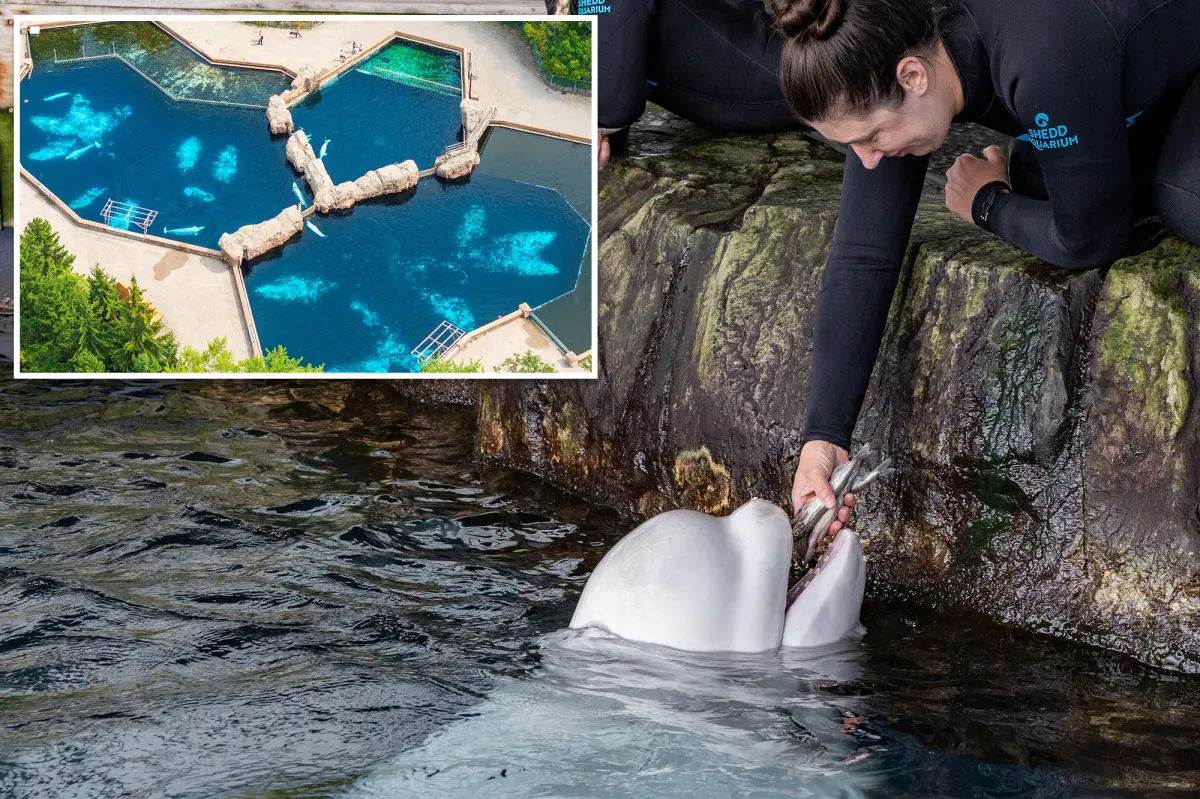
In the quiet, cavernous halls of Chicago’s Shedd Aquarium, a profound silence fell on Tuesday that no amount of bubbling water or ambient whale-song could mask. It was the silence of a heartbeat gone still. Peekachu, a 23-year-old beluga whale, had died. She wasn’t just an aquatic attraction; she was a traveler, a survivor of a crumbling Canadian amusement park, and an exhausted soul who had made a harrowing journey to a place that promised her safety. Despite the state-of-the-art veterinary care, the round-the-clock bedside vigil, and the fervent attention of the aquarists who had grown to love her, the young female succumbed. The immediate cause, as the aquarium disclosed, was a desperate battle against dehydration. In her final hours, caretakers attempted to rehydrate her with fluids and coax her with the comfort of food and medicine, but her body had reached its limit. The announcement came in a stilted, clinical press release, belying the raw, tear-streaked faces of the staff who had dedicated their lives to her wellbeing. She was blind in one eye, a handicap that made her navigation of the vast, unfamiliar pools even more challenging, and she had known a lifetime of struggle long before she ever arrived in the Windy City. In the fluorescent-lit quarantine bays, where the hum of filtration systems drowns out the outside world, grief was unavoidable. Peekachu was not a specimen on a manifest; she was a sentient being with a personality, a vocalization pattern, and a history of trauma that no amount of chlorine could wash away.
Peekachu’s story did not begin in Chicago. It began hundreds of miles away in the aging concrete pools of Marineland, a park located in Niagara Falls, Ontario, that had long been the subject of animal welfare scrutiny. As the park shuttered its doors in 2024, a colossal, logistical rescue mission was launched. Eight whales were destined for the Shedd. The transfer was a monumental feat of engineering—a spectacle of custom-made slings capable of cradling multi-ton marine mammals, hydraulic lifts hoisting them from the water, and temperature-controlled, specially designed containers that mimicked the humidity and chill of their native Arctic waters. Veterinarians monitored every breath, every heart flutter, while support vehicles crawled along the highways with the precious cargo. It was a high-stakes chess game where a single misstep meant disaster. The first wave of four whales arrived in July, and the second wave, including Peekachu, arrived earlier this month. For the Shedd’s team, the arrival of these whales was not just a routine transfer; it was a victory lap, a narrative of redemption juxtaposed against the dark legacy of a dying park. The team held their breath as the slings descended, gently lowering the whales into their temporary habitats, watching as their tails flicked in the unfamiliar, sterile water of the quarantine pools. There was hope that the vast, filtered tanks of Chicago would offer a rebirth—a chance to heal psychological wounds and rebuild the social bonds that had been fractured by a decade of neglect. The human effort involved was staggering, with dozens of specialists, from marine veterinarians to nutritionists and behavioral experts, all united by a single goal: to give these magnificent Arctic ghosts a second chance at life.
The urgency of this move was steeped in tragedy. Marineland’s history is a dark chronicle of animal care failures. Since 2019, a staggering twenty whales—nineteen belugas and one killer whale—had perished within the confines of that park, according to provincial government data gathered through freedom-of-information requests and official statements. The Canadian government, grappling with the ethical and practical fallout, made the momentous decision in January to approve the export of the remaining thirty belugas and four dolphins to new homes across North America and Europe. This relocation was framed as a race against time to prevent the wholesale euthanasia of these majestic creatures. They had to be moved, but moving them was itself a significant gamble. The Shedd Aquarium, with its reputation for research and captive breeding programs, was viewed as a safe harbor, yet the ocean between Marineland’s neglect and Chicago’s care was immense—not just in physical distance, but in psychological impact. Peekachu, like many of the transferred whales, carried the invisible scars of her previous life, one where public performance and cramped quarters took precedence over psychological enrichment and physical health. The choice was stark: leave the whales to languish in a shuttered park with dwindling resources, subject them to the immense stress of a 500-mile land journey to a stable, world-class facility, or face the unthinkable choice of putting them down. For the conservationists and the aquariums, the move was the only viable option, but it was a decision made with heavy hearts, fully aware of the physiological risks that translocation poses to such sensitive animals.
The Shedd’s team knew Peekachu required special attention from the moment she arrived. She was blind in one eye, a limitation that makes navigation and social interaction incredibly challenging for a species that relies heavily on echolocation to build a mental map of its surroundings. Belugas are among the most social of marine mammals, communicating through a complex symphony of clicks, whistles, and chirps to maintain cohesion within a pod. Peekachu reportedly had trouble socializing with her newly arrived companions—a natural consequence of her physical impairment and likely years of social isolation in a declining park. But initially, the prognosis seemed cautiously optimistic. Aquarium officials noted that Peekachu showed “early signs of progress” in the days following her arrival. She was exploring her new environment, responding to the veterinary staff, and perhaps finding the cooler temperatures and cleaner water to be a strange yet soothing relief. Her appetite seemed steady, and her swimming patterns indicated a growing curiosity about her new home. Then, without warning, the trajectory shifted drastically. On Tuesday, blood samples drawn as part of her routine care revealed a critical dehydration issue—her kidneys were failing to maintain the delicate osmotic balance necessary for life. The team sprung into action, initiating aggressive fluid therapy. They tried to encourage her to eat, offering her favorite, high-quality fish, hoping to coax her body back to strength. But the underlying stress of the translocation—the physiological cortisol dump, the disorientation of a new acoustic environment, and the sheer exhaustion of the journey—had taken an unstoppable toll. In a heartbreaking turn, she passed away right in the middle of that frantic, hopeful hour of treatment, surrounded by humans who would have done anything to pull her back from the brink.
Peekachu’s death sends a shockwave through the conservation community, forcing a reckoning with the wisdom of mega-transfers. While the intention was undeniably noble—to save her from a dying, negligent facility—the stress of translocation itself is a well-documented killer in cetaceans. Belugas are creatures of profound habit, thriving on the tightly knit bonds of their family units. Uprooting them, regardless of how gentle the sling or how precise the temperature control, disrupts their core sense of safety and can trigger a cascade of physiological failures, from suppressed immune systems to metabolic breakdowns. The Shedd has promised a full necropsy, committed to sharing the findings “as soon as we have one.” This scientific transparency is crucial, as it will allow other aquariums to learn from the tragedy and refine their own rescue protocols. Meanwhile, the remaining animals at Marineland, along with the other six whales now residing at the Shedd, are under a microscope of scrutiny. Animal rights groups will point to Peekachu’s death as a devastating indictment of the entire transfer plan, arguing that these intelligent creatures are far better suited for sea sanctuaries or protected ocean embayments rather than concrete tanks, no matter how sophisticated. Conversely, aquarium advocates will argue that the move was the only viable alternative to the euthanasia boat, and that Peekachu, despite her tragic end, experienced a level of veterinary care and attention in her final days that vastly exceeded anything she had seen in a decade at Marineland. The debate is stark and uncomfortable, exposing the hard reality that there are no perfect solutions when decades of neglect have already sealed an animal’s fate.
As the Shedd Aquarium processes its grief, the larger mission continues. Peekachu was one of eight whales transferred to Chicago, but the broader plan encompasses the remaining belugas and dolphins destined for the Georgia Aquarium in Atlanta, several SeaWorld locations spanning San Diego to San Antonio, and the Oceanografic Valencia in Spain. These vast institutions will absorb the legacy of Marineland, taking on not just the animals, but the weight of their history and the responsibility of their futures. For the human handlers at the Shedd, there is a profound sense of dashed hope. They will remember Peekachu not as a statistic in a relocation effort, but as a gentle, one-eyed whale who, despite her struggles, looked up at them with a flicker of recognition in her final days. Her short chapter in Chicago ended in tragedy, but her story serves as a poignant reminder of the fragile line between rescue and risk. In the end, the ocean is vast, but the concrete pools are small. The echoes of Peekachu’s song—if she ever sang in her new home—will fade into the background noise of the filtration systems. Yet, her death should not be written off as a mere logistical failure or a simple medical anomaly. It is a stark, humanizing reminder that these are sentient beings with delicate physiologies and deep emotional needs, and that every decision made on their behalf carries a crushing weight of responsibility. The necropsy will reveal the physical cause of her death, but the emotional cause—the silent scream of an upheaval too great, the trauma of a life spent in neglect, and the exhaustion of a final journey that proved too far—will remain the silent, tragic epitaph of a whale who almost made it.