






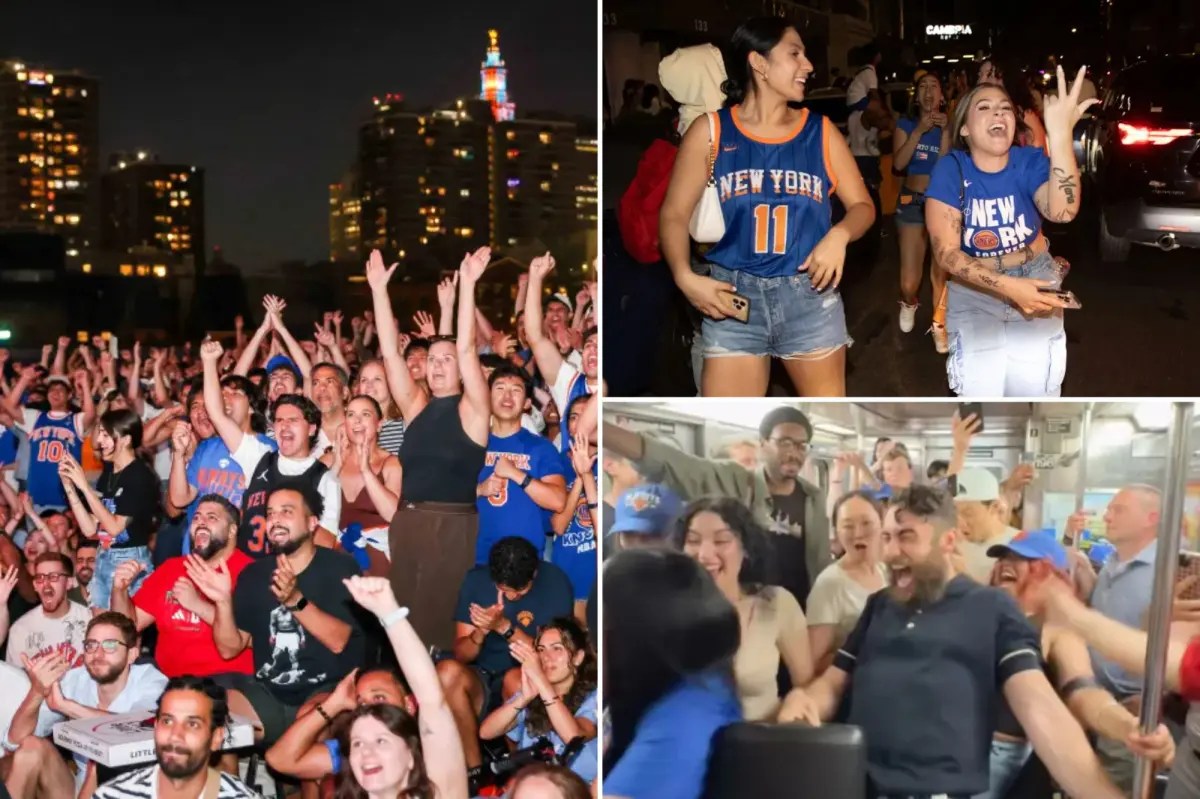
The historic championship run of the New York Knicks did far more than just break a decades-long sports curse; it shattered the invisible, pixelated walls that have silently isolated an entire generation of young New Yorkers. Born into an era of hyper-personalized technology and raised on algorithmic feeds, Gen Z has long been labeled as the most digitally connected yet socially isolated generation in human history. They are digital natives who have spent their formative years navigating the virtual world, often experiencing life through the sterile mediation of glass screens. But when the final buzzer sounded on that historic Saturday night, a profound and unexpected shift occurred across the five boroughs. For the first time in their lives, New York City’s younger demographic experienced a truly unifying, massive common cultural milestone in the physical world. Rather than retreating to their group chats or celebrating behind the safety of social media avatars, thousands of young adults spilled out of their cramped apartments and flooded the concrete streets in a breathtaking, spontaneous wave of collective ecstasy. The Knicks proved to a skeptical generation that “monoculture”—the rare phenomenon of an entire society sharing a single, powerful cultural experience—is not a dusty relic of the past, but a vital, living necessity. It was a milestone marked by a radical rejection of digital isolation, where ideological differences, political anxieties, and social backgrounds vanished into thin air, replaced by the simple, beautiful reality of neighbors rejoicing with neighbors in the flesh.
The sheer spontaneity of the celebrations transformed the legendary grid of New York City into a massive, open-air theater of human connection. No corporate sponsor or city organizer could have engineered the grassroots joy that blossomed on nearly every street corner. In Brooklyn’s Carroll Gardens, a local pizzeria became the heart of the neighborhood when a resident parked his Jeep on Smith Street, set up a television in the back, and broadcasted the game to an ever-growing, shoulder-to-shoulder crowd of cheering passersby. Meanwhile, in the West Village, a young resident equipped with nothing more than a projector, a blank brick wall, and a dream, turned’ 10th Street into a roaring stadium, attracting a sea of humanity that stretched back further than the eye could see. When the final victory was secured, the city erupted into a beautiful, chaotic symphony of shared humanity. Strangers who would typically avoid eye contact on the subway found themselves wrapped in sweaty, tearful embraces, jumping up and down on the pavement as if they had known each other for a lifetime. Subway cars and city buses were instantly transformed into rolling block parties, taken over by self-appointed DJs as passengers sang along in perfect unison to Jay-Z and Alicia Keys’ “Empire State of Mind.” Even those who stayed indoors couldn’t resist the magnetic pull of the moment, leaning precariously out of their brownstone fire escapes to bang pots and pans, wave orange-and-blue flags, and share high-fives with the jubilant crowds parading on the streets below.
For a generation that has grown up under the heavy weight of global crises, modern anxieties, and systemic divisions, this raw outburst of public joy felt like a monumental emotional release. Gen Z has spent years convening in public spaces primarily to voice frustration, march in protest, and stand up against injustice—gatherings born out of anger and necessity. But the Knicks’ victory offered something entirely different: a rare, precious opportunity to gather out of pure, unadulterated happiness. While smartphones did not disappear entirely from the scene, their purpose shifted dramatically; they were no longer tools for mindless, solitary scrolling, but digital eyes capturing a historic reality. Social media platforms like TikTok, normally filled with highly curated, cynical content, were flooded with shaky, authentic videos of block parties, captioned with emotional declarations of “full-body chills” and heartfelt claims that the city “felt like world peace.” The overwhelming sentiment among young adults was a deep sense of wonder at how easily the heavy armor of urban anonymity could be dropped. To embrace a total stranger in the middle of a crowded street, to share a shout of triumph with someone of a completely different generation or background, was a deeply humanizing experience that reminded everyone of the profound joy of being alive, present, and connected in a physical community.
This breathtaking display of unity highlights a deeper cultural shift, illustrating why the death of the shared cultural touchstone has left such a painful void in modern society. As Gen Z podcaster Sagnik Basu thoughtfully reflected in a viral video, sports have quietly become the last standing bastion of monoculture in our fragmented world. In the past, communities were bound together by shared media; families watched the same television broadcasts, listened to the same radio programs, and engaged with a mainstream culture that provided a common language. Today, however, our daily lives are heavily mediated by sophisticated algorithms designed to partition us into increasingly smaller, hyper-specific digital niches. We live packed like sardines in towering apartment buildings, yet we walk through the world separated by noise-canceling headphones, looking down at customized screens that display entirely different realities. The Knicks’ championship run effectively broke this algorithmic spell, forcing millions of people to look up, acknowledge one another, and care deeply about the exact same thing at the exact same moment. It proved that despite the convenience of the digital age, humans still possess an ancient, biological craving for large-scale collective experiences that transcend our individualized bubble, anchoring us to a geographic place and a shared human identity.
Of course, a celebration of this magnitude is rarely entirely peaceful, and a few chaotic incidents did spill over into the headlines, with a small fraction of unruly individuals causing property damage and minor disruptions in Times Square. Yet, these isolated events were mere footnotes compared to the vast, overwhelming majority of New Yorkers who gathered with kindness, respect, and a simple desire to share space with their fellow citizens. This urge to escape the digital panopticon and return to the physical world is not just a temporary reaction to a sports victory; it is the crest of a much larger, quietly growing counter-cultural movement among young people today. Weary of the superficiality of online interactions and the exhausting mental toll of constant digital connection, Gen Zers are actively seeking out analog ways to rebuild their social lives. They are trading the gamified, exhausting world of dating apps for local run clubs and blind dates set up by mutual friends. They are purchasing basic flip phones to free themselves from the tyranny of constant notifications, organizing cozy book clubs, and reclaiming physical “third spaces” like local cafes and parks. The euphoric celebrations in the streets of New York were simply the loudest and most triumphant expression of an entire generation finding its way back to the physical world.
As the city prepares to host the legendary ticker-tape parade running down the Canyon of Heroes, there is a palpable sense of anticipation that goes far beyond the boundaries of sports fandom. This historic parade represents one more invaluable opportunity for New Yorkers of all ages, heritages, and walks of life to stand shoulder-to-shoulder, look up at the falling confetti, and celebrate the magnificent, resilient, and beautifully chaotic metropolis they call home. It is a moment to fully solidify the beautiful lesson learned over these past few weeks: that we are at our happiest and most human when we are together, fully present, and actively participating in the world around us. The Knicks’ victory did not just bring a long-awaited trophy back to Madison Square Garden; it gave an isolated generation of young people a profound blueprint for how to live, how to connect, and how to find genuine joy in a fragmented world. It proved that despite the powerful pull of our screens, the human spirit still hungers for real-world triumph and authentic physical community. So when the music starts, when the streets of Manhattan fill once again with a sea of orange and blue, people will pocket their phones, look their neighbors in the eye, and lose themselves in the beautiful, unifying roar of the crowd.