





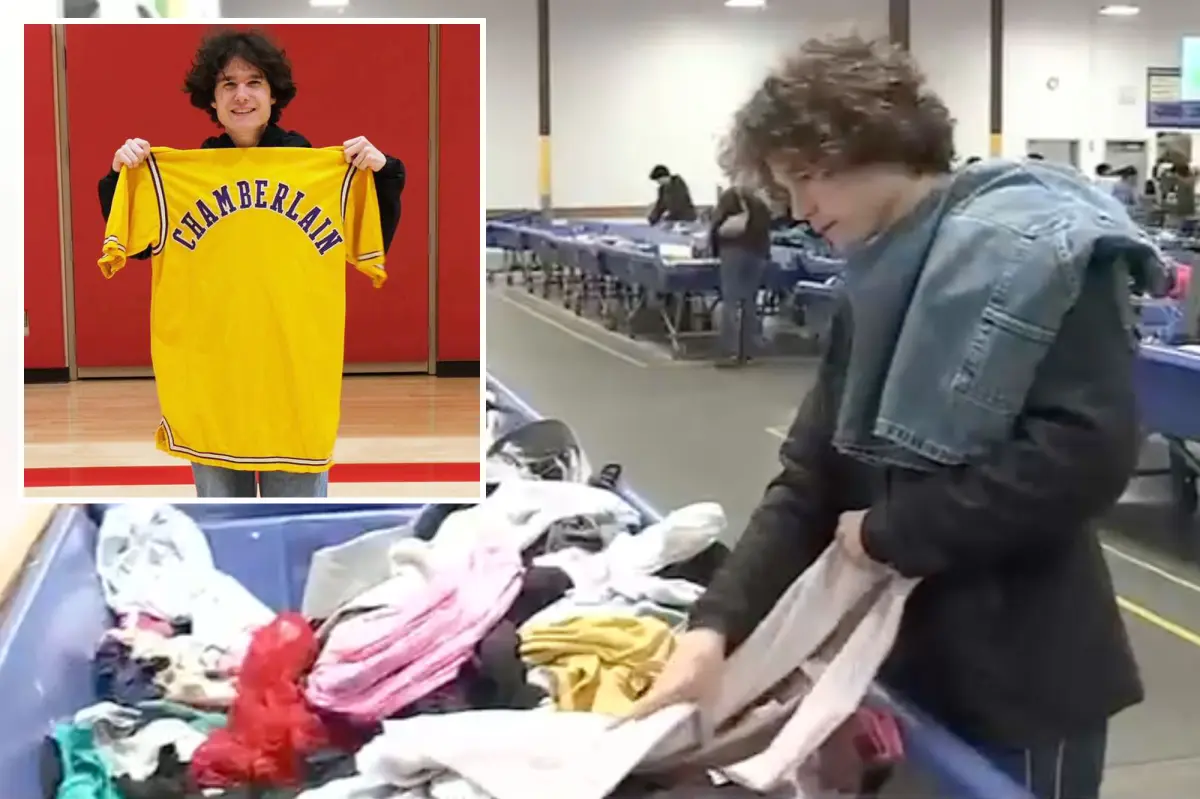
In the quiet, misty suburbs of Hillsboro, Oregon, nineteen-year-old Quinn Brown was embarking on what seemed like just another standard morning routine, unaware that a single, split-second decision would soon rewrite the trajectory of his entire life. To the uninitiated, the Goodwill Outlet is a place of sheer, unadulterated chaos—a sensory overload of massive, blue plastic rolling bins stacked to the brim with discarded household items, tangled garments, tangled electronics, and forgotten relics of the past where shoppers buy items strictly buy-the-pound. On this particular cold, overcast January morning, Brown was doing what he does best: scanning the sea of discarded fabrics with the practiced, hawk-like precision of an experienced reseller who knows how to spot premium quality and rare textures amidst the mountain of ordinary clutter. As he maneuvered through the bustling crowd of bargain hunters, seasoned flippers, and families looking for affordable goods, his eyes caught a flash of vibrant gold and deep, royal purple. Another customer had just reached into a newly wheeled-out bin, momentarily lifting a heavy, vintage-looking knit jacket before decide it wasn’t to his taste and inexplicably throwing it back down onto the pile, right in front of Brown. Instantly acting on a deeply ingrained intuition developed through years of scanning racks and trusting his gut, Brown lunged forward and claimed the heavy garment, feeling the unique weight of history woven into its very threads. It was a classic, vintage Los Angeles Lakers warm-up jacket, looking surprisingly pristine and untouched by time despite the decades that had passed since it was last worn on a professional basketball court. Without hesitating, he placed it in his cart and continued his hunt, and when he finally checked out at the register, the scales measured the garment at a meager price of just $3.07. To anyone else, it was merely an outdated piece of old athletic wear, but to the teenage thrifter, it felt like holding a lightning bolt of pure, unfiltered nostalgia that demanded closer inspection.
This was no ordinary piece of vintage sportswear; it was a physical testament to one of the most towering and mythological figures in the history of American athletics: Wilt Chamberlain. Known affectionately as “Wilt the Stilt” or “The Big Dipper,” Chamberlain was an utterly dominant player who redefined the limits of what a human being could achieve on a basketball court, leaving behind records that still stand completely untouchable to this day. The gold-and-purple warm-up jacket that Brown held in his hands was a relic from the ultimate twilight of Chamberlain’s legendary career—specifically worn during the iconic 1972 NBA Finals and throughout his final, triumphant 1972-73 season with the Los Angeles Lakers. During this magnificent era, the Lakers were a cultural phenomenon, capturing the hearts of millions of basketball fans and solidifying their place in sports history with an unforgettable, dominant championship run. This specific jacket had wrapped around the broad, seven-foot-one-inch frame of Chamberlain as he stood on the sidelines of the Forum, preparing to dominate the court and secure his championship legacy alongside other legends of the game. The thought of this legendary, oversized garment somehow making its way from the glamorous, high-stakes, star-studded arenas of Southern California to a dusty, low-cost donation bin in the rainy Pacific Northwest is a beautiful, baffling mystery in itself, representing a quiet, fifty-year journey through time where an item of immense cultural and historical value was nearly lost to the trash heaps. It carried the sweat of a champion, the tension of high-stakes play-offs, the cheers of roaring stadium crowds, and the quiet determination of a giant, making it a sacred artifact of basketball royalty that had silently survived the passing of decades.
Sensing that he had stumbled upon something far more profound than a standard retro find, Brown decided to share his remarkable discovery with the world, posting a simple photograph of the jacket on his Instagram account to gauge the reaction of fellow collectors and see if anyone could recognize its origins. The image quickly caught the discerning eye of specialists at Sotheby’s, one of the world’s oldest and most prestigious auction houses, who immediately recognized the potentially historic nature of the Lakers garment and arranged for it to be securely shipped to their headquarters in New York City for formal valuation. There, the jacket underwent a rigorous, highly scientific forensic verification process known as photo-matching, conducted by the premier authentication service SIA Photo Match. Experts spent hours meticulously analyzing every single thread, sewing alignment, tag crease, and slight fiber variation visible on the physical jacket, comparing them side-by-side with high-resolution historical images from the 1972 and 1973 NBA seasons. The results were nothing short of breathtaking: the jacket was indisputably verified as the exact one worn by Chamberlain during the 1972 NBA Finals, a series that defined his career. This revelation carried a staggering emotional and financial significance, as the very game jersey Chamberlain wore beneath this jacket during those finals had previously sold at auction for an astronomical $4.9 million. Armed with this undeniable proof of historical authenticity, Sotheby’s officially placed the warm-up jacket on the auction block, estimating its final sale price to land somewhere between a life-altering $150,000 and $250,000, turning a three-dollar thrift store gamble into a financial masterpiece that would capture the attention of national news outlets and sports collectors worldwide.
For Quinn Brown, this extraordinary, life-changing windfall was not merely a stroke of blind, unearned luck, but rather the ultimate validation of a relentless work ethic and an entrepreneurial spirit he had nurtured since his early high school days. He began buying and reselling thrifted goods as a junior in high school, quickly realizing that he possessed a natural knack for identifying hidden value in things others had discarded as worthless junk. What started as a fun, part-time hobby to earn a little extra gas money soon blossomed into a highly sophisticated, full-time business, with the industrious teenager successfully completing more than 10,000 online sales over the course of just three years. Despite a grueling schedule that requires him to spend fifteen to twenty hours every single week digging through dusty bins, sorting through mountains of musty shirts, and packaging orders, Brown’s genuine passion for the thrill of the hunt has never once waned. He is not merely a businessman; he is a genuine, old-school sports enthusiast whose love for the game and its history goes far deeper than the potential profit margins of his online store. In a beautiful twist of fate, on his bedroom dresser sits a well-worn biography of Wilt Chamberlain and a vintage basketball card of the legend that was gifted to him by a close friend—ironic tokens of personal admiration that he owned long before he ever laid eyes on the multimillion-dollar warm-up jacket. His ultimate dream as a fan is not just to make money, but to find vintage, wearable Wilt Chamberlain t-shirts to proudly wear in his daily life, demonstrating a level of humility and authentic passion that keeps him beautifully grounded despite his sudden brushes with extreme wealth and sudden fame.
The magical narrative of Brown’s discovery highlights a broader, deeply human movement in modern society: the rise of thrift culture as both an economic lifeline and a physical form of storytelling. In an era dominated by cheap fast fashion, mass assembly lines, and disposable consumer goods, secondhand shopping has evolved from a budget-conscious necessity into a thrilling, community-driven quest to preserve history and celebrate human individuality. As Hayley Platt, the public relations manager for Goodwill Industries, beautifully articulated, Quinn’s journey serves as the absolute pinnacle of what makes shopping at Goodwill so magical, proving that inside these humble retail spaces, everyday people can uncover genuine historical treasures that change their lives. It is a story that resonates with those who have ever dreamed of finding a hidden map, a message in a bottle, or a fortune hidden in plain sight, transforming the mundane chore of shopping into an adventure filled with endless, starry possibilities. Goodwill stores, which primarily operate to fund community job training programs and support local economies, become modern-day archaeological digs where the forgotten belongings of past generations find new life in the hands of the young and passionate. This narrative beautifully reframes our relationship with physical objects, reminding us that items of great beauty, history, and financial worth are often sitting quietly on dusty shelves, simply waiting for someone with the right eyes, the right heart, and the right curiosity to rescue them from obscurity and share their stories with the world.
As the highly anticipated auction progressed, drawing intense global attention and competitive bidding from elite sports collectors around the world up until its closing date in late July, the reality of his impending fortune began to truly set in for the humble nineteen-year-old. Rather than letting the sudden influx of wealth cloud his young judgment or lead to frivolous spending, the remarkably mature Brown has expressed a clear, wise vision for his future, planning to carefully save and invest every penny of the proceeds to secure his long-term financial independence. He harbors the incredible, almost unfathomable dream of using this historic windfall to pave the way for an early retirement, allowing him to pursue his creative passions, travel the world, and continue exploring the vintage archiving community without the crushing weight of traditional financial strain. Yet, despite the massive payday hovering on his horizon, it is highly unlikely that Brown will ever truly walk away from the deep thrill of the hunt that brought him to this point in the first place. The intoxicating joy of digging through a fresh bin of clothes, the sensory smell of vintage cotton, and the shared camaraderie of the thrift store floor are too deeply woven into his identity to be easily abandoned for a life of leisure. As he moves forward into this exciting new chapter of his young life, Quinn Brown stands as a shining beacon of hope for young dreamers everywhere, proving that sometimes, with a little bit of patience, a keen eye, and a humble three-dollar bill, you can hold the greatness of legends in your hands and change your destiny forever.