



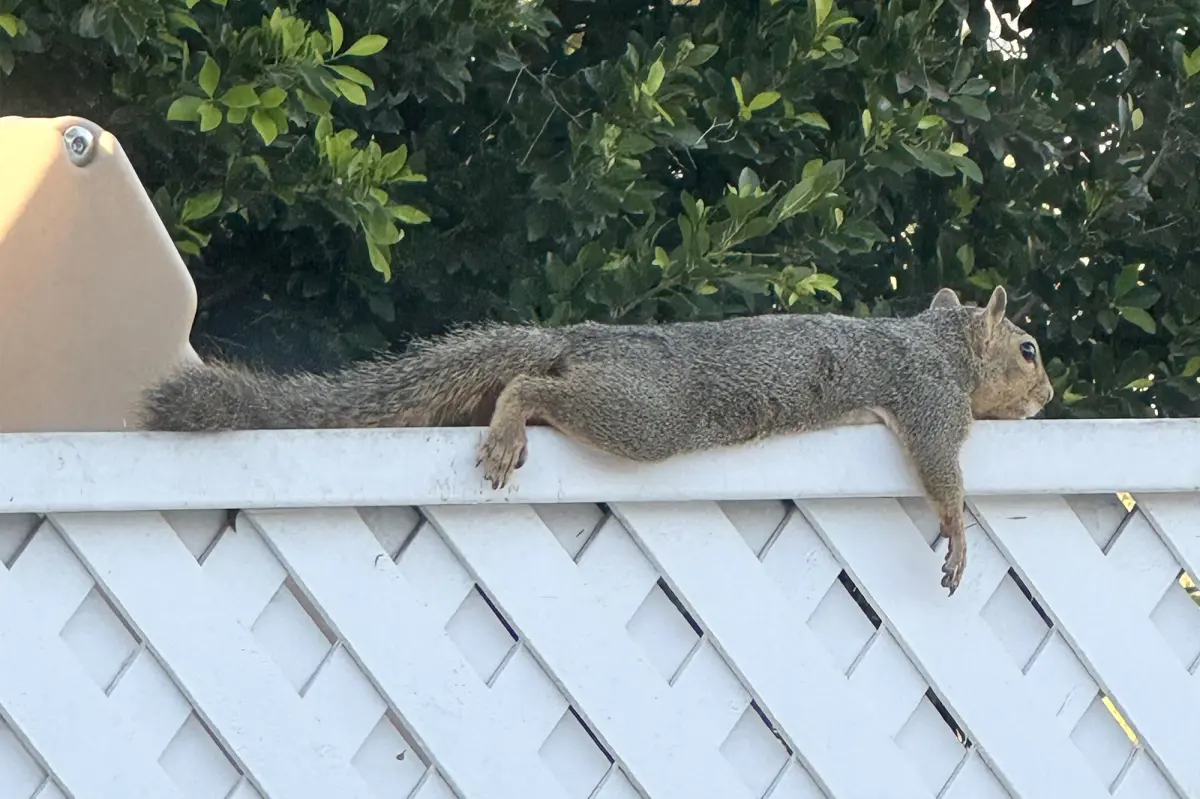
It starts with a strange, almost comic sight: a squirrel lying completely flat on its belly, legs splayed out behind and in front, face pressed against the concrete, looking for all the world like a tiny, furry pancake that has just been dropped from a great height. In Southern California, where a merciless heat wave has turned the region into a shimmering oven, these bushy-tailed acrobats have decided that dignity is overrated. Instead of darting through trees or chattering at dogs, they are surrendering to the sun by stretching themselves across railings, patios, sidewalks, and any patch of shade they can find. Los Angeles residents, initially startled and then utterly delighted, have flooded social media with photographs of these defeated-looking rodents. The images show squirrels in every imaginable pose of surrender: some with their little paws stretched forward, others with their tails limp, and many looking as if they have simply given up on the summer and all its demands. It would be easy to mistake them for roadkill, but these squirrels are very much alive—they are just hot, tired, and absolutely unwilling to pretend otherwise. In a city known for its celebrities, the latest stars to capture the public’s heart are not actors or musicians, but these flattened little survivors, and they have become overnight icons of a shared struggle against the sweltering heat.
The behavior has a name, one that sounds almost as silly as the pose itself: it is called “splooting,” and it is a masterclass in animal thermoregulation. When a squirrel sploots, it presses its entire belly against a cooler surface, stretching its body out as far as possible to maximize contact with the ground. The strategy is simple but brilliant. Mammals tend to have less fur on their undersides, which means the skin on the belly is closer to the surface and better suited for heat exchange. By lying flat on a cool patch of pavement, a shady rock, or a concrete patio, the squirrel essentially uses the earth as a natural cooling pad. The heat from its body flows downward, into the cooler material, and the overheating rodent gets a refreshing, life-saving sense of relief. It is the animal equivalent of pressing your face against a cold window on a scorching day, or lying on a tile floor after a long walk in the sun. The ground acts as a heat sink, drawing warmth away from the animal’s core and helping it maintain a safe body temperature. Far from being a sign of distress or injury, splooting is a calculated, evolutionary adaptation—a clever trick that has allowed squirrels and many other animals to endure extreme temperatures without suffering the worst consequences of heat exhaustion. It might look ridiculous, but it is actually a testament to nature’s ingenuity, a quiet reminder that even the smallest creatures have developed remarkable ways to survive in a world that keeps getting hotter.
The internet has responded to Southern California’s splooting epidemic with all the enthusiasm you would expect from a community that loves both animals and gentle absurdity. On Sunday, a Reddit user posted a photograph of a flattened squirrel with the succinct, perfect caption: “It’s hot, y’all.” That single image, and those four words, captured the spirit of the moment—a shared acknowledgment that the heat is unbearable, and that sometimes the only reasonable response is to lie face-down and wait for mercy. The post exploded. It received thousands of upvotes, and the comments section quickly filled with people sharing their own photographs, their own stories, and their own heartfelt appreciation for the splooting squirrels. “I’ve got three in my backyard right now!” one commenter wrote, their excitement practically visible through the screen. “The squirrels have all had it with this heat,” another declared, summing up the collective mood. Someone else shared a photo of a squirrel at Hollywood Forever Cemetery, the iconic Los Angeles burial ground, where even a cemetery squirrel had apparently decided that the heat was making mortality feel a little too close for comfort. The pictures kept coming, each one funnier and more endearing than the last. There were squirrels frozen in place on wooden fences, squirrels spread across brick walkways, squirrels draped over porch railings like tiny, furry towels. And through it all, the humans of Los Angeles found a strange sense of companionship. In a city where temperatures were soaring into triple digits, where the air conditioning was working overtime, and where people were struggling to go about their daily lives, these splooting squirrels became a symbol of the moment—a reminder that everyone, human or animal, was going through the same hot, exhausting, ridiculous experience together.
But the squirrels are far from alone in their splooting habit. They are simply the most visible, and perhaps the most photogenic, members of a much larger club. Dogs, cats, rabbits, and even bears have all been observed striking the same belly-to-the-ground pose when temperatures spike. It is a universal language of overheated mammals, a shared strategy that crosses species lines. If you have ever seen a dog sprawled out on a kitchen floor after a walk on a hot day, you have witnessed splooting. If you have seen a cat melting into a patch of shade on a sunny windowsill, you have witnessed splooting. The behavior is so common that wildlife experts have a name for it, and they have studied it carefully to understand how different animals cope with rising temperatures. The physiology is the same across species: the less fur on the belly, the better the heat transfer. By flattening themselves against the ground, animals can shed body heat much more efficiently than by standing, sitting, or curling up. They also expose their less insulated body parts to the cooler surface, allowing blood vessels close to the skin to release heat more effectively. In a world where climate change is making heat waves more frequent and more intense, these behaviors are becoming increasingly important—not just for the animals, but for anyone who cares about their survival. Watching a squirrel sploot is not just entertaining; it is a glimpse into the extraordinary resilience of wildlife, an adaptive response that has likely existed for thousands of years but is now becoming a more common sight in our urban landscapes as temperatures climb.
This particular sploot-fest comes at a moment when Los Angeles is being roasted alive. Downtown Los Angeles, Long Beach, and Burbank all reached triple-digit temperatures over the weekend, shattering records and making life miserable for residents and animals alike. The National Weather Service issued heat advisories stretching across Southern California through Thursday, with forecasters warning that conditions could remain oppressive well into October. Inland communities, already more accustomed to heat than the coastal neighborhoods, were bracing for the most extreme numbers, with some areas expected to push past 105 degrees Fahrenheit. The heat wave is not just uncomfortable; it is dangerous. Hospitals across the region have reported an uptick in heat-related illnesses, and officials are urging people to stay indoors, drink plenty of water, and check on vulnerable neighbors. As the sun blazes down and the air grows thick and heavy, even the most dedicated sunbathers are abandoning the outdoors, leaving the streets, parks, and sidewalks to the wildlife—and to the squirrels, who have apparently decided that the best way to deal with the heat is to embrace it, quite literally, with every inch of their furry bodies. The forecast offers little relief, with forecasters warning that a high-pressure system is parked over the region, refusing to budge and trapping hot air like a lid on a pot. For a city that is no stranger to warm weather, this stretch of days has become a test of endurance, a reminder that the changing climate is not a distant threat but a present reality.
And yet, in the midst of all this discomfort, there is something unexpectedly heartwarming about the splooting squirrels. They have given Los Angeles a moment of shared laughter, a chance to look at one another and say, “Yes, this is absurd, and yes, we are all in this together.” The photographs flooding social media are not just silly pictures; they are a form of community bonding, a way for people to find connection and comfort in the middle of a miserable heat wave. They remind us that animals, like humans, are just trying to get through the day, and that sometimes the best we can do is lie flat on our bellies and take whatever relief we can find. There is a lesson in the humble sploot—a lesson about the power of adaptation, the importance of humor, and the simple, stubborn will to survive. As Southern California braces for more blistering days, residents and squirrels alike are finding their own ways to cope. For humans, that might mean cranking the air conditioning, heading to the beach, or drinking an extra glass of cold water. For the squirrels, it means finding the shadiest, coolest spot they can, stretching out as far as they can, and refusing to let the heat win. They are not giving up; they are adapting. They are not defeated; they are resting. And in their hilarious, belly-down, paws-out poses, they are showing all of us a small but powerful truth: when the world gets too hot to handle, the best thing you can do is slow down, stay low, and find whatever comfort you can—even if it means becoming a furry pancake for a few precious hours. So the next time you see a splooting squirrel in your yard, in a park, or on a Reddit feed, take a moment to appreciate the resilience and humor that they bring to this sweltering season. They are not roadkill. They are not in trouble. They are simply Californians, coping with the heat in the most natural way they know, and inviting us all to join them in a collective sigh of surrender and solidarity.