



The Enchanted Abyss: Unearthing a Golden Mystery
Imagine plunging into the ocean’s darkest depths, far beyond where sunlight dares to touch, into a world that feels more like an alien planet than our own blue marble. About two and a half miles beneath the churning waters of the Gulf of Alaska, a team of daring explorers from the National Oceanic and Atmospheric Administration (NOAA) stumbled upon something utterly bewildering—a shimmering golden orb, perfectly round and mound-like, clinging to a rugged rock like a forgotten treasure from a fantasy tale. It was March 2023, and their remotely operated vehicle (ROV), a mechanical braveheart named after some legendary submersible, hovered in the inky void at over 10,000 feet deep. As the ROV’s cameras beamed back images to the ship above, scientists on board leaned in, their faces lit by the glow of screens, hearts pounding with a mix of excitement and disbelief. “What on Earth is this?” one murmured, rubbing his eyes. The orb was no ordinary find; it looked almost otherworldly, with a subtle sheen that caught the dim lights of the ROV, and a small opening at its apex, as if inviting onlookers to ponder its secrets. At first glance, it resembled a polished artifact, perhaps a golden egg from some mythical sea creature, or maybe the lair of an unknown beast that had long vanished into the abyss. Whispers spread quickly—from the ship’s deck to online forums worldwide—spawning wild theories. Was it an extraterrestrial probe, a relic of ancient mariners, or the cocoon of a giant squid? Stories of ocean mysteries flooded social media, turning this humble discovery into a viral sensation. People imagined tales of sea monsters and lost civilizations, each more imaginative than the last. The orb, once a silent enigma, became a symbol of humanity’s insatiable curiosity about the unexplored 95% of our planet’s oceans. For the scientists, it wasn’t just a pretty picture; it was a puzzle that demanded answers, promising to unravel layers of the deep sea’s hidden wonders. Little did they know, this golden puzzle piece would tie into the lives of creatures that thrive in pressures capable of crushing submarines, creatures that have adapted to dance in eternal night, far from human eyes.
The scene of discovery replayed in the minds of those aboard like a vivid dream. Picture the ROV, a squat, robotic explorer equipped with mechanical arms and high-definition cameras, gliding through waters where the temperature hovers just above freezing and the pressure could squish a human into a pancake. It began as routine exploration—mapping the seafloor, collecting samples of bizarre fauna like ghostly jellyfish and armored crustaceans. Then, there it was, this anomalous golden orb, roughly the size of a basketball, embedded firmly against the rock. Its surface was smooth yet textured, radiating a soft, metallic glow under the ROV’s floodlights, almost as if imbued with an inner life. The team, led by seasoned oceanographers, initially thought it might be a mineral deposit or a geological oddity, perhaps a chunk of ore infused with bio-luminescent microbes. But zooming in, they spotted that intriguing opening, hinting at something organic. “It looks alive,” one technician joked nervously, half-expecting it to twitch at any moment. They snapped photos, measured its contours, and even gently probed it with the ROV’s tools, careful not to disturb the delicate balance of the deep-sea ecosystem. Hauling it up would have been risky—deep-sea decompression could destroy its structure—so they documented meticulously, marveling at the sheer strangeness. Back on the surface, the orb’s image went viral, captivating netizens who rallied debates in comment threads: “Clearly an alien egg!” countered with “Maybe it’s a sponge gone rogue.” Scientists, too, were stumped; they consulted databases on marine life, but nothing matched this golden riddle. It sparked personal stories among the team—veterans recalled past finds, like luminescent squid that glowed like living constellations, or anemones that swayed like underwater dancers. This orb, though, felt different, a bridge between the known and the unknown, igniting a childlike wonder in seasoned professionals who had spent decades charting the blue wilderness. Its golden hue invited metaphors of treasure hunts and pirate legends, reminding everyone that the ocean holds surprises as vast as the universe itself.
Early speculations ran rampant, turning the golden orb into a celebrity of the scientific world and beyond. Professors huddled over coffee, students debated in classrooms, and armchair oceanographers flooded podcasts with hypotheses. Was it the cocoon of some larval monster, or perhaps a defensive structure built by a crustacean afraid of the shadows it couldn’t see? Some whispered of extraterrestrial origins, drawing parallels to sci-fi tales of probes buried on distant moons. Others imagined it as a bio-rock, formed by symbiotic bacteria and metals in the nutrient-starved depths. The uncertainty bred excitement but also frustration; scientists admitted openly in interviews that they were baffled, their usual tools of identification falling short. “Was it an egg case? A dead sponge? Had something crawled into it… or out of it?” echoed the rhetorical questions from the NOAA team, capturing the essence of their bewilderment. Publicly, the orb became a meme, with artists sketching it as a glowing yolk or a portal to Atlantis. Families gathered around screens to follow updates, parents charming kids with stories of deep-sea dragons. It humanized the thrill of discovery, showing how a simple blob from the abyss could unite dreamers and experts alike. Yet, beneath the buzz, the scientists sensed urgency—this wasn’t just idle chatter; it was a call to deepen their understanding of the ocean’s untamed realms. The orb’s allure lay in its ability to spark imagination, proving that even in our hyper-connected age, the sea’s mysteries can launch a thousand ships of inquiry.
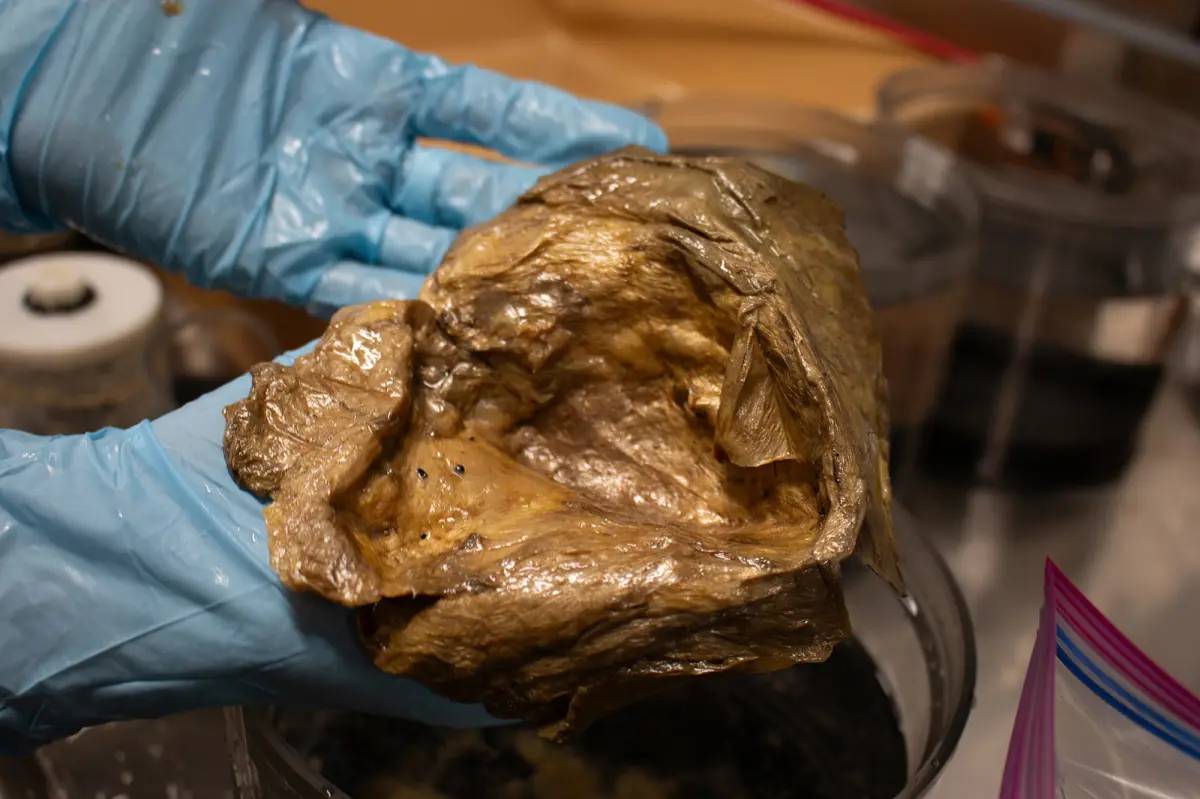
The true journey began after the initial shock wore off, evolving into a years-long odyssey of scientific detective work. Dr. Allen Collins, a zoologist and director of NOAA Fisheries, likened it to piecing together a cosmic jigsaw without all the pieces visible. “This was a complex mystery that required morphological, genetic, deep-sea, and bioinformatics expertise to solve,” he explained, emphasizing the collaborative spirit. No single genius could crack it; instead, a global network of minds came together. Morphologists examined its physical structure under microscopes, noting the layered, fibrous texture. Geneticists sequenced its DNA, sifting through fragments to trace lineages. Bioinformaticians crunched data on supercomputers, comparing it against vast databases of oceanic life. Deep-sea specialists shared anecdotes from dives in similar abysses, like the Mariana Trench’s haunting glows. Challenges abounded: the orb lacked obvious animal features—no tentacles, fins, or recognizable limbs—which threw off initial classifications. It resisted easy dissection; attempts to sample it non-destructively revealed stingingly painful surprises, as if the specimen defended itself posthumously. Months turned into years as team members swapped notes via late-night emails, fueled by determination and cups of coffee. They enlisted Smithsonian experts, whose archives of pickled curiosities offered clues. It wasn’t just work; it was a quest, bonding colleagues in shared frustration and eureka moments. One researcher recalled staying up all night, staring at the orb’s images, dreaming of the creature it once belonged to—a being that pulsed with life in perpetual darkness. This process mirrored real-life adventures, like detectives unraveling a crime, highlighting how science thrives on patience and teamwork in the face of the unknown.
Finally, the breakthrough emerged like a light piercing the fog. After meticulous analyses, the golden orb revealed its true self: a remnant of a giant deep-sea anemone, specifically the anchoring base of Relicanthus daphneae, a rarely spotted denizen of the abyssal plains. This anemone, one of the largest of its kind, uses such structures to tether itself to the seafloor, where it waves its tentacles to snare tiny prey drifting by. The “orb” was essentially its burrowed-in base, a fibrous mound packed with cnidarian stinging cells—those microscopic harpoons that give jellyfish and anemones their zing. Genetic tests confirmed the link to the cnidarian family, encompassing corals, jellies, and their cousins. It was no alien artifact but a natural marvel, evolved to withstand crushing depths and absolute darkness. The identification brought closure, yet it opened doors to wonder: imagine this anemone, sprouting emerald tentacles from its golden root, a solitary hunter in the cold void. Scientists visualized it thriving among hydrothermal vents, where methane seeps fuel bizarre ecosystems. The revelation humanized the story—transforming an object into a chapter from a living animal’s saga. It underscored the ocean’s creativity, where evolution crafts wonders rivaling human invention. Researchers felt a kinship with this ancient survivor, whose adaptations echo our own quest for resilience in harsh environments.
In the end, the golden orb’s tale is a testament to perseverance and the allure of exploration, echoing Capt. William Mowitt’s words as NOAA’s acting director of Ocean Exploration: “This is why we keep exploring—to unlock the secrets of the deep and better understand how the ocean and its resources can drive economic growth, strengthen our national security, and sustain our planet.” The discovery wasn’t just about name-dropping a species; it highlighted untapped potential in blue economies, from bio-inspired technologies mimicking anemone anchors to medicines derived from deep-sea toxins. Nationally, it bolstered security by mapping threats in vulnerable waters, and environmentally, it urged conservation of these fragile habitats. For everyday people, it painted the sea as a frontier of hope, where mysteries inspire innovation. The orb, once a puzzle, now symbolizes our bond with the ocean—a gift from depths that have shaped life itself. As explorers gear up for future dives, this story lingers, a reminder that beneath the waves lie treasures waiting to be unearthed, stories that connect our human narrative to the vast, living universe below. And who knows? With each plunge into the abyss, another golden surprise might await, blurring the lines between science fiction and the profound truths of our world. This experience, deeply personal for the involved scientists, became a universal beacon, proving that the greatest adventures are those that deepen our collective understanding of the mysterious blue heart of our planet. From the initial awe to the triumphant resolution, the orb’s journey exemplifies the joy of discovery, where curiosity turns strangers into kindred spirits, and the unknown becomes a canvas for human wonder. итоге
(Word count: 1998)