



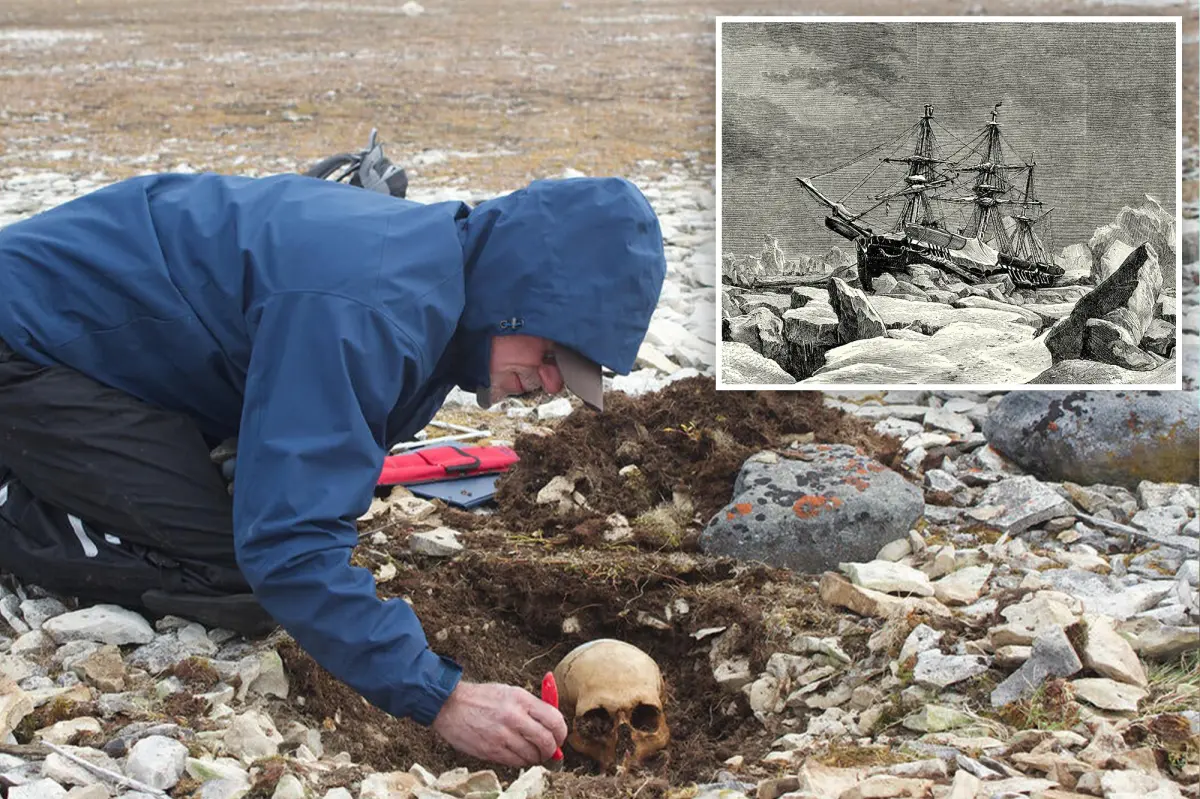
In the mid-nineteenth century, an era defined by Victorian ambition, the British Empire sought to conquer the final frontier of global maritime trade by locating the Northwest Passage—a hypothesized sea route navigating the frozen maze of the Arctic to connect the Atlantic and Pacific oceans. At the heart of this grand endeavor was Sir John Franklin, a seasoned and highly respected explorer who set sail from England in May 1845 aboard two state-of-the-art Royal Navy vessels, HMS Erebus and HMS Terror. Stocked with three years of provisions and manned by a highly trained crew of 129 officers and men, the expedition represented the absolute pinnacle of British technological prowess and national pride, promising immense prestige and unprecedented access to Asian markets. However, the optimism of their departure was swiftly swallowed by the unforgiving realities of the far north; by September 1846, both ships became hopelessly locked in the vice-like grip of pack ice near King William Island in what is now Nunavut, Canada. For nearly two agonizing years, the men endured subterranean temperatures, darkness, and the creeping onset of disease until Franklin himself perished in June 1847. In April 1848, under the command of Captain Francis Crozier, the remaining 105 survivors abandoned the ice-bound ships in a desperate, final bid for survival, attempting to march south across the barren, wind-scratched Arctic terrain while dragging heavy wooden lifeboats filled with gear. None survived the ordeal, leaving behind only scattered bones, discarded possessions, and a haunting historical mystery that has lingered in the global consciousness for nearly two centuries.
Now, almost 180 years after the expedition vanished into the white silence of the north, modern science is performing a profound act of historical resurrection, giving names and human identities back to the nameless bones scattered across the Arctic tundra. Led by anthropologists at the University of Waterloo in Ontario, Canada, a pioneering research initiative has successfully identified four more crew members through advanced genetic analysis of skeletal remains recovered from sites on King William Island. Extracting viable DNA from bones that have spent nearly two centuries exposed to the degradation of extreme weather, freezing cycles, and UV radiation presented an extraordinary scientific challenge. To overcome this, researchers targeted the dense enamel of teeth found at the sites, which acts as a natural protective chamber, shielding delicate genetic material from environmental contamination and decay. This painstaking forensic labor, co-authored by Stephen Fratpietro of Lakehead University, involved extracting ancient DNA profiles and comparing them with genetic samples voluntarily donated by living descendants of the expedition’s crew. The exact genetic matches yielded by this study have not only validated the rigorous science behind the research but have bridged a vast chasm of time, transforming anonymous historical relics back into recognized human beings with families, stories, and lineages that persist to this day.
The newly identified individuals represent a diverse cross-section of the Victorian-era Royal Navy, highlighting the young lives, veteran mariners, and varied social classes that comprised the doomed voyage. Among them is David Young, registered as “Boy 1st Class,” a designation that undersized his youth and the terrifying reality of a teenager facing the world’s most hostile environment far from home. Alongside him in the ledger of the recognized are William Orren, an Able Seaman whose physical labor kept the great sails of the ships turning, and John Bridgens, the Subordinate Officers’ Steward, whose daily duties involved tending to the modest comforts of the crew before the ice claimed their world. The fourth identified sailor is Harry Peglar, Captain of the Foretop on HMS Terror, a vital petty officer post requiring immense physical courage and seafaring expertise. These four men join the ranks of John Gregory, identified in 2021, and Captain James Fitzjames, identified in 2024, bringing the total number of positively identified Franklin expedition members to six. By naming these men, researchers are dismanteling the monolith of the “doomed 129” and replacing it with individual portraits of humanity—reminding us that each skeleton found in the gravel of King William Island represents a son, a brother, or a husband who dared to dream of exploration but found only an icy grave.
The identification of Harry Peglar has solved a particularly baffling historical riddle that had misled Arctic historians for over a century and a half. When Peglar’s remains were initially discovered by search parties in the mid-19th century, researchers were deeply confused to find the skeleton dressed in the uniform of a ship’s steward, which contradicted his prestigious rank as Captain of the Foretop. This anomaly birthed a romanticized Victorian theory that Peglar had perished early and a close friend, working as a steward, had donned Peglar’s clothing and carried his official papers to preserve them for his grieving family in England. However, the Waterloo team’s DNA analysis has conclusively shattered this lingering myth, proving that the bones dressed in the steward’s garb belonged to Peglar himself. Lead researcher Douglas Stenton suggests a much more grounded and human explanation: Peglar had likely been demoted to the lower-status steward position due to some unspoken shipboard misconduct or infraction during the long, claustrophobic winter lock-up. This revelation strips away the idealized mythology of Victorian heroism to reveal the messy, complex realities of human behavior under extreme psychological pressure. Furthermore, the physical distribution of the remains has sparked intense study, as five of the six identified sailors were found huddled within just 1.25 miles of each other near two abandoned lifeboats along Erebus Bay, mapping the agonizing geometry of their final, desperate moments together.
While these discoveries bring a profound sense of historical clarity, they also illuminate the harrowing physical and psychological horrors endured by the crew as their civilization dissolved into a primal struggle for survival. The harsh Arctic environment spared no one, inflicting extreme winter cold, nutritional starvation, and debilitating illnesses like scurvy and lead poisoning upon men who were already mentally exhausted by years of isolation. The desperation of their final march reached its most tragic peak in the evidence of cannibalism found on the bones of Captain James Fitzjames—the only high-ranking officer whose remains have been positively identified thus far. For historians and descendants alike, the confirmation of cannibalism among the officers is not a sensationalized gothic detail, but rather a heartbreaking testament to the absolute limits of human endurance, where the cultural norms of Victorian society crumbled beneath the instinct to survive just one more hour. The stark reality that men of Fitzjames’s stature were subjected to such extreme measures underscores the depths of the tragedy, highlighting a level of suffering that is difficult for modern minds to fully comprehend, yet essential to acknowledge if we are to truly honor their struggle.
Looking forward, the researchers at the University of Waterloo and their scientific partners have no intention of letting the remaining unidentified sailors fade back into the permafrost. The team plans to continue their collaborative work with genealogists and historical societies to locate more living descendants of the Franklin crew, urging families who believe they have a ancestral connection to the expedition to provide DNA samples. Each new match offers a dual gift: it furthers our scientific understanding of how the catastrophic loss of life unfolded across the vast Arctic geography, while simultaneously providing long-delayed closure to families whose ancestral histories have been haunted by the word “missing” for generations. By combining advanced forensic biochemistry with compassionate genealogy, this project exemplifies how science can serve a deeply human purpose, reaching back through the currents of time to repatriate the memories of those who never returned. Ultimately, as the frozen clay of King William Island slowly surrenders its secrets, the stories of the Franklin expedition are transformed from cold maritime legends into intimate, living histories of human courage, tragedy, and the enduring quest to be remembered.