



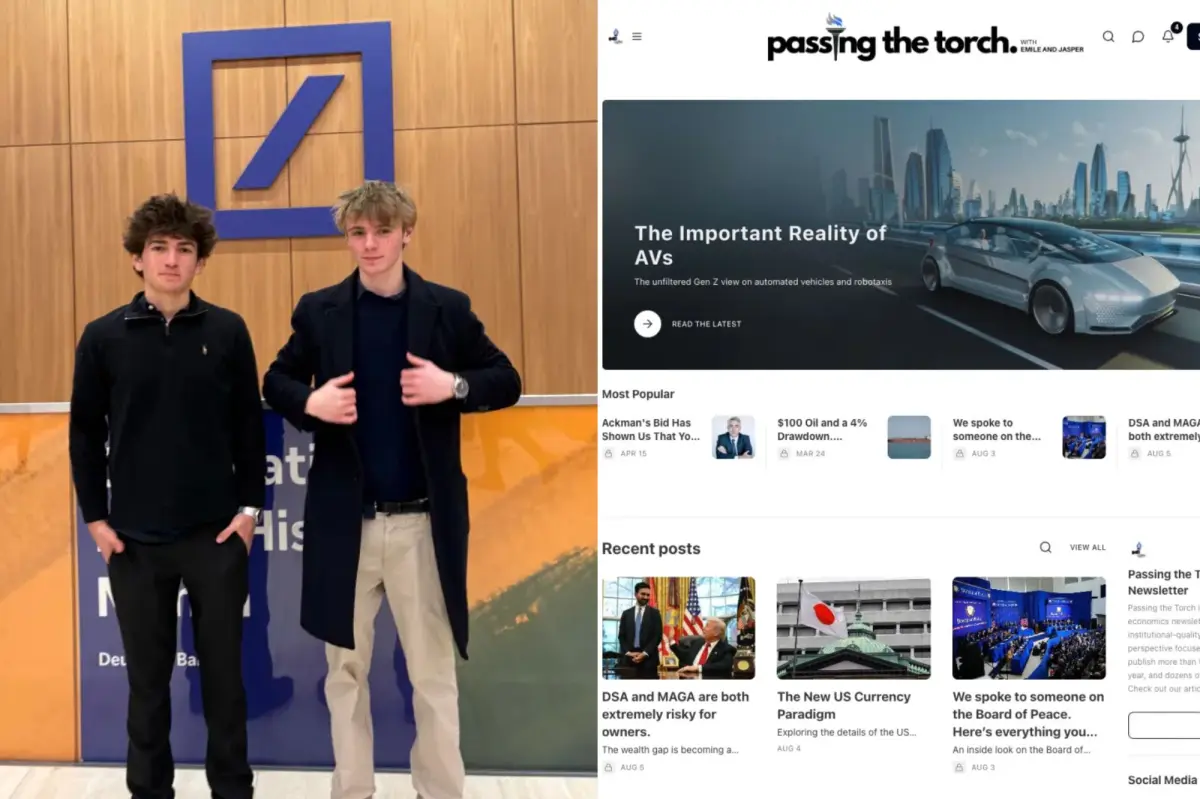
Wall Street has a new guilty pleasure, and it isn’t an exotic derivative or a secretive private equity wager. It’s a newsletter written by two teenagers who are still asking for permission to use the bathroom in class. Passing the Torch (PTT) was born in the spring of 2025, not in a sleek Manhattan boardroom, but amidst the clatter of trays and the crackle of algebra notes in the lunchroom of Berkeley Carroll, an elite prep school in Brooklyn’s Park Slope. Founders Jasper Gould and Emile Chilingirian, now both 17 and on the cusp of their senior year, were sophomores then, engaged in spirited, almost ruthless debates about the trajectory of capitalism and the crumbling trust in institutions. They realized their lunchtime sparring sessions—a bizarre hybrid of pre-calculus exhaustion and chemistry-driven logic—held more insight than the stale market analyses they were reading online. With a shared laptop and a burst of adolescent hubris, they decided to publish their thoughts, dubbing the project Passing the Torch, a name that perfectly encapsulates their mission: to pass the baton of cultural and financial understanding from the old guard to the hyper-connected, deeply skeptical Generation Z. The irony is palpable. These are students who have yet to vote in a presidential election, yet they are advising some of the most powerful investors on Earth. They navigate the hallways and the AP classes, but they also navigate the raw, unfiltered data streams of TikTok and Reddit, translating digital chaos into coherent, predictive market signals. Gould candidly admits they were likely neglecting their homework, but in doing so, they tapped into a vein of authentic thought that has sent shockwaves through the financial establishment, positioning them as unlikely oracles for a generation that rarely trusts adults—except, perhaps, these two specific ones.
Since its inception, the newsletter’s subscriber list has exploded into a financial hall of fame. Nearly 60,000 readers subscribe, and shockingly, over two-thirds of them use corporate email addresses to do so. Employees at McKinsey, JP Morgan, Blackstone, and Nvidia constitute thousands of these subscribers. The lists grow deeper with executives from Goldman Sachs, Morgan Stanley, Palantir, and Microsoft. What draws these high-powered, time-constrained professionals to a publication written by teens? PTT offers a mirror into a demographic that is notoriously difficult to survey or understand. Traditional market research relies on focus groups and curated data, but PTT offers a raw, unfiltered stream of consciousness from the generation that will inherit the global economy. The subscription pricing is modest—$15 a month or $150 a year—yet the annual revenue from the Substack alone sits firmly in the five-figure range, a tidy sum for two high school students who spend roughly 30 hours a week researching and writing the issues. For these readers, PTT operates as a vital piece of intelligence. They don’t subscribe to hear stock tips; they subscribe to understand the cultural undercurrents that dictate future customer behavior and market sentiment. The newsletter often blends anecdotal observations from high school hallways with hard statistical data, creating a unique genre of reporting that feels part sociological study, part financial forecast. A recent piece examined Gen Z’s visceral skepticism toward robotaxis and autonomous vehicles, contrasting the optimistic techno-futurism of Silicon Valley with the uncomfortable reality of safety concerns and a desire for human control. Another delved into the bizarre resurgence of wristwatches among teenagers, analyzing how this analog fixation serves as a fashionable rebellion against the omnipresence of AI and algorithmic feeds.
The content reads like a penetrating anthropological study, filtered through the lens of 17-year-old intellect. PTT doesn’t just track numbers; it tracks feelings, anxieties, and cultural shifts. It breaks down why sneaker culture is dying, not simply as a market retraction, but as a profound shift where functionality and subtlety have replaced loud logos and hype. Sam Shaffer, an early reader and former eBay executive who now consults the New Zealand government on business development, perfectly articulated the appeal: “I read this and The Atlantic with equal levels of intrigue. Their writing is not focused on crushing the market… it’s about the trends they see in their world.” This distinction is crucial—PTT lacks the cynical, transactional tone of typical financial media. It possesses a youthful curiosity and an unbecoming honesty that is deeply refreshing. Emile Chilingirian believes that high finance and Big Tech types simply crave the “Gen-Z takes” and the “variant views that the market may not have priced in yet.” They are living in the future that investors are trying to predict. While analysts try to extrapolate trends from spreadsheets, Gould and Chilingirian are experiencing them in real-time. They are immersed in the group chats, the video game lobbies, and the cafeteria conversations where economic preferences are actually formed. “The only other source of high school intel is when investors ask their children,” Gould noted, highlighting the gaping void in market research that their newsletter so deftly fills. They are the equivalent of having a native informant in the heart of the consumer economy, translating the cryptic lingo and volatile preferences of millions of young people into a language Wall Street can understand.
What makes their reporting even more striking is its distinctly populist flavor, despite the privileged world they inhabit. Berkeley Carroll is an institution where tuition exceeds $66,000 a year—a figure that puts them firmly in an economic bubble. Yet, the authors maintain a grounded, critical perspective on capitalism. This is achieved through their near-constant communication with high schoolers across the entire country. Gould and Chilingirian don’t just talk to their wealthy peers in Park Slope; they actively cultivate relationships with students from disparate socioeconomic backgrounds, ensuring their newsletter carries the diverse voice of an entire generation, not just the upper crust of Brooklyn. This connection keeps their takes grounded, focusing on the struggles of job insecurity, the anxiety of student debt, and the deep-seated mistrust of political institutions that spans income brackets. While they acknowledge the privilege of their own education, they are acutely aware that Gen Z’s existential dread and pragmatic economic nationalism are universal. They combine this sprawling network of informants with a rigorous curiosity, spending their free time poring over economic reports and Federal Reserve statements to back up their cultural findings. The result is a polished, sharp-witted publication that reads beyond its authors’ years. They have managed to de-couple the concept of financial journalism from the stale wallpaper of corporate media, making it relevant again for a generation that treats traditional news with a knowing shrug. Their success is a testament to the power of genuine connection and the fact that understanding a generation requires listening to them, not just analyzing their buying habits from a distance.
Beyond the newsletter, Gould and Chilingirian are deeply entrenched in financial education through the Brooklyn Youth Charitable Investment Group (BYCIG). What began as a pizza-fueled gathering with friends to casually talk stocks has transformed into a significant non-profit. Today, over 1,000 students from all corners of the United States have passed through its virtual and physical doors. The organization does not treat young people as passive learners. It puts them directly in front of the highest echelons of economic thought. BYCIG has hosted talks featuring the chief economists of the White House, Wells Fargo, and the Conference Board of Canada, alongside managing directors from titans like UBS, Morgan Stanley, and JP Morgan Chase. But the true heart of BYCIG lies in its investment arm, which manages a real fund of approximately $50,000 raised by supportive parents and astute finance professionals. Student teams operate like actual junior analysts. They research, formulate, and pitch investment ideas to an advisory committee composed of seasoned financial experts. When the board approves a proposition, it is sent to a licensed accountant who executes the trade. The audacity of this structure is breathtaking—teenagers wielding real capital, accountable for real risk, backed by institutional wisdom. Crucially, they are also instilled with a sense of social responsibility; a portion of their returns is regularly donated to charity. The results have been nothing short of spectacular. Out of the twelve current positions in their portfolio, three have appreciated by over 40%, allowing the fund to outperform the broader market significantly. This hands-on approach teaches lessons that no textbook can convey: the gravity of decision-making, the humility of a losing trade, and the euphoria of a well-researched win.
Jasper’s father, Nick Gould, a tech industry veteran and self-employed executive coach, speaks to the reaction from the outside world. “The primary reaction is amazement,” he says, reflecting on the sprawling ecosystem his son has built. A man with a modest 200-subscriber newsletter of his own, Nick wryly credits PTT as the primary source of any growth he’s seen in his year-old publication. The Gould household is perhaps a microcosm of the wider market’s confusion: here is a brilliant, motivated teenager whose insights are more sought after than those of seasoned experts. But despite their meteoric rise, Gould and Chilingirian remain anchored in reality. Both are currently in the throes of college application season, navigating the same stresses as millions of their peers. They are now rising seniors, and with that, they face a peculiar logistical challenge that most 17-year-olds never confront: succession planning. They are actively thinking about the future of both the newsletter and the non-profit, seeking ways to ensure the torch is passed smoothly to the next generation of student analysts. There’s a poignant, almost bittersweet acknowledgment of their own constraints. “We can’t set up a hedge fund just yet,” Gould laughed, in a moment of relatable teenage limitation. “I won’t be 18 for another two months.” In that single line lies the entire paradox of Passing the Torch—a venture that operates with the maturity and insight of a top-tier financial firm, yet is ultimately bound by the legal and logistical realities of adolescence. Their story is not just a viral sensation; it is a profound commentary on the future of thought leadership. It proves that perspective is the foundational currency of success, and that the most valuable insights often come from those we least expect—especially when those individuals are brave enough to speak their truth from a high school lunchroom.