


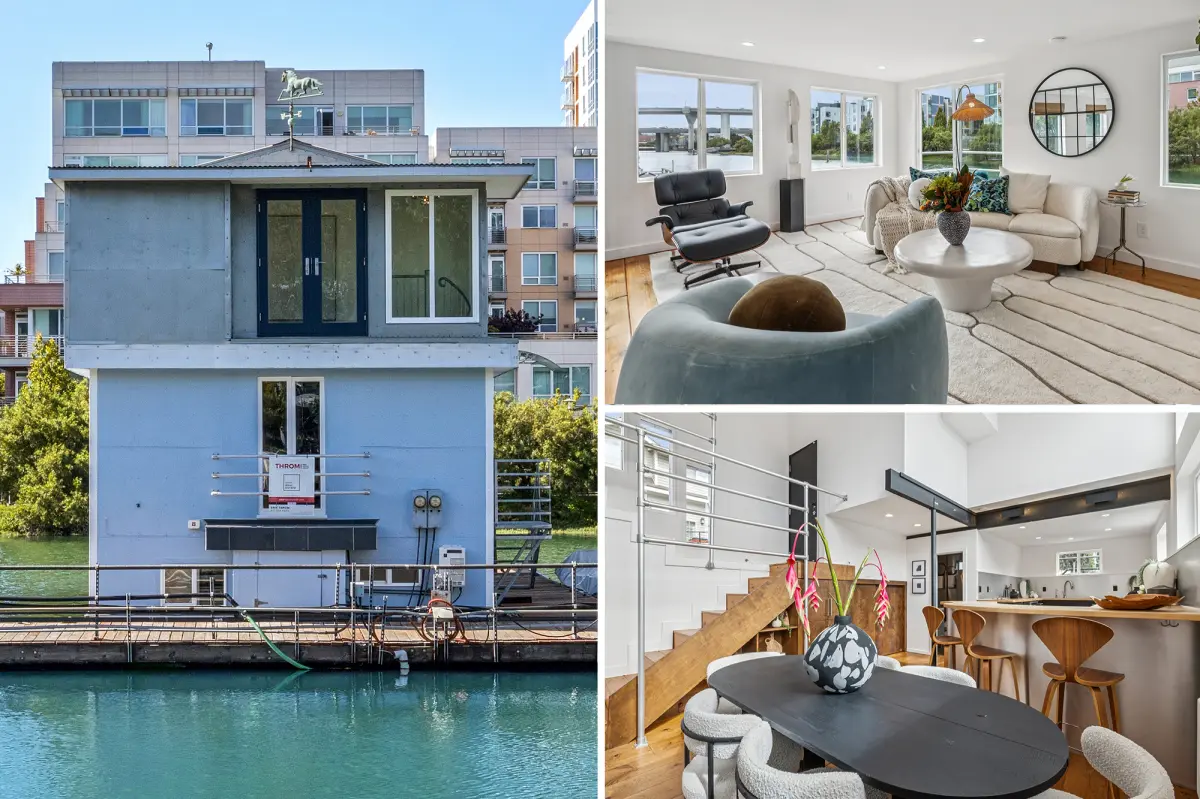
Imagine waking up in a house that gently tilts with the tide, then stepping outside into the heart of the most consequential economic boom of your lifetime. That is the strange reality on offer at 300 Channel Street #14 in San Francisco’s Mission Rock neighborhood, where one of the city’s exceedingly rare Mission Creek houseboats has just hit the market for $1.749 million. For the newly minted millionaires and ambitious engineers who populate the nearby offices of OpenAI, this is a ten-minute walk from the epicenter of the AI gold rush—close enough that you could roll out of a rocking bed and be in the middle of Silicon Valley’s latest frenzy before your morning matcha has even cooled. The idea of living on a boat while working on artificial intelligence might seem straight out of a satirical novel, but it is a very real listing in a city that has always made room for the strange, the ambitious, and the spectacularly well-funded. The property is one of only twenty such floating homes on Mission Creek, a tiny maritime community tucked into an old industrial channel that has somehow survived decades of change while the city around it transformed beyond recognition. It offers three floors, three bedrooms, and three nautical-themed bathrooms in 1,780 square feet of living space, along with two parking spots, a pleasure boat, and access to a separate 40-foot berth. In a city where conventional houses routinely cost millions, the price tag—while eye-watering to most Americans—is almost a bargain for the tech elite who measure their wealth in equity and stock options. But the real value lies in the intangibles: the lapping of water against the hull, the sway of the deck underfoot, the knowledge that home is not fixed to the earth but floating on it. This is not just a house; it is a rebellion against the static, corporate, glassy world that surrounds it, even as it is priced precisely for the people who built that world.
The physical details of the houseboat are a delightful puzzle. At 1,780 square feet, it is no cramped canal barge; it is a genuine floating residence with three floors, three bedrooms, and three bathrooms all styled with nautical touches that remind you where you are. The kitchen and living spaces are designed for the peculiar rhythm of life on water, where nothing is ever perfectly level and every step comes with a gentle reminder that the ground can move. Two parking spots are included, which is a quiet luxury in San Francisco, and the listing also comes with a pleasure boat and use of a separate 40-foot berth to store it. So the buyer is not just purchasing a home; they are purchasing a small fleet and the infrastructure to maintain it. The asking price of $1.749 million may sound inflated to those still recovering from sticker shock over Bay Area real estate, but context matters. Mission Creek Harbor is a finite world: only twenty berths exist, and they have historically changed hands privately, often within families, through handshake deals and whispered word of mouth rather than public listings. This particular home was purchased by its current owner, Tyson Graham, in 2002 for $225,000. He built the structure that now sits on the site, pouring years of labor into what would become a sevenfold increase in value. For the new buyer, the opportunity is twofold: keep the existing structure as a quirky primary residence, or tear it down and build anew, subject to the necessary approvals from the harbor and the city. The latter path is for those who dream of a custom floating palace. The former is for those who appreciate the rough edges and character that only nonstandard living can provide. Either way, the purchase is a rare chance to enter a community that has been closed to outsiders for decades. In a city where almost everything can be bought if the price is right, this is one of the few places where supply is genuinely frozen. There will never be more than twenty. There is no new inventory. What exists now is all that ever will. That scarcity, more than the square footage or the nautical bathrooms, is what makes the listing so remarkable—and so expensive.
Buying into this unusual community is not like snapping up a conventional condo, and the restrictions are part of what makes it so special. Short-term rentals are forbidden, so the houseboat cannot become another Airbnb cash cow. Absentee ownership is also banned, meaning the buyer must actually live there, becoming part of the fabric of Mission Creek. Residents are required to participate in biannual volunteer work days, a communal ritual that keeps the docks, common spaces, and water around them in good shape. There is a monthly fee of $1,183 associated with living on the channel, which goes toward the maintenance and shared costs that come with a floating neighborhood. For some, these rules might feel like an imposition; for others, they are the key to preserving a way of life that has vanished almost everywhere else in San Francisco. The community has existed since around 1959, when the first houseboats were permanently moored in this stretch of water, and it has developed its own traditions, friendships, and informal governance over the decades. Because berths have historically been passed down privately among family members, the public has rarely had a chance to buy in. When another Mission Creek floating home was listed for $1.8 million in 2019, the agent handling the sale said it was believed to be the first of the twenty berths ever offered on the open market. That makes this new listing only the second time in the community’s long history that an outsider has been invited to join. It is not merely a purchase; it is a rare admission into a secret, floating society. The people who live here know one another, watch out for one another, and share a bond that comes from living on water in a city that has turned its back on the sea. For a wealthy tech worker accustomed to the anonymous luxury of glass towers, this could be a shock to the system. But for someone seeking authenticity, community, and a home with a pulse, it is an almost impossible opportunity. The rules are not obstacles; they are the framework of a tiny utopia.
The listing captures a wild juxtaposition in modern real estate, one that tells the story of San Francisco’s transformation in a single image. When houseboats were first permanently moored here, Mission Creek was an industrial wasteland, a working channel surrounded by warehouses and factories, its waters heavily polluted by decades of neglect. The people who chose to live on it were not dot-com billionaires; they were artists, eccentrics, and seekers of cheap shelter in a city that was still finding its post-industrial identity. They came for the low rents and the freedom of a life unmoored from the grid, trading comfort and convenience for a front-row seat to the tide. Today, that once gritty sliver of the city is surrounded by corporate capital on every side. Tech giants dominate the skyline. The UCSF biotech and life-science campuses tower nearby, filled with researchers hunting for the next breakthrough in medicine. The Golden State Warriors’ Chase Center and the San Francisco Giants’ Oracle Park are just a short walk away, bringing thousands of fans and millions of dollars to the neighborhood. The smell of diesel and salt water has been replaced, at least in part, by the aroma of artisanal coffee and the buzz of electric scooters. It is hard to imagine a more perfect symbol of the Bay Area’s arc: a humble, polluted creek that has become one of the most valuable stretches of water on earth, a place where a floating shack can carry a price tag that would buy a mansion in most of America. The AI boom is just the latest chapter in this story. OpenAI’s headquarters, a short stroll from the houseboat, has become a pilgrimage site for young engineers, venture capitalists, and journalists trying to understand the future. The sidewalks are filled with people discussing neural networks and compute clusters, while below them, the houseboats bob gently, oblivious to the frenzy above. That contrast is both absurd and beautiful. It is a reminder that even the most transformative technologies are built by human beings who need homes, communities, and a reason to stay.
For the lucky buyer, life at Mission Creek will be unlike anything else in the tech world. Mornings might begin with the sound of water lapping against the hull, a gull crying overhead, and the sight of sunlight dancing on the channel. The commute to OpenAI is short enough that a coffee bought at a nearby café would still be hot by the time you reach your desk, but the mental transition from houseboat to headquarters is immense. At night, after a day of building systems that could change the world, you would return to a home that rocks gently with the wake of passing boats, a constant reminder that nature is not something to be conquered but to be lived alongside. The community’s rules—no short-term rentals, no absentee owners, mandatory volunteer work days—ensure that the neighborhood remains populated by people who are actually invested in it, not by absentee investors looking for a return. The monthly fee of $1,183 covers the costs of maintaining a floating home, but it also buys entry into a group of neighbors who share a collective duty to keep their little world alive. There are biannual workdays when residents come together to clean the docks, repair shared spaces, and gossip about the latest tides. There are dinners on decks and conversations across boats, friendships forged in the shared experience of living somewhere that most people would never even consider. It is not a life for everyone. The space is unconventional, the storage options are limited, and the whole structure moves with the weather in a way that can test even the strongest stomach. But for the right person—someone who values authenticity over conventional luxury, community over isolation, water over concrete—it could be a dream. The houseboat is more than a real estate listing; it is a statement about how to live well in a city that is increasingly hostile to everything except work and wealth. It says that there is still room for the weird, the wonderful, and the waterlogged. It says that even in the heart of the AI boom, you can choose to stay anchored to something real.
Ultimately, this houseboat is a metaphor for San Francisco itself in the age of artificial intelligence. The city is floating, too—on waves of capital, hype, and invention, never quite grounded, always bobbing between triumph and disaster. The people who live there are riding those waves, some with more grace than others. The AI boom has minted a new class of millionaires, many of them young and brilliant, who are looking for homes that reflect their values and their status. A conventional penthouse in a glass tower is one option, but it is also the obvious one, the choice of every finance bro and crypto king. A houseboat on Mission Creek, by contrast, is a signal. It says that you can afford almost anything and chose this. It says that you understand the history of the city and want to be part of its strangeness, not just its growth. It says that you are willing to trade solid ground for the gentle uncertainty of the water, a trade that feels very much in the spirit of an industry where nothing is certain and everything is possible. And yet, the price tag, the restrictions, and the rarity of the listing also remind us of an uncomfortable truth: the same forces that made the AI boom have made San Francisco almost unlivable for anyone without immense wealth. The people who originally built floating homes on Mission Creek were not millionaires. They were seeking an alternative to a world that had no place for them. Now, that alternative costs $1.749 million and is marketed to the very people who represent the mainstream they were escaping. There is a sadness in that, but also a kind of continuity. Cities change. Creeks change. Boats survive. Whoever buys this home will become part of a story that began decades ago, in a polluted channel where dreamers anchored their lives to the water. They will inherit a community that has resisted the relentless pressure of development, even as the tide of money rose around it. They will wake up each morning to the sound of water and walk to work in the heart of the future, carrying with them a piece of the past. That, perhaps, is the real value of the listing. It is not just a house. It is a way to float above the noise, to stay connected to something elemental, to live in the center of the boom while remaining slightly apart from it. In a city defined by movement and ambition, that is the rarest luxury of all.