



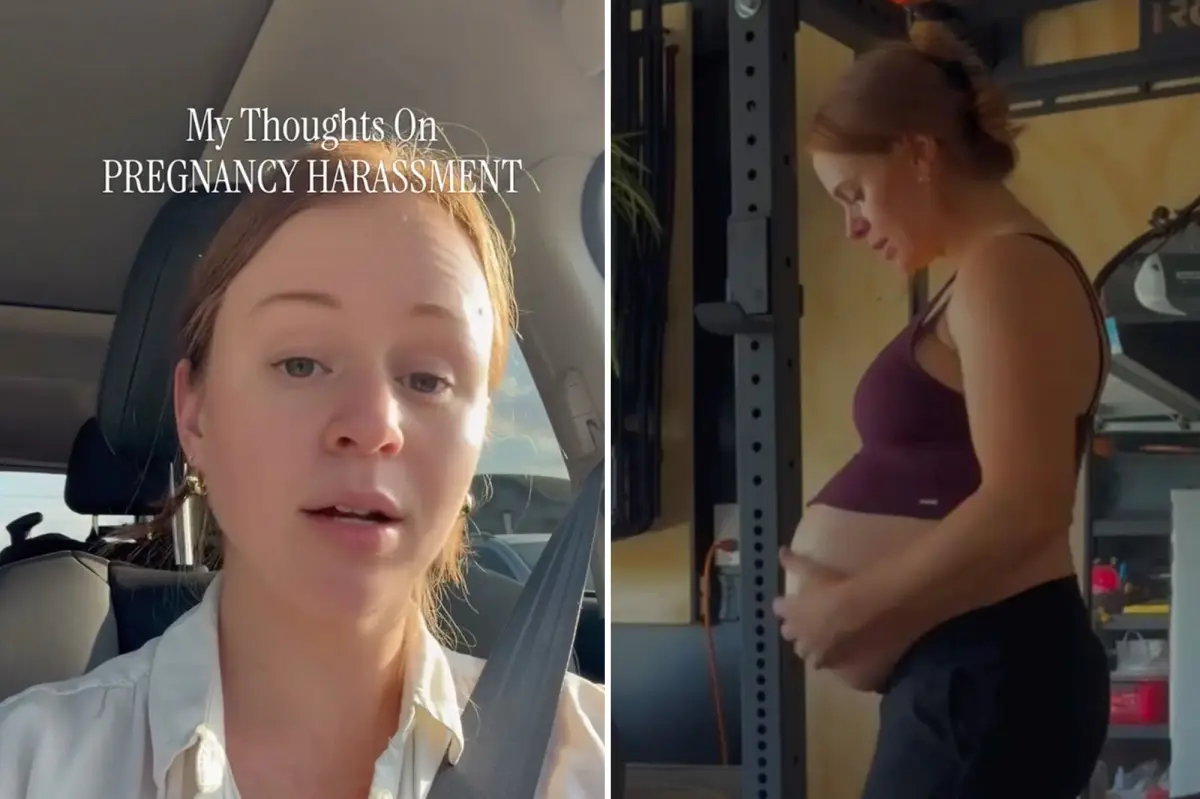
The journey of pregnancy is often romanticized as a period of serene anticipation and glowing maternal bliss, yet for countless expectant mothers, it is frequently marred by an invasive, highly normalized form of social boundary-crossing. For Dr. Natalie Forsell, a pelvic floor personal trainer navigating her fourth pregnancy, the breaking point arrived not from the physical toll of carrying new life, but from the unmitigated audacity of a stranger on the street. While quietly minding her own business, Forsell was confronted by an intrusive passerby—colloquially dubbed a “Karen”—who felt entirely entitled to scrutinize her visible belly. Appalled by the physical dimensions of Forsell’s torso, this stranger boldly assumed she was carrying twins, loudly demanding to know how she could possibly be so enormous when she still had a full three months left before her due date. This unsolicited encounter was the ultimate straw that broke the camel’s back, transforming Forsell’s internal frustration into a powerful force for social advocacy. Channeling her righteous anger into a constructive outlet, she took to social media to call out this toxic behavior, introducing a viral and desperately needed vocabulary term to the cultural lexicon: “Pregnancy Harassment.” As a fitness professional who prides herself on her physical capability, Forsell found herself deeply exhausted by the energy required to remain polite in the face of such profound ignorance. She emphasized that while she is profoundly obsessed with and grateful for her body’s strength—continuing to hit the gym, deadlift heavy weights multiple times a week, and celebrate her physical autonomy—the mental strain of dealing with these constant public evaluations is a heavy burden that no pregnant person should have to bear.
By definition, Pregnancy Harassment represents the unmitigated audacity of strangers, acquaintances, or even relatives to provide intentionally or unintentionally rude commentary on a woman’s midsection, operating under the deeply flawed assumption that once a female stomach reaches a certain diameter, it somehow becomes public property. This bizarre social phenomenon transforms a deeply personal biological process into a platform for public debate, speculation, and unsolicited advice, reducing a complex human being to a mere spectacle for onlookers to evaluate. The sheer arrogance required to look at a pregnant woman and comment on her physical dimensions betrays a wider, systemic societal issue regarding how we view women’s bodies. Historically and culturally, women have been subjected to relentless, superficial physical scrutiny, but pregnancy seems to amplify this intrusion to an astronomical degree, stripping away normal boundaries of respect and privacy. Strangers who would never dream of commenting on a person’s weight under normal circumstances suddenly feel completely deputized to offer critical dietary warnings, physical assessments, and intrusive questions the moment a baby bump becomes visible. This entitlement is not just mildly annoying; it is incredibly damaging to an expectant mother’s mental health. The psychological energy required to constantly deflect, ignore, or politely smile through these microaggressions is immense, especially when a woman is already navigating the overwhelming physical, hormonal, and emotional shifts that characterize the gestation of human life.
This frustrating reality resonates on a deeply personal level with mothers worldwide, including those who have navigated multiple pregnancies and experienced the relentless onslaught of public commentary firsthand. Carrying four children, for instance, exposes a mother to a unique brand of public judgment, where strangers frequently imply that she must be a glutton for punishment or some kind of biological anomaly simply for choosing to build a large family. These intrusive remarks often feel like sudden, metaphorical drive-by shootings; they sting the recipient deeply, leaving a lingering trail of self-consciousness and irritation, while the perpetrator walks away entirely unscathed, oblivious to the emotional disruption they have caused. This behavior highlights a weird, parasocial relationship that society develops with pregnant women, wherein total strangers feel they possess an absolute right to comment on a process they have no personal stake in. This boundary-crossing is particularly egregious when it comes to men who attempt to “man-splain” the physical realities, symptoms, or medical aspects of pregnancy to women who have actually lived the experience multiple times over. The sheer absurdity of someone with zero biological capability or personal experience lecturing a seasoned mother on how she should feel, eat, or carry her child is a testament to how deeply entrenched this sense of entitlement truly is. It serves as a stark reminder that pregnancy does not bypass a woman’s need for basic respect, autonomy, and personal space, and that sharing a public area does not grant anyone access to a woman’s medical history.
Importantly, Forsell’s viral crusade highlights a critical truth: the damaging effects of Pregnancy Harassment extend far beyond the walls of the maternity ward, deeply impacting women who are not even pregnant. The systemic societal obsession with policing women’s torsos means that many individuals struggling with severe medical conditions—such as Polycystic Ovary Syndrome (PCOS), endometriosis, chronic bloating, or uterine fibroids—are routinely subjected to the exact same painful, intrusive questioning. For a woman fighting an agonizing, silent battle with her hormones, physical pain, or devastating fertility struggles, having a stranger brightly ask when she is due is an emotional gut punch that can trigger profound grief, anxiety, and shame. Recognizing the cruelty of these assumptions, Forsell admits to adopting a brilliant, highly effective tactic to give intrusive “well-wishers” a taste of their own medicine. On multiple occasions, when confronted by strangers commenting on her size, she has looked them dead in the eye with a completely expressionless, deadpan face and declared, “I’m not pregnant, I actually just have a tumor, but thanks for noticing!” This stunning counter-response instantly shifts the burden of discomfort back to where it belongs, leaving the offending party trapped in a state of pure, unadulterated embarrassment. It serves as a necessary, sharp lesson in social boundaries, illustrating that assuming anyone is pregnant based purely on physical appearance is a highly dangerous, insensitive gamble that should be permanently retired from social interaction.
The widespread reaction to Forsell’s online message quickly released a floodgate of shared traumas and absurd anecdotes from women of all body types, proving that within the current cultural paradigm, pregnant women simply cannot win. For every mother berated for being “too large,” there is another who is actively shamed or highly scrutinized for carrying “too small,” a critique that can carry devastating emotional consequences. One mother shared her anxiety when strangers repeatedly told her she “didn’t even look pregnant” and questioned her stage of gestation, comments that deeply triggered her fears because her daughter was actively suffering from intrauterine growth restriction in utero. Other women recalled being told by strangers that they looked “so tired” or even accused of faking their pregnancies entirely because their bumps did not conform to the observer’s arbitrary expectations. Twin mothers recounted the exhausting wildness of public commentary, with one mother choosing to directly fight fire with fire by responding to a stranger’s critique of her large stomach by pointing out that the stranger’s stomach was equally large. Even professional medical experts, including an experienced sonographer, chimed in to validate this collective frustration, confirming with absolute scientific confidence that every single woman carries her pregnancy in a completely unique way. Because factors like abdominal muscle tone, height, uterine position, and skeletal structure dictate how a bump presents outward, it is biologically impossible to accurately judge the health, size, or gestation of a baby simply by looking at the mother’s belly.
Ultimately, the collective exhaustion surrounding this issue points to a simple, non-negotiable golden rule of human decency: if you see a bump, do not ask, do not comment, and do not offer unsolicited wisdom. Pregnancy is a deeply sacred, highly complex, and intensely private biological journey that remains personal even after it has been publicly announced, and a woman’s body is never an open invitation for public commentary. Unless an expectant mother actively brings up her pregnancy in conversation, the most respectful course of action for anyone—whether a relative, acquaintance, or total stranger—is to remain entirely silent, or, if a comment is truly unavoidable and welcomed, to offer a simple, warm compliment about how beautiful and glowing she looks. We must move toward a culture that respects bodily autonomy and stops treating women’s midsections as conversation starters or public property. Dr. Natalie Forsell’s empowering, microphone-dropping conclusion serves as the perfect guidepost for this cultural shift, reminding us that whether a woman’s stomach is housing a developing baby, a complex medical condition, or simply an exceptionally satisfying burrito, the physical shape and size of her midsection is the absolute least interesting thing about her. Instead of demanding that women shrink, expand, or explain themselves to satisfy public curiosity, society must reclaim its manners and focus on celebrating women for their strength, their intellect, their professional achievements, and their undeniable capabilities—like deadlifting heavy iron while quietly performing the modern miracle of growing a human life.