





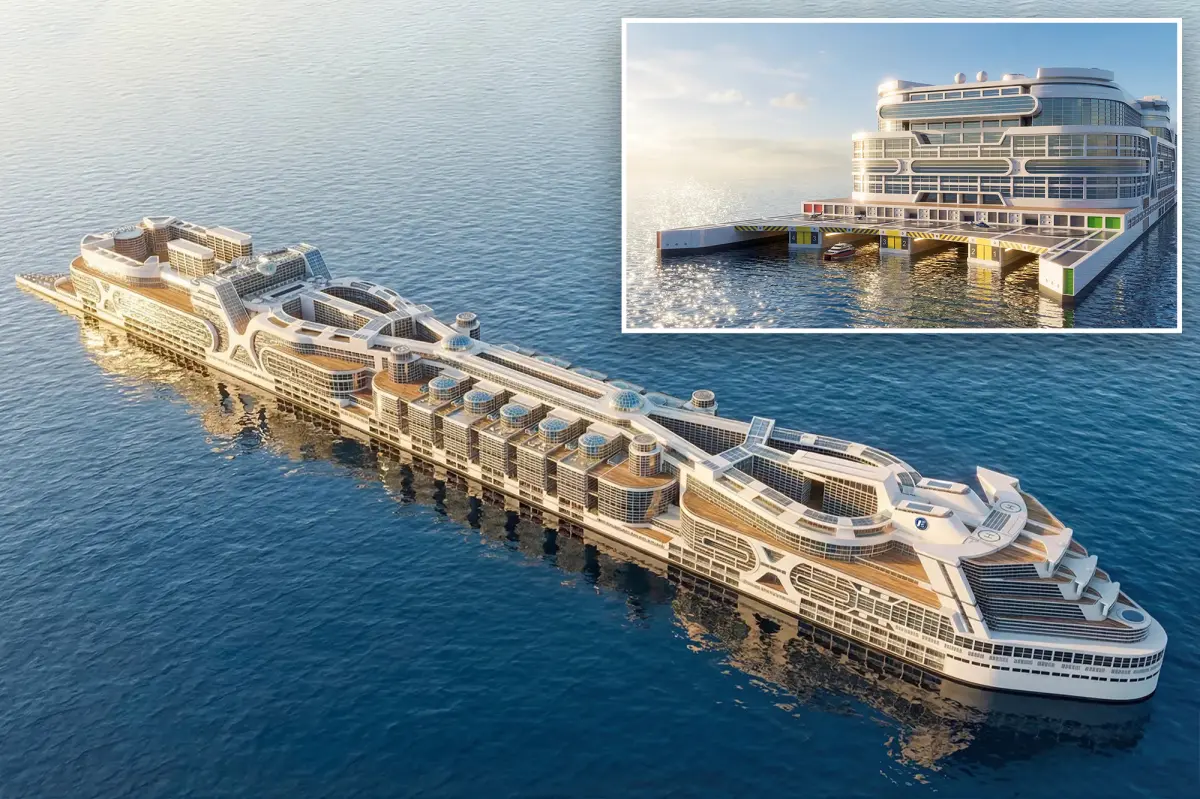
The ocean has always held a mystical, almost magnetic pull over the human spirit, serving as a canvas for our wild dreams of exploration and limitless freedom. This age-old longing to escape the physical constraints of dry land is the driving force behind the resurrection of the Freedom Ship—a design concept so massive and aspirational that it transcends the boundaries of traditional naval engineering to propose the creation of the world’s first genuine floating city. Originally conceived in the late 1990s by the forward-thinking engineer Norman Nixon, the visionary blueprint for this oceanic metropolis unfortunately drifted into obscurity after his passing in 2012. Today, however, these ambitious plans have been breathed new life, resurrected under the passionate leadership of Roger Gooch, the visionary chief executive officer of Freedom Cruise Line. Gooch, who remains steadfast in his belief that humanity is finally ready to embrace a permanent life on the waves, publicly emphasized that while they feel confident they can put this monument together, capitalization remains the absolute key. This colossal endeavor is not merely a bid to construct a super-sized version of today’s luxury cruise liners, which are ultimately designed for short-term tourism and leisure. Instead, the Freedom Ship represents a profound philosophical shift in how we conceive of community, society, and domestic life. To put its mind-boggling scale into perspective, one only has to look at Royal Caribbean’s $2 billion marvel, the Icon of the Seas, which stands as a titan of modern cruise luxury with a maximum capacity of 7,600 guests and 2,350 crew members. The Freedom Ship utterly dwarfs this vessel, aiming to accommodate an astonishing total design capacity of 80,000 people. It is a bold, civilizational leap forward, challenging our fundamental understanding of what it means to belong to a location, proposing a sovereign, mobile sanctuary where the horizon is ever-changing and the artificial boundaries of nations gently dissolve into the vast, open sea.
To transform a dream of this magnitude into physical reality requires not only immense architectural daring but also an unprecedented financial commitment, with current cost estimates reaching a staggering $16.16 billion, or roughly £12 billion. This astronomical investment would construct a mile-long vessel designed to function as a fully operational, self-contained community, featuring permanent apartments and houses for approximately 50,000 long-term residents who wish to make the ocean their permanent address. Alongside these pioneers, the ship will accommodate 10,000 rotating tourists seeking a transformative travel experience, all supported, serviced, and kept safe by a dedicated, 20,000-strong crew of professionals who will manage the municipality’s daily maintenance, safety, and operational needs. Despite these massive figures, the design team has gone to great lengths to ensure that the physical environment of this massive structure feels remarkably human, gentle, and welcoming rather than cold, clinical, or industrial. Roger Gooch has highlighted that the artistic and architectural teams deliberately moved away from designing a monolithic, intimidating block of steel, electing instead to soften the ship’s visual edges and integrate expansive open-air walkways, beautiful parks, and thriving green spaces that bring a sense of terrestrial sanity to the deep blue. The guiding philosophy behind the ship’s leisure and communal areas is that life aboard should not feel like a perpetual, exhausting vacation or an artificial theme park; rather, it is designed to feel familiar, grounding, and beautifully ordinary—citizens will walk their dogs, meet neighbors for morning coffee, and enjoy quiet library afternoons. By prioritizing accessible parks, light-filled public squares, and natural elements, the ship’s designers hope to offer a peaceful, balanced lifestyle where the quiet comfort of daily routines can easily coexist with the majestic, awe-inspiring presence of the surrounding global wilderness, ensuring that residents never feel trapped in a steel box but rather embraced by a floating garden.
Stepping inside this floating metropolis, one would discover a meticulously planned urban ecosystem designed to provide all the comforts, conveniences, and institutions of a premier mainland city. Families living aboard will not have to sacrifice their children’s education or their own career aspirations, as the Freedom Ship is slated to house fully accredited schools, colleges, and professional development centers, alongside essential services like banks, dental clinics, and retail stores. Commuting across the mile-long structure will be a breeze, thanks to a zero-emission, futuristic tram system that will smoothly and quietly glide throughout the decks, connecting residential neighborhoods, administrative offices, and sprawling commercial districts. Food enthusiasts will find solace in a massive, beautifully designed two-story food hall capable of satisfying the most diverse, unique, and demanding culinary cravings from around the world. But the community life of this floating city extends far beyond basic necessities; it is designed to foster a rich cultural and recreational lifestyle that rivals the world’s greatest capitals. The blueprints include a magnificent 15,000-seat sports stadium for athletic matches and community gatherings, a massive indoor water park, tranquil recreational parks, a spacious convention center for international dialogues, a state-of-the-art music hall, and two dedicated museums showcasing historical and contemporary art. Dive lovers and marine enthusiasts will not even need to jump into the open ocean to experience its wonders, as the ship will host a gargantuan, beautifully curated aquarium inside its core. By blending these diverse urban amenities, the Freedom Ship seeks to cultivate a deep, vibrant social fabric, ensuring that life at sea remains intellectually stimulating, physically active, and socially fulfilling, proving that human culture can truly flourish anywhere, even on a moving platform that knows no borders, operating out of reach of traditional municipal divisions.
From a technical and navigational perspective, the operational reality of the Freedom Ship demands engineering solutions that are as innovative as they are ecologically conscious. Powering a city of 80,000 people requires an immense, highly reliable energy source, which is why designers have opted for a clean, highly efficient nuclear propulsion system. This advanced nuclear power source will allow the ship to remain entirely self-sustaining for decades, avoiding the environmental impact and frequent refueling stops associated with traditional fossil-fuel maritime transport, ensuring a minimal carbon footprint. Because of its colossal, unprecedented physical footprint, the Freedom Ship will be virtually impossible to dock at any existing commercial harbor or port anywhere on the planet; instead, it is destined to live permanently in international waters, slowly and continuously circumnavigating the globe every two to three years. This endless voyage will take residents past major coastal regions across Europe, Asia, Africa, and the Americas, offering a breathtaking, slowly turning front-row seat to the planet’s diverse geography and climates as they glide peacefully by. To bridge the logistically complex gap between this sovereign ocean community and the terrestrial world, the ship’s design features a highly sophisticated logistics and transit network. An active fleet of fast, highly stable passenger ferries and heavy-duty utility tenders will constantly shuttle between the ship and nearby coastal cities, while eight state-of-the-art helipads built atop the vessel’s massive roof will accommodate rapid air transport for residents, priority cargo, and medical emergencies alike. This multi-layered transportation system ensures that while the ship remains a self-contained sanctuary in global waters, its citizens will never feel isolated, maintaining seamless access to mainland cultures, family members, medical facilities, and global business networks, resulting in an unparalleled blend of absolute physical autonomy and terrestrial connectivity.
Despite the breathtaking potential of this ocean-going metropolis, the modern pioneers championing the Freedom Ship face the formidable financial and logistical challenges that inevitably accompany any history-defining endeavor. Roger Gooch openly acknowledges that securing the necessary capital is the master key that will unlock the ship’s shipyard construction, prompting an intensive, highly active global search for forward-thinking investors and visionary financial partners who believe in the future of alternative living. His optimism has found deep resonance in the international maritime sector, with Sridev Mookerjea, an accomplished project manager at Singapore’s prominent Blossom Group, publicly pledging his full support and declaring that with Gooch’s patience, vision, and determination, the sky is the limit for this extraordinary construct. If funding is successfully secured, the physical construction of this steel leviathan is estimated to take roughly four years to complete. However, the development team has proposed a uniquely humanistic and pioneering construction strategy: plans are in place to allow the very first wave of residents to move into their finished marine homes while the final phases of construction are still being completed on other, distant portions of the ship. This bold approach evokes the classic pioneering spirit of early human settlers who built their towns cabin by cabin, giving rise to a highly dedicated, close-knit founding community that will help design the social rules, municipal governance, and community values of the ship from its raw, industrial beginnings. Living amidst the literal birth of their floating home, these passionate early adopters will not just be real estate buyers, but active co-creators of a historical milestone, helping to navigate the infant community’s challenges, celebrating milestones together, and witnessing their dream of a borderless life take shape deck by deck, weld by weld.
Looking forward, the alluring mystique of the Freedom Ship transcends the mere mechanics of its naval construction, tapping into a profound, timely philosophical exploration of human adaptability, environmental resilience, and the future of global civilization. For thousands of years, humanity has looked to the ocean as a wild, untamed frontier—a space of temporary passage and trade rather than a permanent, domestic home. By aiming to establish a sustainable, self-sufficient, and deeply human society on the high seas, this grand project challenges us to radically reconsider our relationship with our blue planet, suggesting that our oceans can become places of community, safety, and peace rather than boundaries of national separation and isolation. As terrestrial nations increasingly grapple with overcrowding, changing political climates, and the rising sea levels driven by regional and global environmental shifts, the concept of a mobile, nuclear-powered city offers an inspiring, preventative alternative focused on international cooperation, ecological stewardship, and the peaceful coexistence of a diverse population. It serves as a powerful reminder that no matter how complex or daunting our earthly challenges may become, the human spirit is fundamentally defined by its refusal to be constrained, always searching for new ways to build, connect, and survive. Whether the Freedom Ship ultimately sets sail across the oceans or remains a beautiful, inspiring dream preserved on draftsmen’s tables, the conversations it provokes about freedom, community, and our collective human destiny will continue to ripple outward for generations. It encapsulates our timeless, poetic desire to conquer the horizon, proving that we are not merely land-dwelling creatures destined to look at the water from afar, but cosmic explorers ready to embrace the sea as our ultimate, shared home, carving wild, peaceful paths of discovery across the world’s deep blue canvas, and proving once and for all that our home is not just where we stand, but where we dare to go.