


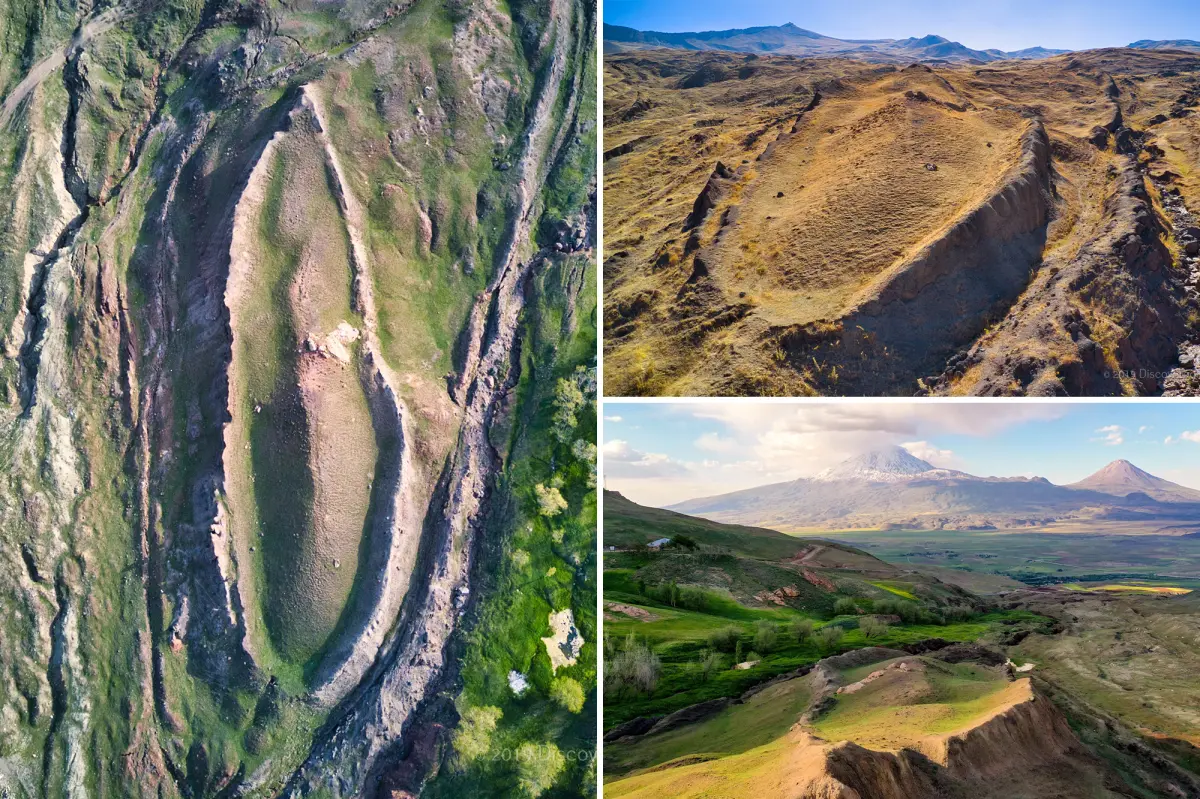
For centuries, the story of Noah’s Ark has hovered somewhere between faith, folklore, and archaeological possibility. It is one of those ancient tales that refuses to fade, partly because it speaks to something deep within us—the hope that a great catastrophe could be survived, that a vessel built by human hands could carry life into a new beginning. Now, a team of researchers believes they are closer than ever to proving that the Ark was not just a story, but a physical reality. The focus of their work is a strange, boat-shaped formation in eastern Turkey, known as the Durupınar formation. Located not far from the towering peak of Mount Ararat—the very mountain where the Bible says the Ark came to rest—the structure stretches roughly 538 feet long and has fascinated explorers, believers, and skeptics for decades. Andrew Jones, the founder of Noah’s Ark Scans, is careful not to overstate things, but he is clearly hopeful. “In archaeology, you deal with probabilities,” he said, “and we’re inching towards where we believe we will have confirmation this winter after our soil analysis is done with Sivas University, who’s our partner in this.” That measured tone, full of cautious optimism, may be exactly what the story needs. It is not the shout of a treasure hunter, but the careful voice of a researcher who believes the ground beneath his feet has secrets to tell.
The Durupınar formation was first spotted in 1959, and from the very beginning, it sparked a particular kind of wonder. It is not hard to see why. From above, the shape of the earth and rock resembles the hull of an enormous ship, with a prow that seems to point forward, as if it had once drifted and then settled into the mountainside. For decades, that shape has been enough to draw people to this remote corner of the world, each one hoping to find proof that the Ark is real. But the site has also attracted plenty of criticism. Geologists and archaeologists have often dismissed the formation as a natural oddity—perhaps a syncline, a fold in the Earth’s layers, or simply a block of bedrock that happened to weather into a boat-like form. For a long time, the debate seemed stuck in a standoff: believers pointed to the shape, and skeptics pointed to the science. But Jones and his team believe they are finally shifting the balance. They have not been relying on aerial photographs or surface impressions. Instead, they have been drilling into the ground, pulling up samples, and using ground-penetrating radar to see what lies beneath the surface. And what they have found, they say, does not match the skeptics’ explanation. The idea that this is just solid rock, Jones argues, is no longer holding up to direct investigation.
What changed? It comes down to what the team found when they actually broke through the surface. Jones says they drilled in more than twelve locations across the formation, and at none of those sites did they hit the solid bedrock that critics had predicted. That alone is significant, because it challenges the long-held assumption that the Durupınar formation is simply an unremarkable piece of the mountain. Instead, the drills brought up rich, dark soil—black earth that seemed strikingly different from the surrounding landscape. For Jones, that was a moment of quiet vindication. The skeptics had said, “This is a solid mass of rock, a syncline or a block of bedrock,” and the team’s response was simple: we looked, and we did not find bedrock at all. What they did find was soil that could tell a much more interesting story. The researchers plan to analyze that soil this winter, working with partners at Sivas University and Ankara University. They are looking specifically for organic content—the kind of material that might be left behind if a massive wooden structure had once existed and then slowly decayed into the earth. The Bible describes Noah’s Ark as a giant wooden boat, Jones notes, and if that boat had truly come to rest there, centuries of rot and decomposition would have left traces. Wood does not vanish without a trace; it breaks down, changes the chemistry of the soil, and leaves behind organic matter that can be measured.
The implications of that black soil are enormous. If the tests confirm that the formation contains elevated levels of organic material, especially the kind associated with decayed wood, it would give the team their strongest evidence yet that human hands—or ancient hands—built something there. Jones points to a 2024 soil survey that he says found three times more organic matter inside the boat-shaped formation than in samples collected just outside it. That kind of contrast is exactly what you might expect if something large and organic had once rested in that spot, slowly decomposing into the earth over thousands of years. Of course, organic matter alone would not prove that the structure is Noah’s Ark. But it would prove that the formation is not just an inert lump of rock. It would show that the site holds traces of something else, something that once lived or was built from living materials. And that would reopen the door to a possibility many have dismissed: that the Durupınar formation is not just a natural curiosity, but a site of real archaeological significance. Jones and his team are not ready to say the mystery is solved. They are, in their own words, inching toward confirmation. But after years of being told that they were reading too much into vague radar scans and surface shapes, the discovery of rich, dark soil feels like a step in the right direction.
Still, it is important to remember that the burden of proof is heavy. Extraordinary claims require extraordinary evidence, and few claims are more extraordinary than saying that the remains of Noah’s Ark have been found. The scientific community has every right to remain skeptical until the results are published and independently verified. Critics have long argued that the formation could have been shaped by natural forces, and that the boat-like appearance is a coincidence—a trick of perspective and erosion. Jones understands that skepticism. In fact, he welcomes the challenge, because he believes the new data will stand up to scrutiny. “They’ve criticized in the past, saying all those scans you can interpret different ways,” he said. But now, the team has core samples, physical evidence from the ground itself, not just images and interpretations. The coming soil analysis will not be the final word, but it will be a crucial piece of the puzzle. If the organic content is as high as the team suspects, it will force the conversation to move forward. It will no longer be enough to say the formation is just rock, because the drilling has already shown that it is not. What it actually is—an ancient shipwreck, a natural anomaly, or something else entirely—remains to be seen. But the search itself has become a story of persistence, of people who refused to let doubt silence their questions.
So what happens next? This winter, the soil samples will be tested, and the results will be analyzed and debated. Jones and his team are hoping for confirmation, but they are also prepared for the possibility that the evidence might be ambiguous. In archaeology, answers rarely come in neat, dramatic packages. They come in layers, in traces, in the slow accumulation of data that eventually points in one direction or another. Even if the Durupınar formation never proves to be the final resting place of Noah’s Ark, the work being done there has already deepened our understanding of the region and its ancient history. It has reminded us that the past is not always as distant as we think, and that the stories we tell about it can inspire us to dig a little deeper. For believers, the site will always hold a sacred meaning, a connection to a story of survival and renewal. For scientists, it is a puzzle to be solved, a question to be tested. And for the rest of us, it is a reminder that some mysteries are worth pursuing, even when the odds seem long. The black soil has been pulled from the earth. The tests are coming. And whether the answer is yes or no, the search for Noah’s Ark will continue—because as long as the mountain stands, the story will not let us go.