




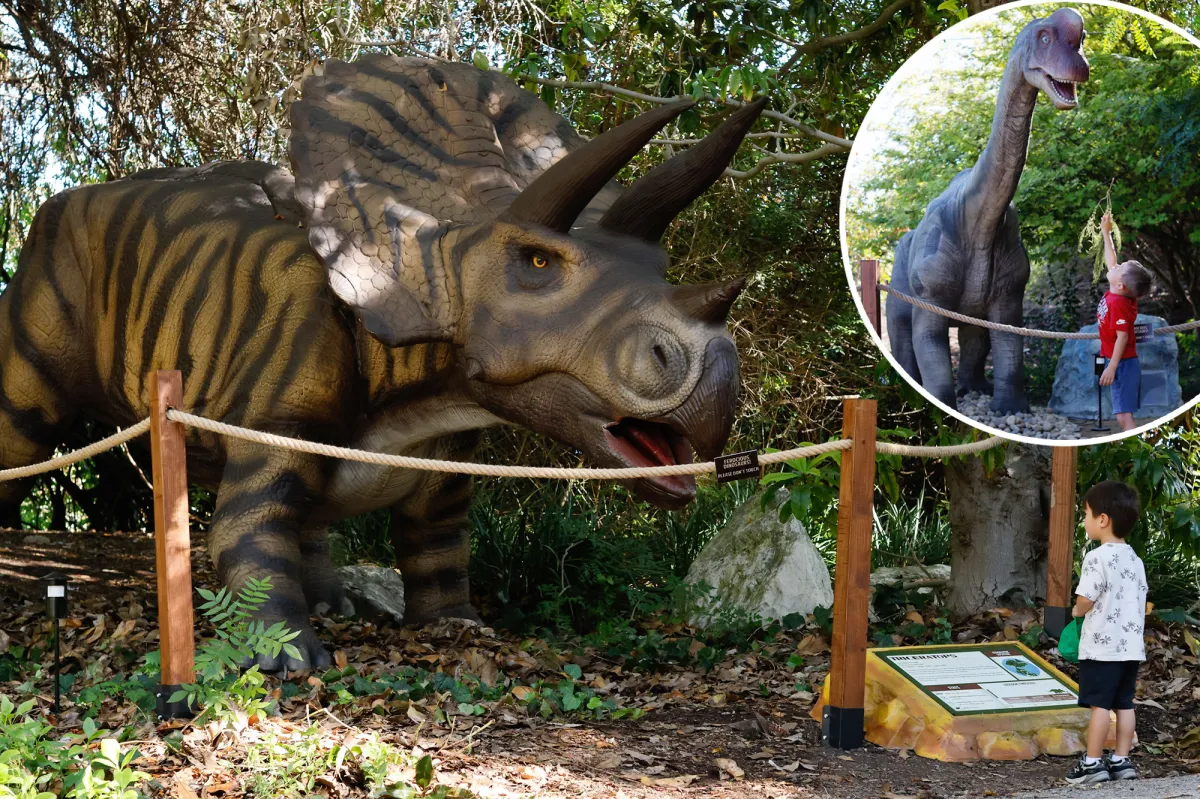
Step out of your car and you’ll hear it before you see it—a low, ancient rumble swallowed by the sound of wind in the trees. You’re at the South Coast Botanic Garden, a stunning 87-acre sanctuary on the Palos Verdes Peninsula, and today the normal rules of a quiet botanical walk do not apply. Instead of just roses and succulents, you’ll find a herd of living, breathing, animatronic dinosaurs lurking among the eucalyptus and pines. The air smells like sun-warmed earth and blooming sage, but something primal makes your heart beat a little faster. A child in front of you freezes, clutching a parent’s hand, as a massive neck twists from behind a cluster of ferns. The creature’s tail whips. Its jaw creaks open. For a moment, you forget that this is a sculpture, a machine, a marvel of engineering. You are simply inside the story. That’s the magic of this place: it doesn’t ask you to suspend disbelief so much as it invites you to remember what it feels like to wonder. The garden has always been a place of quiet beauty, but when you add dinosaurs to 87 acres of living plants and flowers, you get something else entirely—a strange, joyful collision of deep time and the present moment. You don’t just walk through the garden; you journey through another world.
The animatronic dinosaurs are not hidden in some sterile hall. They are scattered throughout the garden’s winding trails, tucked into wooded glens, posed at the edge of ponds, and peeking over hillsides. You’ll meet a towering Tyrannosaurus rex with a jaw full of toothy menace, a long-necked Brachiosaurus that seems to graze the treetops, a spiked Stegosaurus, a horned Triceratops, and smaller, quicker-looking raptors that make you glance over your shoulder. Their skin texture is startlingly realistic—rough, scaly, painted in mottled shades of green, brown, and rust. Their chests heave. Their eyes blink. Their heads swivel and their bodies jerk with hydraulic power as they let out roars that seem to vibrate through your chest. There is a theatre to it all, and you become part of the audience whether you like it or not. Some visitors laugh nervously. Others clap. Kids scream with delight and hide behind their parents only to peek out a second later. Even the most skeptical adult, arms crossed, phone in hand, eventually cracks a smile when a baby dinosaur tilts its head and lets out a squeaky chirp. It’s ridiculous in the best way—a little cheesy, a little awe-inspiring, and completely endearing. The creatures are placed so carefully within the landscape that they look less like exhibits and more like residents. Every turn in the path feels like a scene from a nature documentary that never existed, or maybe one that did millions of years ago. You start to imagine what this place must have looked like when the world was young, when the seas were higher, and the green earth belonged to giants.
But this is not just a spectacle for thrill-seekers. The exhibit is quietly, wonderfully educational. Along the paths, interpretive signs and displays explain each dinosaur’s name, era, habitat, and diet. You learn which dinosaurs roamed in herds and which were solitary hunters, which ate plants and which ate flesh, and how scientists have pieced together these stories from bones, footprints, and fossilized dung. It’s the kind of learning that sneaks up on you. A six-year-old might stare at a dinosaur’s teeth and ask why they’re so sharp. A grandparent might explain that ferns and cycads were around in the age of dinosaurs, pointing to the living plants that fill the garden. And suddenly, a Sunday walk becomes a conversation about extinction, evolution, and the endurance of life. The garden itself becomes a living textbook. You’ll notice that many of the plants around you—ferns, mosses, palm-like cycads, and ancient conifers—are closely related to species that existed during the Mesozoic era. The exhibit encourages you to connect the dots between the giant creatures of the past and the fragile ecosystem of today. It sparks curiosity, and that curiosity stays with you long after you leave. You might find yourself Googling dinosaur facts over dinner or explaining to a friend what a pterosaur isn’t (hint: not technically a dinosaur). The exhibit turns casual visitors into amateur paleontologists. It makes you ask questions. It makes you care. And that, perhaps, is the most valuable thing it does—because when you care about a species that lived 150 million years ago, it becomes easier to care about the creatures in your own backyard.
There is also something deeply emotional about walking among these prehistoric giants. In our normal lives, we are strapped to our phones, our schedules, our worries. But here, surrounded by these enormous, impossible creatures, time softens. You watch a toddler negotiate with a dinosaur—no, not real, but yes, alive—and you remember what it felt like to believe. You see a ten-year-old who knows every dinosaur species by heart, proudly explaining the difference between a Jurassic and Cretaceous dinosaur to a patient dad. You see a woman in her seventies laughing at the comical head tilt of a Velociraptor, her husband snapping a photo. The exhibit creates a shared space where generations can meet. Grandparents and grandchildren don’t need the same apps or interests to stand side by side in front of a roaring T. rex and feel the same small thrill. It’s hard to be cynical when you’re staring into the unblinking eyes of a creature that once ruled the earth. You feel a strange tenderness, too. These animatronic giants are powerful, but they are also vulnerable—silent when the mechanism rests, motionless in the afternoon sun. They remind us of loss, of the great extinctions that erased entire worlds. And yet they also remind us of resilience: life finds a way, on a huge scale, and then again in a million smaller forms. In a garden that was once itself a landfill, now alive with flowers and dinosaurs, the message is even stronger. Ruined landscapes can become gardens. Lost creatures can return, in memory, in imagination, in art. It’s hard to walk away unmoved.
If you’re planning a visit, come ready to wander. The garden spans 87 acres, and the dinosaur trail threads through a large portion of it, so comfortable shoes are a must. You’ll want a camera, of course, but you’ll also want time—time to stop, to listen, to let the wind carry the roars, to watch the light filter through the trees onto a dinosaur’s spotted back. Mornings are often quieter, when the garden smells freshest and the crowds are thinner. Afternoons bring families and laughter and the delighted chaos of children on school breaks. Some visitors choose to make a day of it, bringing a picnic to enjoy at one of the garden’s grassy areas, surrounded by the odd sight of a distant dinosaur head rising above the shrubs. Check the garden’s website for current hours and ticket prices, and don’t be surprised if the dinosaur exhibit is part of a seasonal event—many visitors return year after year to see the garden shift with the seasons and the dinosaur lineup change. Beyond the dinosaurs, the garden has plenty to offer: themed plant collections, peaceful walking paths, and countless little corners made for sitting and gazing. But the dinosaurs are, undeniably, the stars. They steal the show. They make you laugh. They make you gasp. They turn a gentle stroll into an adventure and a familiar weekday outing into something you’ll tell stories about. If you can, visit late in the afternoon; the golden hour makes everything look even more magical, and the dinosaur roars echoing in the soft evening light feel less like a theme park and more like a strange, beautiful dream.
Leaving the South Coast Botanic Garden, you carry something with you. It’s not just souvenirs from the gift shop—though those are fun, too—but a renewed sense of scale. For a brief while, you shared space with creatures that lived in a world without people, without roads, without anything familiar. And yet the ferns around you, the trees, the tiny insects darting across the path—they echo that ancient world in a thousand subtle ways. The exhibit is a reminder that our planet has always been a place of constant change, constant surprise, and constant life. It humbles you. It also fills you with hope. If a garden can bloom on an old landfill, and if machines can bring back the shadows of dinosaurs, then perhaps imagination is one of the most powerful things we have. It lets us connect with a past we can never touch. It lets us teach our children about creatures we’ll never see. It lets us step out of our ordinary lives, if only for an afternoon, and feel the curious and ancient wonder of being alive on this earth. So go. Let yourself be small in front of something enormous. Let yourself be thrilled, terrified, melted, and amazed. The dinosaurs are waiting, hidden among 87 acres of green, ready to bring out the child in you. The only question is whether you’ll dare to meet them.