

It’s no secret that the American romantic landscape is shifting beneath our feet, and if you’ve been paying attention to dating apps, friendship circles, or even the news, you’ve likely felt it. Monogamy, long treated as the default setting for love and commitment, is increasingly being questioned, reimagined, and in some corners of the country, quietly retired altogether. Nowhere is this transformation more visible than in California, a state that has always welcomed the unconventional and the progressive. According to a fresh study from the dating app Sister Wives, California has been named the third most polyamorous state in the nation, with Los Angeles emerging as a genuine hotspot for those seeking to love more than one partner at a time. It’s an eye-opening snapshot of a changing culture, and it suggests that Hollywood’s famous on-screen triangles are far from just a dramatic device for the big screen. Real people in L.A. are exploring relationships that involve more than two adults, and they’re doing so with increasing openness and intention. The study, which drew from the behavior of roughly 15,000 users, found that California accounts for 7.19% of all Sister Wives signups, an impressive slice that places the Golden State solidly in the top three. What’s perhaps most interesting is that California isn’t alone. The whole country seems to be taking a second look at traditional romance, and the data suggests that polyamory is no longer a fringe curiosity or a whispered secret. It’s becoming a visible, tangible part of modern dating life, with all of its complexities, joys, and logistical challenges. For many, it’s less about rejecting love and more about expanding its possibilities, a shift that asks us to reconsider what committed relationships are supposed to look like in the twenty-first century.
If you think this trend is limited to a small, dedicated community, the national numbers might surprise you. Interest in polyamory appears to be exploding, with Google searches for the word surging by a staggering 5,000% in just the past week. That kind of meteoric rise suggests a cultural moment, a collective curiosity that goes far beyond anything we’ve seen before. While California may be the third-place finisher, the crown goes to two states that might not immediately come to mind when you think of alternative relationship styles: Texas and Florida. Texas claimed the undisputed polyamory crown, accounting for 10.08% of all Sister Wives signups, a commanding lead that blew past the competition. The Lone Star State was boosted by a thriving singles scene and more than 14,800 monthly searches for polyamory, and two of its metros cracked the top five. Houston strutted into third place among American cities with 1.86% of users, while Dallas landed fifth with 1.25%. Meanwhile, Florida snagged second place overall with 7.4% of users, proving that the Sunshine State has more than just beaches and theme parks to offer. Its nightlife spots turned out to be fertile ground for romantic sharing, with Tampa coming in 13th among the most polyamorous cities in the country with 0.66% of users, and Jacksonville tight on its heels at 14th with 0.65%. It’s a fascinating twist on the usual cultural geography, and it suggests that the desire for multiple partners doesn’t belong to any one region, ideology, or lifestyle. Southern hospitality, it turns out, can extend in ways we never quite imagined.
When you zoom in from the state level to individual cities, the picture becomes even more interesting. Atlanta, Georgia, takes the top spot as the most polyamorous city in the United States, accounting for a whopping 2.09% of all Sister Wives users. The city’s embrace of ethical non-monogamy is backed by a lively local community, including Facebook poly groups with more than 4,000 members and local surveys showing that 28% of daters in the area are open to moving beyond traditional romance. That kind of willingness to explore is a sign of the times, and Atlanta has clearly become a safe harbor for people who want to design relationships on their own terms. New York City, as you might expect, claimed second place among U.S. cities with 1.95% of users, helping to drive New York state to a fifth-place finish overall. The city that never sleeps is, of course, also a city that never seems to run out of romantic possibilities. Los Angeles landed seventh place among cities with 1.04% of users, a solid showing that cements the region’s status as a hub for open-minded dating. Yet for all the spotlight on these big, cosmopolitan centers, there are also surprising quiet places in the rankings. At the other end of the spectrum, Vermont came in dead last, mustering a meager 0.12% of users. Up there, it seems, three might genuinely be an unwelcome crowd. But even with those regional differences, the overall message is clear: polyamory has moved out of the shadows and into the mainstream conversation. It’s not about a specific kind of person or a particular part of the country. It’s about a growing number of people who are asking themselves whether love has to be limited, and who are increasingly finding the courage to answer that question for themselves.
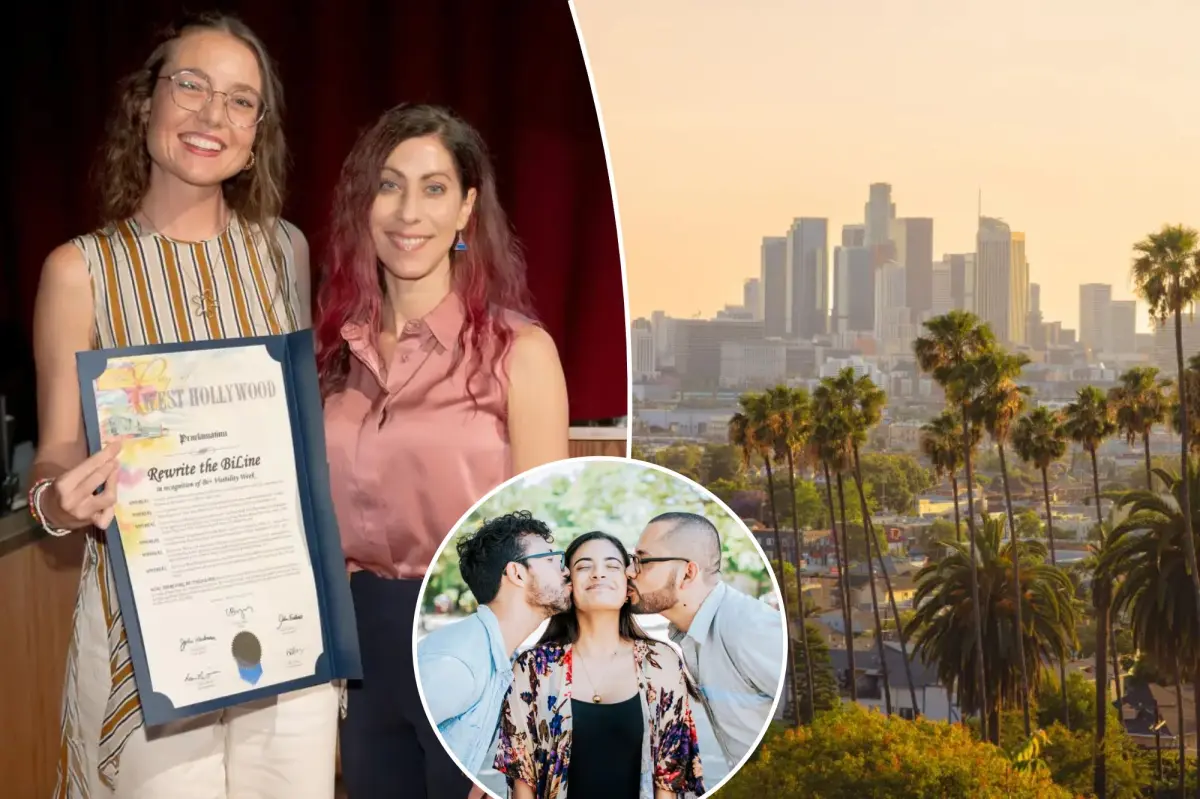
California’s embrace of polyamory isn’t just showing up in dating app data; it’s also making its way into the law books in a way that could have lasting implications. Just last week, West Hollywood officials unanimously approved a groundbreaking new domestic partnership registry that allows three or more consenting adults to formally register their relationships with the city. This is a genuinely historic step, one that acknowledges that families and committed partnerships come in many forms. The measure offers certain practical rights, including hospital visitation and additional tenant protections, which can make an enormous difference in the daily lives of people in multi-partner relationships. But it’s important to understand what it does not do. The registry does not grant the same legal rights as marriage or state-recognized domestic partnerships. That means there are still significant gaps in legal protection, from inheritance and health care decision-making to parental rights and tax matters. Still, the symbolic weight of this move cannot be overstated. When a city officially says that your relationship is worthy of recognition, even in a limited form, it sends a powerful message to residents and to the rest of the country. It says that love, in all its complexity, deserves a place in public life. It says that the law should catch up with the reality of how people actually live. And it opens the door for other municipalities and perhaps eventually states to follow suit. For the thousands of people in California who identify as polyamorous, this is more than a headline. It’s a validation. It’s a sign that their relationships are no longer invisible, and it’s a step, however small, toward a future where the law recognizes that there is no single right way to love.
So why is this happening now, and why in these particular places? The answer is a mix of social, cultural, and technological forces. Dating apps like Sister Wives have made it easier than ever for people to find like-minded partners, to be transparent about their desires, and to build communities that once felt impossible to locate. The internet has turned a scattered, often isolated population into a connected and vocal movement. At the same time, the broader culture has shifted. The language of consent, communication, and emotional honesty has become central to how we talk about relationships, and those values align naturally with the principles of ethical non-monogamy. People are increasingly rejecting the idea that jealousy and possessiveness are unavoidable parts of love. They’re asking hard questions about what they truly need from their romantic lives, and many are discovering that the answer is more expansive than they were raised to believe. In cities like Atlanta, Austin, New York, and Los Angeles, there is a density of progressive-minded singles that makes it easier to find partners willing to explore non-traditional arrangements. In places like Tampa and Jacksonville, vibrant nightlife scenes create opportunities for casual and serious connections alike. And in Texas, with its booming economy and growing urban centers, there’s a sense of possibility and reinvention that extends to relationships. Meanwhile, California’s long history as a land of alternative lifestyles, from free love to queer liberation, makes it a natural home for polyamory. The state has always been a place where people come to reinvent themselves, and that spirit of experimentation is clearly carrying over into the bedroom and the living room.
The rise of polyamory is not just a story about sex or dating. It’s a story about how we define family, commitment, and happiness in a world that is changing faster than our institutions can keep up. It raises profound questions. Can you love more than one person deeply and honestly without dividing yourself into pieces? Can jealousy be managed, or even transformed, with enough communication and trust? What does a healthy relationship look like when there is no script to follow? The people exploring polyamory are, in many ways, pioneers. They are navigating uncharted territory without maps, building relationship structures from scratch, and learning as they go. Some of these arrangements will work beautifully, providing profound companionship and support. Others will fail, sometimes painfully, like any relationship can. But the growing interest in polyamory suggests that a significant number of Americans are no longer content to default to tradition simply because it’s tradition. They want relationships that are honest, meaningful, and tailored to their actual lives. And they want the legal and social recognition that comes with that. The West Hollywood registry is a small but significant step in that direction, and the massive surge in searches and app signups suggests that public appetite for these conversations is only growing. We may not know exactly where this cultural shift will lead, or what the American family will look like in fifty years. But one thing is clear: love is becoming more expansive, more inclusive, and more honest. And for anyone who has ever felt that their heart was too big for a single box, that is not a threat. It’s a liberation.