






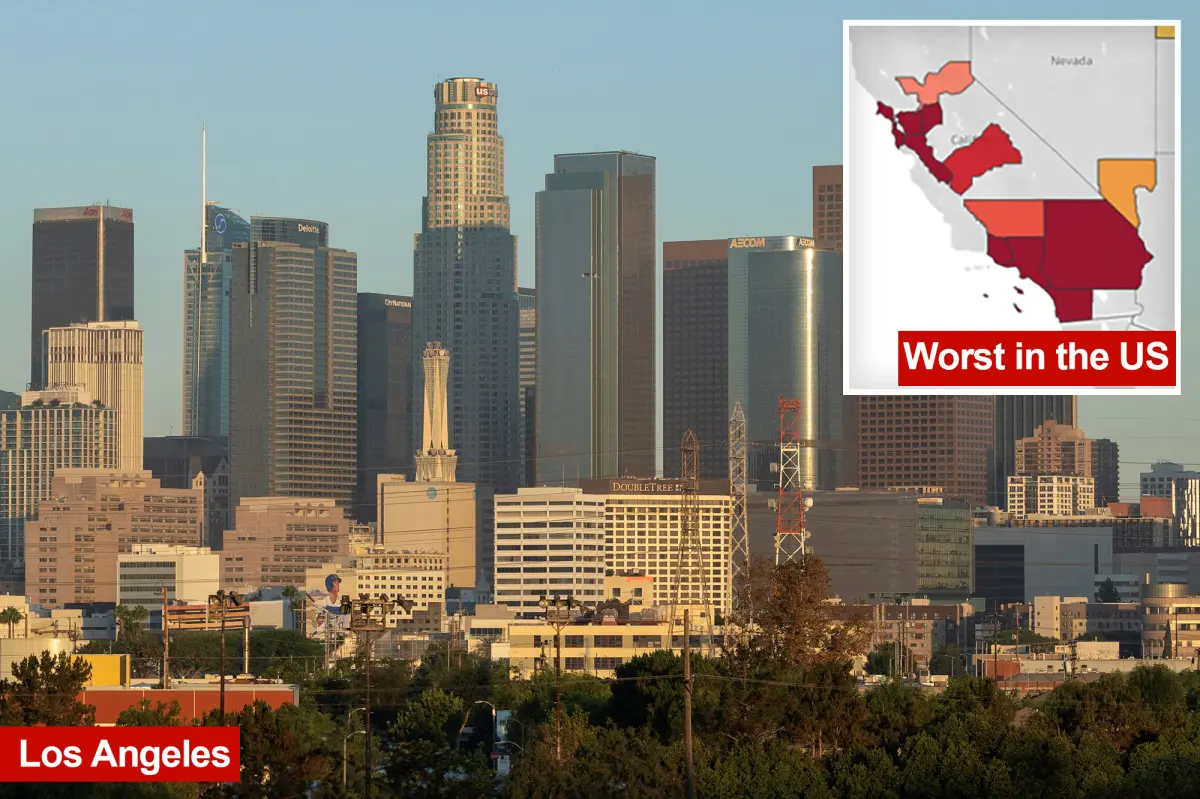
The American dream of homeownership has always carried a certain weight, but in Los Angeles, that dream has become a crushing financial nightmare that now defines the city’s reality. The City of Angels, long celebrated for its glamour and opportunity, has found itself at the very bottom of a national housing report card, earning a failing grade that underscores just how broken the housing market has become. The statistics paint a picture of a city where the gap between aspiration and reality has grown so wide that it seems almost insurmountable for the average person. What was once a place where working families could find affordable housing has transformed into a landscape where even those with solid incomes find themselves locked out of the market. The fundamental promise of American prosperity, that hard work should translate into the ability to provide shelter for one’s family, feels like a distant memory in a region that has become a cautionary tale for the entire nation.
The raw numbers behind Los Angeles’s failing grade are nothing short of staggering. Realtor.com’s comprehensive analysis ranked the LA metropolitan area dead last among America’s 100 largest metros for both housing affordability and new home construction, delivering an embarrassing F grade that reflects the severity of the crisis. The typical home in the Los Angeles-Long Beach area commands a listing price of over $1.1 million, while the median household income struggles to reach just $91,000 annually. When you put these figures side by side, the disparity becomes painfully clear. A family earning the median income, attempting to purchase that typical home with a modest 10% down payment and a standard 30-year mortgage at 6.5% interest, would find themselves devoting a breathtaking 84.4% of their monthly income to housing costs. This figure is nearly three times the 30% threshold that financial experts have long considered the maximum for healthy housing affordability. The math simply does not work for ordinary families, and the consequences ripple through every aspect of life in the region, affecting everything from family budgets to career choices to the fundamental question of whether one can even continue to call this city home.
To truly understand the depth of this crisis, one must consider what it would actually take for a typical Los Angeles family to achieve that mythical 30% housing cost ratio. The analysis reveals a truly mind-boggling figure: a buyer would need to make a down payment of approximately 68% of the home’s purchase price, which translates to roughly $768,000 in cold, hard cash. This is not a savings goal that represents prudent financial planning; it is an impossibility for the vast majority of American families. As Realtor.com’s Senior Economist Joel Berner bluntly stated, a monthly mortgage payment on the typical LA home is simply not affordable to typical income earners. The human toll of this reality cannot be overstated. Teachers, nurses, firefighters, and the essential workers who keep the city running find themselves priced out of the very communities they serve. Young families are forced to choose between crippling housing costs and leaving behind their support networks, their jobs, and their roots. The American Dream has not just been deferred in Los Angeles; for many, it has been effectively cancelled, replaced by a cycle of rising rents, precarious living situations, and the constant anxiety of wondering whether one missed payment could lead to displacement.
The housing crisis in Los Angeles is not merely a problem of high prices; it is also a crisis of supply that shows no signs of abating. The region’s permit-to-population ratio stands at just 0.47, meaning that for every resident in the area, fewer than half as many homes are being permitted as the national average. This staggering shortfall means that the supply-side price relief that economists might hope for is not on the horizon, leaving buyers with little expectation of finding more affordable options anytime soon. The lack of new construction represents a failure not just of market forces but of policy, planning, and political will. While the city has shown some signs of price softening, with home values dipping slightly from a year earlier, this modest adjustment does nothing to address the fundamental imbalance between supply and demand that has driven the market to such extremes. The result is a housing ecosystem that serves investors and the wealthy while excluding everyone else, a system that has become so entrenched that even the natural market corrections seen in other parts of the country barely register in the Los Angeles market.
The humiliation of Los Angeles’s failing grade is not an isolated phenomenon, as much of California finds itself clustered at the bottom of the national rankings, painting a stark picture of a state in crisis. Oxnard-Thousand Oaks-Ventura ranked 95th, San Francisco-Oakland came in at 94th, San Diego at 92nd, Stockton-Lodi at 91st, and San Jose at 90th, all receiving F grades. Even Riverside, which managed to score slightly better at 88th place, still received a failing mark, though its relatively stronger homebuilding score of 50.5 offers a possible glimmer of hope for future buyers. In total, seven of the 13 metropolitan areas that received F grades were in California, demonstrating that this is not merely a Los Angeles problem but a systemic issue affecting the entire state. The other failing metros include Providence, Rhode Island; New York-Newark; Honolulu; Boston; Worcester, Massachusetts; and Miami-Fort Lauderdale. This geographic distribution reveals a troubling pattern: the nation’s most desirable and economically vibrant regions are simultaneously its most unaffordable, creating a paradox where opportunity and exclusion go hand in hand.
Yet even in this landscape of housing despair, there exists a counterpoint that offers a vision of what could be possible with different priorities and policies. Des Moines, Iowa, topped the national report card for both affordability and homebuilding, demonstrating that it is possible to create housing markets that work for ordinary people. The contrast between Los Angeles and Des Moines is not merely a matter of geography or population density; it reflects fundamentally different approaches to housing policy, land use regulation, and the political will to address the needs of working families. While California grapples with the consequences of decades of restrictive zoning, limited construction, and runaway speculation, places like Des Moines have managed to maintain a balance between economic growth and housing affordability. The lesson is clear: the housing crisis in Los Angeles is not an inevitable consequence of urban success but rather the result of choices made and opportunities missed. As the city confronts its failing grade, it faces a moment of reckoning that will require difficult decisions about growth, development, and the very character of the community. The question is whether Los Angeles can learn from its failures and from the success of places like Des Moines before the dream of homeownership becomes permanently out of reach for generations to come.