





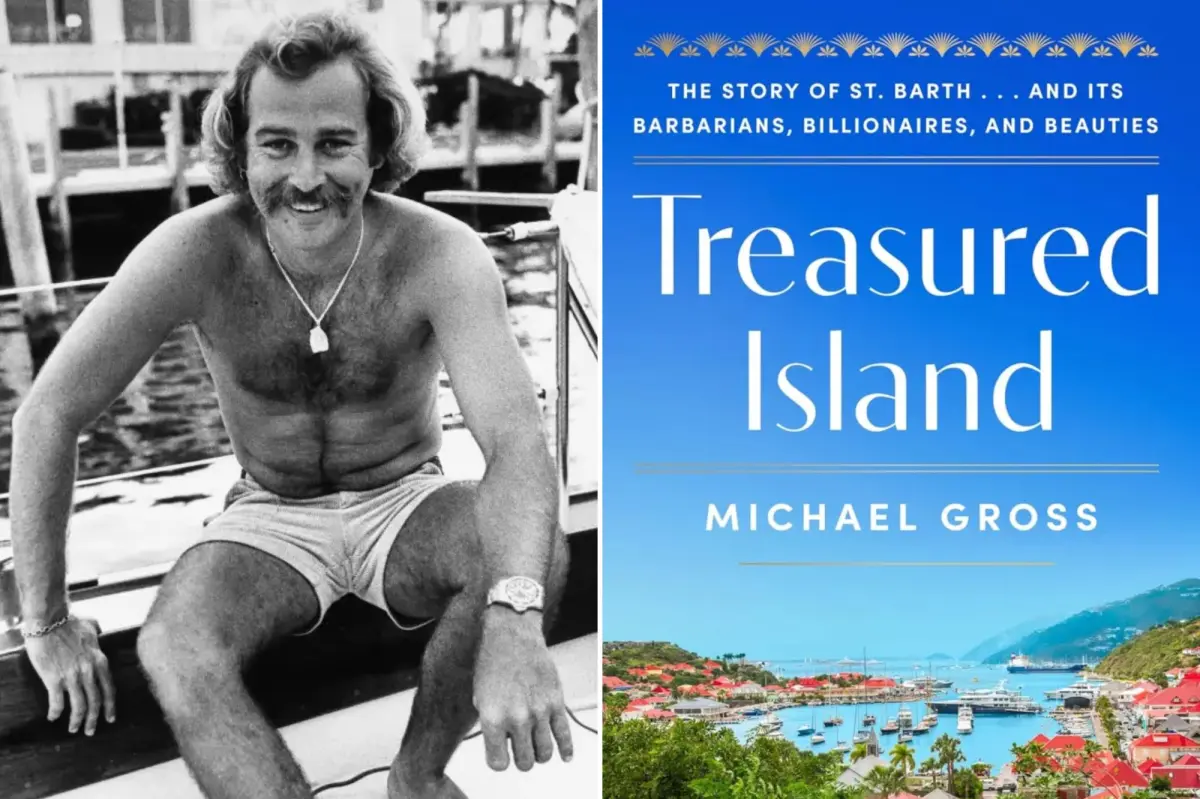
Long before St. Barth became the pristine, manicured playground of modern billionaires, superyachts, and highly exclusive beach clubs, it existed as a raw, scruffy, and somewhat lawless outpost in the Caribbean Sea. In the late 1960s and 1970s, this tiny French island was not a haven for luxury fashion houses, but rather a magnetic sanctuary for an eclectic crew of ex-pat dropouts, draft dodgers, drifters, and self-proclaimed modern pirates looking to escape the suffocating structures of conventional society. Among the first of this new wave of arrivals was David Wegman, a free-spirited, self-taught artist and musician from Fort Wayne, Indiana. Wegman’s journey to the island was a testament to the era’s restless search for absolute freedom; after abandoning his previous life as a dragster racer on the United States’ East Coast, he lived aboard a boat off Key West before setting sail for the Caribbean. In 1974, he rowed ashore at Gustavia harbor from his sailboat, The African Queen III, seeking fuel for his stove. He was met not with customs forms and red tape, but with a friendly local who traded a bottle of overproof rum for his needs, cementing Wegman’s love for this unpretentious tropical paradise. Within a few years, Wegman found himself back in the bohemian ecosystem of Key West, living above a dive bar on Duval Street. It was here that he crossed paths with an aspiring, hitherto unsuccessful Nashville country songwriter named Jimmy Buffett, who was playing gigs for meager tips. Wegman painted the wooden signs advertising Buffett’s early shows, while a mutual friend named J.J. Walsh worked at a small restaurant just up the road. Together, this loose-knit circle of sun-drenched dreamers, small-time hustlers, and artists formed a tight bond, unaware that their shared thirst for adventure, cheap rum, and open water would soon redefine the cultural landscape of St. Barth and turn a sleepy volcanic island into a legendary nexus of tropical hedonism.
As the 1970s progressed, the economy of St. Barth remained deeply rooted in its historic tradition of maritime smuggling, though the cargo was rapidly evolving from traditional contraband like French perfume, electronics, and alcohol to high-grade marijuana and hashish. While characters like J.J. Walsh and Larry “Groovy” Gray successfully navigated these warm waters, David Wegman found himself entangled in one of the most audacious smuggling operations of the era. In 1979, Wegman was approached by representatives of a massive, Mafia-connected criminal enterprise who presented him with an offer he simply couldn’t refuse. This led to his role as a crew member aboard the Olaug, a mammoth 189-foot Liberian cargo vessel. The ship embarked on a dizzying international journey, sailing from Trinidad to the coast of Lebanon to load a massive shipment of illegal narcotics, before charting a course back toward the United States. However, the voyage came to a dramatic halt off the coast of Sandy Hook, New Jersey, when federal agents intercepted the vessel. In the hold of the Olaug, authorities discovered 480 burlap bags stuffed to the brim with inner tubes containing 42,000 pounds of hashish—a haul valued at a staggering $40 million, which the prosecuting U.S. Attorney proudly declared to be the single largest seizure of hashish in American history to date. Wegman and four of his fellow crewmates originally pleaded innocent but eventually adjusted their pleas, resulting in an eighteen-month sentence in a federal penitentiary. Far from breaking his spirit, the prison stint only sharpened Wegman’s desire for the carefree life of the islands. Immediately upon his release in 1981, he reclaimed his beloved old sailboat, steered it back to St. Barth, and dropped anchor in the sapphire waters of Saint-Jean Bay, right alongside the vessel of another notorious marijuana smuggler named Les Riley. It was during this heady homecoming period that Wegman painted the legendary, brightly colored wood-carved “Cheeseburger in Paradise” sign that would hang outside the island’s most iconic tavern, immortalizing a favorite catchphrase of his old smuggler buddy, Groovy Gray.
By the end of the 1970s, Jimmy Buffett had also fallen hopelessly in love with the sun-baked, slow-paced allure of St. Barth, viewing it as the real-life manifestation of the escapist mythology he was actively weaving into his music. In 1979, he decided to put down roots on the island by partnering with J.J. Walsh and Groovy Gray to purchase an older, somewhat dilapidated hotel and restaurant in the sleepy town of Lorient called Autour du Rocher. Buffett’s romantic, often naive vision of hotel ownership was deeply inspired by Herman Wouk’s classic comic novel Don’t Stop the Carnival, which hilariously chronicles the endless logistical disasters and colorful eccentricities of running a resort on a fictional Caribbean island. For Buffett, Autour du Rocher was never a calculated business venture; indeed, he would later candidly describe the property as a massive, unending financial nightmare and a beautifully stupid thing to own, admitting he never saw a single dime of profit return from his investment. Instead, the true value of the hotel lay in the pure, unadulterated bragging rights it afforded him—allowing him to sit comfortably on a barstool anywhere in the world and proudly declare to strangers that he owned a piece of a legendary, lawless drinking establishment in the West Indies. To fund this lifestyle and commit fully to the island, Buffett sold his prized sailboat, Euphoria II, during a casual transaction at Le Sélect bar and purchased a charming home overlooking the sweeping vistas of Saint-Jean. Meanwhile, the hotel quickly transformed under the direction of Walsh, Gray, and Wegman. The team installed a pool table, opened a quirky jewelry boutique, and began selling hand-designed Autour du Rocher T-shirts screen-printed by Wegman, whose pastels of local island life were snapped up by wealthy visitors for thousands of dollars. The hotel became a physical extension of Buffett’s songs: a place where the lines between reality and fiction blurred, and where anyone with a thirst for adventure could find a temporary home.
The fragile, insular peace of this tropical sanctuary was not destined to last without friction, particularly as the outside world began to catch wind of the island’s lawless charm. The burgeoning celebrity culture on St. Barth, spearheaded largely by Buffett’s presence, received a jolt of unwanted publicity with the publication of a high-profile Rolling Stone profile of the musician. In the article, writer Chet Flippo candidly remarked that Buffett had previously run marijuana through the islands himself and painted St. Barth as a notorious, daytime-sleepy smuggler’s haven where outlaws slipped their boats into the dark ocean waters under the cover of night to conduct illicit business. This public revelation represented a massive, unforgivable breach of the sacred smuggler’s code of silence, deeply angering many of the hardened fugitives and local captains who relied on anonymity to survive. Wegman recalled that several prominent island figures threatened Buffett, warning him to keep his mouth shut if he wanted to remain on St. Barth. Ultimately, it was only through his immense personal charm, his willingness to play free acoustic concerts for the locals, and his status as a beloved performer that Buffett managed to barely smooth over the brewing tension. This era marked the transition of St. Barth into a premier celebrity destination, a transformation fueled by the contrast between its rough-around-the-edges infrastructure and its beautiful clientele. The nightly social circuit of this wild crowd invariably began at Le Sélect in Gustavia, which Flippo described as a grimy, open-air crossroads populated by exotic charlatans, conspiratorial whispers in multiple languages, and wandering dogs, featuring primitive outhouses that would make a sewer rat gag. It was here that wealthy elites, naked hippie children, and hard-eyed drug runners drank cheap beer hand-in-hand, before migrating to the late-night scene at the PLM hotel—where Billy Joel famously first met a young Christie Brinkley—and finally ending their wild nights at the chaotic sanctuary of Autour du Rocher.
To those who lived through the golden age of Autour du Rocher, the hotel was much more than a business; it was a nightly theater of absurd, beautiful, and highly illicit human behavior. The venue remained quiet and ghostly empty until about one in the morning, at which point it suddenly erupted with a chaotic mix of local restaurant workers looking to unwind, adventurous young American tourists drawn like moths to a flame, and the wealthy smugglers who financed the entire scene. Dylan Doherty, who landed a job as the club’s teenage disc jockey, found himself standing directly in the eye of this drug-fueled hurricane. Doherty recalled that the smugglers, despite their massive wealth, hummed with a deceptively blue-collar energy, dressing like ordinary construction workers or electricians while throwing astronomical sums of cash around the bar with reckless abandon. To survive and thrive in this environment, Doherty embraced the smugglers, earning their trust to the point where they would casually use him as a temporary custodian for their illicit cargo. While performing odd jobs on various sailboats around the harbor, such as repairing a broken mast, the young DJ would routinely stumble upon jaw-dropping sights: thirty tightly packed bales of marijuana lining a cabin, or heavy duffel bags stuffed to the brim with bricks of cold, hard cash. Smugglers would hand him bags of cocaine for safekeeping, only to show up at his house days later asking, “Hey Dylan, where’s that bag?” The atmosphere was an intoxicating, highly dangerous cocktail of youthful innocence and adult criminality, where teenage kids were exposed to a lifetime of wild experiences in a single season, learning valuable, rough-hewn life lessons amidst a backdrop of extreme wealth, coastal beauty, and total systemic lawlessness.
As the 1980s took hold, the easygoing, weed-fueled counterculture of St. Barth began to shift into a much faster, far more volatile gear, driven by the explosive arrival of high-grade South American cocaine. Brett McKee, a young and adventurous smuggler who arrived on the island in 1980 for a brief three-week vacation only to end up staying for four wild years, witnessed this dramatic evolution firsthand. McKee admitted that he quickly fell in with the wrong crowd, losing himself in a spiral of hedonism that rapidly progressed from simple beers and marijuana into what he termed “the cloud”—the high-octane, incredibly chaotic world of cocaine. The memories of this period are a vivid, X-rated blur of nonstop indulgence: spending sun-drenched days on speedboats, watching the sunset at tennis star Yannick Noah’s private villa, and attending uninhibited orgies at Groovy Gray’s house. By the time the sun began to rise over Autour du Rocher, the patrons’ cognitive functions were completely shot, replaced by a raw, primal pursuit of pleasure that pushed all boundaries of societal decency. McKee recalled crashed pickup trucks, casual sexual encounters in full view of onlookers peer-watching through the hotel windows, and legendary scenes of sheer debauchery where individuals on the pool table passed around silver trays laden with lines of cocaine. Looking back on those days, McKee and others of his generation do so with a mixture of sheer disbelief and a strange, wistful nostalgia for a lost epoch of unbridled personal freedom. While Autour du Rocher eventually burned down in a mysterious fire years later, the wild spirits of the modern pirates, artists, and musicians who once called its barstools home left an indelible mark on the island. Their lawless, beautiful madness established the initial mystique of St. Barth, creating a legendary romantic lore that continues to whisper beneath the polished, ultra-luxurious surface of the modern Caribbean paradise.