


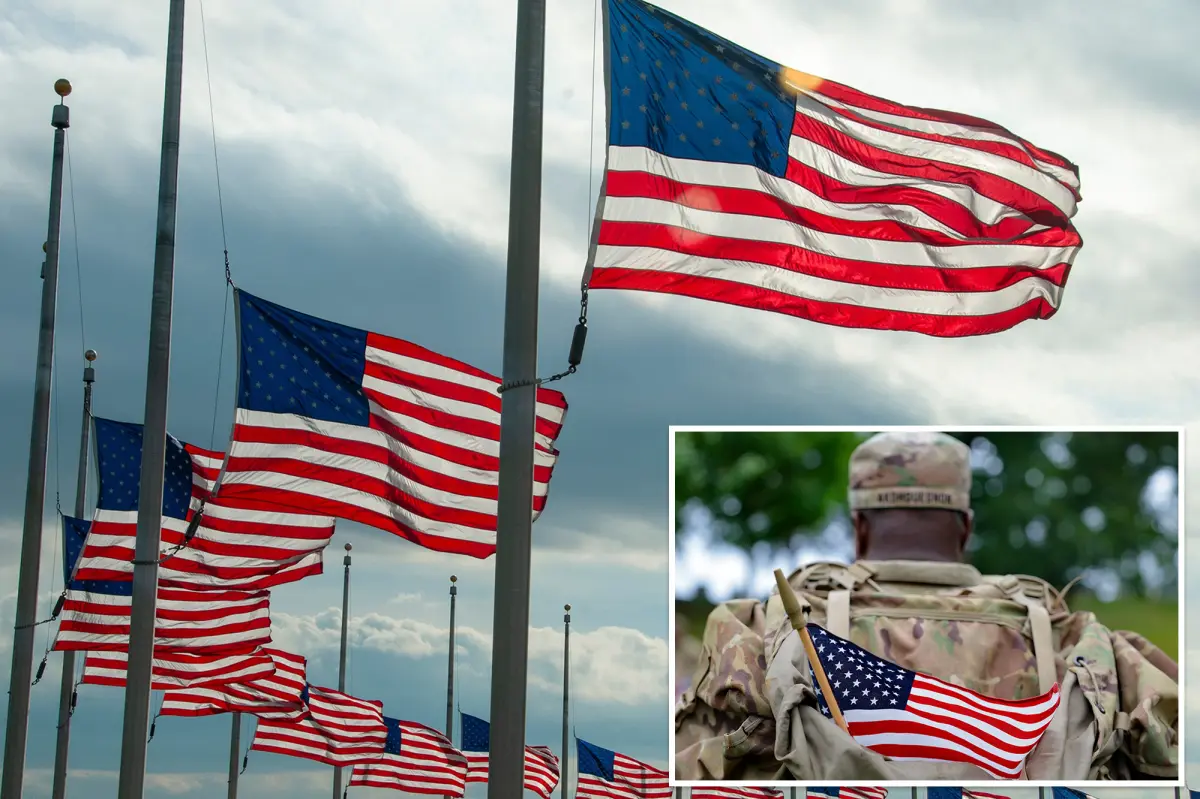
Every year, as the final Monday of May approaches, a quiet, contemplative hush settles over the United States, transforming bustling city squares, tranquil suburban neighborhoods, and rural country roads alike into sacred spaces of profound, collective reflection. From the sun-kissed coastlines of Hawaii and the vast, open plains of Texas, to the historic avenues of Georgia and New York—where the stark, black-and-white POW-MIA flag joins the American flag over all state buildings from sunrise to sunset—the nation pauses to engage in an act of remembrance that transcends mere holiday barbecues and long three-day weekends. This is Memorial Day, a solemn window dedicated exclusively to honoring the countless members of the United States Armed Forces who laid down their lives in the service of their country. At the very heart of this national tribute is the American flag, a vibrant physical emblem that serves as a canvas for our shared grief and deepest gratitude. Yet, the flag’s presence on this historic day is not designed to be a static display; it is a deeply codified, physically dynamic performance of mourning and resilience. When ordered to fly at half-staff, the banner serves as a silent, heartbreaking proxy for the thousands of young men and women who marched off to foreign shores and never returned, leaving behind vacant chairs at family dinner tables, unfulfilled dreams, and grieving communities. For Gold Star families, who live with the quiet, permanent ache of loss every single day of the year, this highly visible posturing of the flag is a crucial validation of their private sorrow, showing them that their immense personal sacrifice is recognized, felt, and held in the highest esteem by a grateful country. It is a visual whisper of comfort cast across a vast, complex landscape, ensuring that the legacy of those who gave everything to preserve the ideals of liberty remains vividly alive in the hearts of the living.
Despite the long-standing, meticulous traditions governing this national day of remembrance, many well-meaning citizens inadvertently overlook the precise choreography dictated by the United States Flag Code, mistakenly leaving their flags either fully raised or completely lowered all day long. As veteran advocates such as Aaron Bacon of the American Legion emphasize, this simple oversight inadvertently strips the day of its highly intentional narrative arc, missing the profound psychological and emotional transition embedded in the flag’s physical movement. To truly understand why this movement matters, one must travel back through the corridors of time to the emotional aftermath of the American Civil War, a catastrophic domestic conflict that tore the nation apart and left behind a landscape deeply scarred by unimaginable tragedy and loss. It was in 1868, amidst the raw wounds of a healing republic, that the tradition was born as “Decoration Day,” of which the Grand Army of the Republic originally declared a time set aside for surviving families, grieving mothers, and comrades to adorn the graves of fallen soldiers with the first sweet blooms of spring. For over a century, localized communities gathered in quiet cemeteries to manually lay flowers on headstones, slowly transforming their private grief into a collaborative, national ritual of community healing. This grassroots movement continued to grow alongside the nation, eventually leading Congress to formally designate Memorial Day as an official national federal holiday, a declaration made over five decades ago that anchored it permanently to the last Monday in May starting in 1971. This crucial legislative milestone, passing through the Uniform Monday Holiday Act, was not merely about creating a convenient long holiday weekend, but rather about institutionalizing a national promise that the rapid passage of decades would never erode the memory of those who died to keep the union intact, nor diminish the dignity of the symbols we lift in their honor.
The human core of Memorial Day lives on within the spoken and unspoken stories of those who never had the chance to grow old, narratives that demand to be told continuously to keep their immense sacrifices from fading into cold, sterile historical statistics. In his poignant 1992 Memorial Day radio address, President George H.W. Bush captured this societal imperative with striking clarity, urging the nation to speak the names of the fallen aloud so that their grieving relatives would know they do not carry their heavy burdens of sorrow in lonely isolation. “On this day, we must tell the stories of those who fought and died in freedom’s cause. We must tell their stories because those who’ve lost loved ones need to know that a grateful Nation will always remember,” Bush proclaimed, speaking with the deep empathy of a combat veteran who had watched his own classmates and flight crew perish in the skies of the Pacific. He understood that a nation’s character is defined not only by its political triumphs, but by how it honors its dead, emphasizing that actively passing these narratives down to children and grandchildren is the only way to safeguard the fragile experiment of our democracy. “We must tell their stories so that our children and grandchildren will understand what our lives might have been like had it not been for their sacrifice,” he added, highlighting the terrifying parallel of what could have been. When future generations understand that their everyday liberties—their freedom to speak, worship, choose, and live without fear—were purchased at the agonizing price of young lives cut short, those freedoms cease to be taken for granted. This humanized legacy transforms the abstract concept of patriotism into an active, generational covenant of gratitude, ensuring that the final letters home, the family portraits left on fireplace mantles, and the empty uniforms are met with active preservation rather than complacent silence or apathy.
The actual technical choreography of the flag on Memorial Day morning is a beautiful, solemn ritual that directly mirrors the emotional trajectory of a nation grappling with both heavy grief and unyielding hope. At the very moment of sunrise, keepers of the flag do not simply raise the banner halfway; instead, in accordance with the strict mandates of the US Flag Code, they hoist it briskly and triumphantly to the very peak of the staff for a brief, shining moment before slowly, reverently lowering it to the midpoint. This initial, rapid rise to the top pays instant homage to the nobility of the service members’ lives and achievements, while the subsequent lowering represents a nation sinking into collective mourning, bowing its head in recognition of the brutal, ongoing cost of conflict. The flag remains at this half-staff position until precisely noon, a quiet interval dedicated entirely to reflecting on the sacrifices of the fallen and standing in solidarity with the families who still bear the psychological scars of their absence. But at the stroke of midday, a powerful and symbolic transformation occurs: the flag is ceremonially raised once more to full-staff, where it remains proudly unfurled until the sun sinks below the horizon. As noted by the experts at the Colorado-based Custom Flag Company, this midday transition is incredibly intentional and powerful, shifting the focus of the day from a morning of mourning the dead to an afternoon of celebrating the living. Raising the flag signifies that the nation refuses to remain defeated by grief; it is a fierce declaration of national resolve, an active reminder that our country moves forward. Aaron Bacon of the American Legion reiterates this, explaining that “that moment when the flag is raised isn’t just a rule; it reflects the sacrifice and resilience of our nation and those who serve,” embodying a promise that the republic will continue to champion liberty and support those who protect it.
While Memorial Day stands as the primary annual occasion for this collective demonstration of grief and national resilience, the United States Flag Code reserves this somber half-staff protocol for only five other specifically designated calendar dates, each representing a distinct, deeply human chapter of American sacrifice and trial. The first of these occurs on Peace Officers Memorial Day, observed every May 15, which honors the courageous local law enforcement officers who laid down their lives protecting their hometown communities. This is followed later in the summer on July 27 by United States Korean War Veterans Armistice Day, a solemn occasion that remembers those who fought in the brutal winter trenches of a conflict that is too often overlooked in average history textbook accounts. Later in the year, the flag is lowered on Patriot Day, September 11, drawing the entire nation back to the world-altering tragedies of the 2001 terrorist attacks, honoring both the victims and the profound selflessness of the first responders who ran directly into danger. Then, on National Pearl Harbor Remembrance Day, observed on December 7, the flag dips to half-staff to mark the infamous 1941 surprise attack that thrust an entire generation of Americans into the crucible of World War II. Beyond these four set calendar dates, the flag is also lowered to half-staff when specifically ordered by the President of the United States during periods of profound mourning following the death of major public figures or in the immediate wake of unspeakable national tragedies that shake the nation’s conscience. Together, these days serve as a permanent framework of remembrance, illustrating that the flag is a living, breathing metric of our national heart, dipping low to share in our pain and rising high to celebrate our stubborn endurance.
Ultimately, observing these precise flag protocols with dedication, accuracy, and care is not an empty exercise in civic bureaucracy or nationalistic vanity; it is an active, deeply personal gesture of empathy toward the countless families whose realities have been permanently altered by service and sacrifice. When we take the vital moments to step outside our homes, schools, and offices to perform the physical transition of the flag from half-staff to full-staff, we are active participants in a living monument, signaling to veteran families that their pain is openly observed, respected, and carried by the community surrounding them. As Aaron Bacon passionately emphasizes, the American flag must never be treated as just a piece of colorful polyester or cotton decoration to be casually strung up for holiday aesthetic enjoyment and then forgotten amidst the rush of weekend plans; it is a sacred tapestry woven from the threads of courage, devotion, and supreme selflessness, representing those who gave their lives for our freedoms and their left-behind families who carry the weight of that legacy. By committing ourselves to understand and practice these daily customs, we ensure that the memory of our fallen warriors remains vibrant, dynamic, and deeply humanized in our modern, often-distracted communities. In this simple, rhythmic act of raising and lowering the flag, we find a beautiful, enduring metaphor for the human condition itself: a powerful acknowledgment that while we must always make space to weep for what we have lost, we must also summon the strength to stand tall, look toward the horizon, and build a future worthy of their incredible sacrifice. By taking these actions seriously, we bridge the gap between historical text and human heart, proving that the star-spangled banner does indeed still wave over a nation that remembers, honors, and loves its defenders.