


To wander through the vast, windswept horizons of Yellowstone National Park, the Florissant Fossil Beds of Colorado, or the rugged, majestic badlands of Theodore Roosevelt National Park is to cross paths with a silent, stony mystery that has transcended time. Standing tall against the elements are incredible natural monuments: towering, petrified tree trunks frozen in time, pointing straight up toward the heavens like ancient sentinels. For centuries, these remarkable geological formations, scientifically classified as “polystrate fossils,” have quietly existed as marvels of the natural world, beloved by hikers and park rangers alike. However, they have recently become the dramatic focal point of a deeply human and passionate debate over the very history of our planet, capturing the imaginations of millions on social media and reigniting an age-old clash between faith and science. The heart of the controversy lies in the physical nature of these trees: they pierce vertically through multiple thick layers of sedimentary rock—rock strata that mainstream geologists traditionally claim took millions of years to slowly deposit and solidify. This stark contrast between vertical, organic trunks and horizontal, slow-growing rock layers has caused a massive stir, leading some researchers and biblical literalists to suggest that these petrified forests might not be the slow-cooked results of evolutionary eras, but rather the dramatic, sudden calling cards of Noah’s Flood and the Great Deluge described in ancient scriptures.
For those who look at the world through the lens of biblical literalism, the traditional evolutionary timeline of these fossilized trees simply does not make logical sense when applied to basic biology. Think about the lifecycle of a tree: when a giant tree dies in the forest today, it does not remain standing upright for hundreds of thousands of years, patiently waiting for infinitesimal specks of dust, windblown dirt, and river silt to gently settle around its bark until it is buried. Long before a few inches of soil could form, the tree would succumb to the relentless forces of nature; it would rot, get eaten away by insects, be toppled by the wind, and dissolve back into the earth. This common-sense argument was recently brought into the digital spotlight by the research group Noah’s Ark Scans, whose viral posts on social media argued that a tree must be rapidly buried by massive sediment flows to prevent decay. Creation scientists, including researchers like Ian Juby, have traveled the globe to document these anomalies, pointing to places like the Joggins Fossil Cliffs in Nova Scotia, Canada, where fossilized trees are found with broken roots, tangled in layered sediment, and sometimes even buried completely upside down. To these researchers, this messy, violent arrangement is not the product of a peaceful, slow passage of time, but rather the unmistakable signature of a catastrophic, water-logged event of global proportions—a massive, sudden flood that ripped up entire forests and entombed them in thick layers of mud in a matter of days.
Mainstream geologists and scientific skeptics, however, view these formations through a very different lens, arguing that rapid burial does not conflict with an ancient Earth. Rather than attributing polystrate fossils to a single, planet-drowning supernatural deluge, they explain them through the natural lens of localized, catastrophic events that have occurred repeatedly throughout our planet’s 4.5-billion-year history. A powerful and highly instructive example of this occurred in our own modern era during the 1980 eruption of Mount St. Helens in Washington State. When the volcano erupted with unimaginable fury, it triggered massive landslides, volcanic mudflows, and giant waves that swept millions of trees into nearby Spirit Lake. As these logs became waterlogged, their heavy root ends naturally sank first, causing thousands of trees to float vertically in the water. Over time, sediment from the volcanic chaos quickly settled around them, burying them upright in thick layers of mud and ash within a matter of days, perfectly replicating the structure of polystrate fossils without any global divine intervention. The late British geologist Derek Ager famously highlighted this dynamic when he argued that while the idea of a tree standing upright for hundreds of thousand of years was indeed “ridiculous,” it simply proved that geological sedimentation can be incredibly rapid at times, showing that Earth’s history is a long, slow epic punctuated by sudden, violent local disasters.
Beyond the technical debates over rock layers, root structures, and volcanic ash, this clash of perspectives reveals a deeply human struggle for meaning, identity, and truth. On digital forums and social media platforms, the conversation surrounding polystrate fossils often transcends scientific theory and erupts into emotional, deeply personal exchanges. For many believers, these petrified trunks are far more than scientific curiosity; they are physical, tangible anchors for their faith in a world that often dismisses their sacred scriptures as ancient folklore. To feel that science validates the stories of Genesis brings a sense of deep comfort, reassurance, and validation of their spiritual worldview, especially when they feel their beliefs are mocked by mainstream society. Conversely, for the scientific community, the creationist interpretation can feel like a frustrating rejection of peer-reviewed empirical evidence, an attempt to force the complex, ancient history of our planet into a rigid, literal reading of religious texts. This friction highlights a fascinating aspect of the human condition: our tendency to look at the exact same physical evidence—a stone tree frozen in the earth—and see two entirely different stories of where we came from, illustrating how our personal beliefs, fears, and hopes shape the way we interpret the physical world around us.
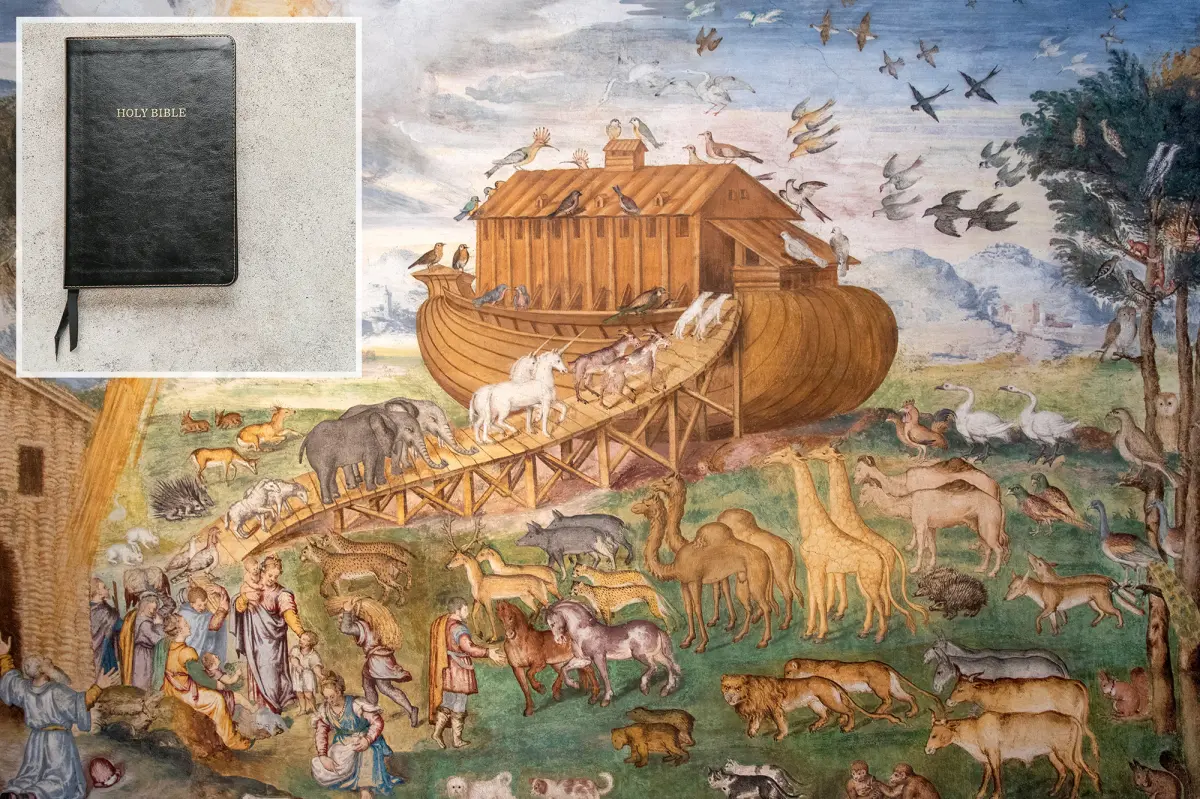
While some search for answers in the petrified forests of North America, others have taken their quest directly to the rugged, high-altitude landscapes of Eastern Turkey, hoping to find the ultimate physical proof of the Genesis narrative: the lost Ark itself. The same research group, Noah’s Ark Scans, led by investigator Andrew Jones, has been focusing their efforts on the Durupinar site—a mysterious, 538-foot boat-shaped formation nestled near Mount Ararat that matches the biblical dimensions of the Ark. Rather than rushing in with bulldozers and shovels, the team is taking a remarkably cautious, respectful, and modern scientific approach. They are utilizing non-invasive technologies, such as ground-penetrating radar and soil chemistry analysis, to peek beneath the surface without damaging the site or stirring up political and cultural controversy. Interestingly, their initial findings have yielded intriguing anomalies that have caught the attention of both supporters and curious onlookers. Soil samples taken from within the boat-shaped formation have shown distinct differences in pH levels, organic matter, and potassium compared to the surrounding earth—anomalies that the team suggests are highly consistent with the chemical signature of long-decayed wood. Furthermore, the vegetation inside the formation strangely turns yellow much earlier in the season than the surrounding grass, indicating that there is a distinct, foreign structure buried beneath the mudflow that is affecting the local soil.
In the end, whether one looks at these towering stone trees and the boat-shaped contours in Turkey as evidence of a divine flood or as the fascinating results of natural, localized geological processes, they both speak to something beautiful and enduring about the human spirit. We are, by our very nature, a species of seekers, driven by a profound need to find physical, tangible connections to the ancient stories that define our cultures and our beliefs. We want to touch the past, to find the physical evidence of the legends that we carry in our hearts, and to make sense of the immense, mysterious planet we call home. The ongoing debate over polystrate fossils and the search for Noah’s Ark remind us that science and faith do not always have to exist in a state of hostile warfare; instead, they can represent different paths of a shared human journey to understand our origins. Whether these stone columns are the remnants of a great deluge or the scars of ancient volcanic ash, they succeed in making us pause, look down at the ground beneath our feet, and wonder at the deep, mysterious history of the Earth, reminding us that there is still so much left to discover in the delicate space where the material world and the human heart meet.