


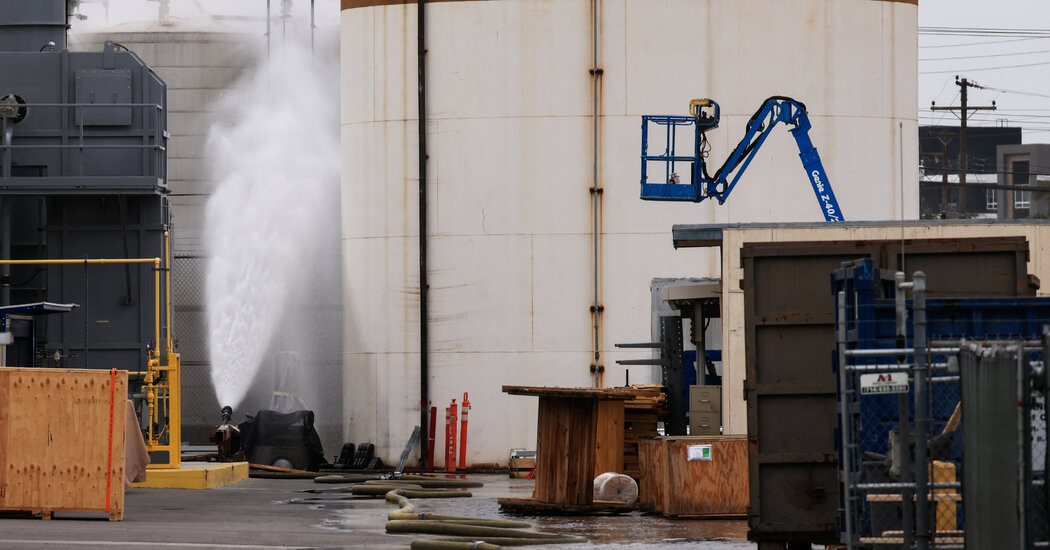
Underneath the deceptive calm of a Southern California weekend, a silent, invisible menace began to brew inside a massive 7,000-gallon industrial steel tank in Garden Grove, threatening to shatter the peace of a densely populated suburb. The vessel, located at an industrial plant owned by aerospace manufacturer GKN Aerospace, contained methyl methacrylate—a highly volatile and toxic liquid typically used in the creation of acrylic plastics and plexiglass, but which had now transformed into a ticking ecological time bomb. Throughout a tense Friday night and into Saturday morning, heat and pressure continued to build relentlessly within the unstable chamber, with internal temperature readings steadily climbing from 77 to 90 degrees Fahrenheit at an alarming rate of approximately one degree per hour. This escalating thermal runaway left emergency response officials grappling with a terrifying scenario: a catastrophic structural rupture or a massive explosion that could spew a highly toxic, suffocating cloud over a wide residential area merely miles from the gates of Disneyland. Yet, amidst the terror, there remained a delicate, nerve-wracking scientific paradox. Officials explained that the rising heat might actually be the byproduct of a chemical reaction where the liquid was beginning to cure and solidify from the outside in, much like a giant ice cube freezing through its core. If the tank’s reinforced steel shell could withstand the intense expansion and immense pressure of this curing process, the material might successfully stabilize into a harmless solid; if the structural integrity failed, however, the consequences would be sudden, violent, and devastating for the thousands of families living in its shadow.
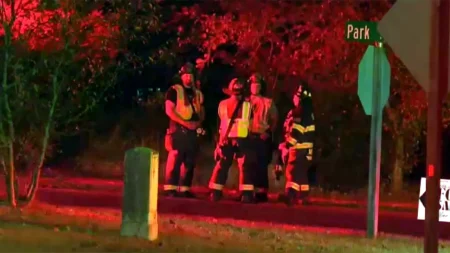
The burden of preventing this catastrophic failure fell upon the shoulders of dedicated local emergency responders, led by Craig Covey, an incident commander with the Orange County Fire Authority, who spearheaded an exhausting, round-the-clock battle to stabilize the site. In a dramatic, high-stakes overnight operation, highly trained hazardous materials crews slipped into the danger zone under the cover of darkness. Their primary mission was to eliminate the explosive potential of a second, even larger chemical tank adjacent to the failing vessel to prevent a domino-effect disaster that could level the entire industrial park. It was during this daring, pitch-black infiltration that the team was finally able to get close enough to read the primary tank’s internal temperature and pressure gauges, which had been obscured and inaccessible since Friday morning, revealing that the internal heat was rising far faster than superficial drone thermal readings had suggested. This critical discovery highlighted the absolute desperation of the situation, especially given that earlier, well-intentioned efforts by GKN Aerospace to inject a stabilizing, neutralizing agent into the volatile mixture had been completely thwarted when the tank’s valves malfunctioned and locked shut. Left with no mechanical way to cool the interior or vent the pressure, Covey’s team resorted to a continuous, heavy deluge of external water to desperately slow the thermal reaction down. Meanwhile, as a critical safety net, engineers worked frantically on emergency contingency designs to construct barriers that would redirect any toxic fluid leaks away from local storm drains and freshwater river channels, channeling any potential environmental runoff directly toward the vast, assimilative capacity of the Pacific Ocean.
As the scientific battle raged at the industrial facility, the immediate human toll of the crisis unfolded across the sprawling neighborhoods of Garden Grove, where approximately 40,000 residents were suddenly forced to flee their homes. This vibrant community, known as a cultural anchor for Southern California’s Vietnamese refugee and immigrant diaspora, faced a monumental logistical challenge as local leaders rushed to communicate the scale of the danger. Councilwoman Cindy Tran described an exhaustive, multilingual outreach effort, with city staff establishing 24-hour telephone hotlines, broadcasting emergency phone alerts in multiple languages, and sending police officers directly to suburban doorsteps under the glare of red and blue cruiser lights to ensure every family was warned. For many older Vietnamese refugees in the area, the sudden, forced midnight evacuation carried painful echoes of historic displacements, adding a heavy layer of emotional trauma to an already chaotic situation. Despite these frantic, door-to-door efforts, human nature and a deep-seated attachment to home proved powerful; local Congressman Derek Tran revealed that the Garden Grove Police Department estimated roughly 15 percent of the local population had chosen to ignore the evacuation orders. These residents elected to stay… in the potential blast zone, choosing the familiar comfort of their living rooms and the desire to protect their lifetime of accumulated possessions over the sterile uncertainty of emergency disaster shelters.
For those who did obey the evacuation orders, life was abruptly reduced to the surreal, public confines of an American Red Cross refuge established at a park in neighboring Fountain Valley. Here, the raw, personal realities of sudden displacement clashed vividly with the mundane patterns of ordinary suburban leisure under the mild Southern California sun. Inside the shelter, hundreds of displaced neighbors found themselves living a life suspended, with family pets micro-managed on leashes and lines of weary people endlessly waiting to take turns at a limited number of electrical outlets to charge cellphones and stay connected with loved ones. Outside the shelter doors, the regular rhythm of the suburban park continued uninterrupted: early-morning joggers trotted along the paths, dog-walkers strolled through the grass, golfers teed off on the adjacent greens, and children laughed as they fed breadcrumbs to ducks on the banks of a quiet pond. Among the displaced was 62-year-old Mark Olson, who had been jolted from his bed in the pre-dawn hours by a booming police loudspeaker warning and spent a painful night pacing the perimeter of the shelter, managing only three hours of sleep on a stiff emergency cot that offered no comfort to his aching back. Conversely, 77-year-old Cora Amolenda of nearby Cypress exhibited a quiet, inspiring resilience. Drawing on decades of experience working erratic night shifts as a hospital nurse, she was able to sleep soundly amid the ambient noise of the gymnasium floor, expressing profound gratitude for the care provided by volunteer staff while gently wondering when the crisis would end so she could perform the simple, dignified ritual of a warm shower.
As the hours ticked away without a resolution, the alarming scale of the industrial threat quickly escalated the situation from a local emergency to a matter of state and federal concern. On Saturday afternoon, California Governor Gavin Newsom formally declared a state of emergency, a decisive political maneuver that immediately unlocked critical state-level disaster funding, streamlined emergency coordination, and cleared away bureaucratic barriers to assist the displaced population. Simultaneously, newly elected Representative Derek Tran worked to mobilize a robust federal response, coordinating directly with the United States Environmental Protection Agency to deploy specialized toxicological observers directly to the Garden Grove site. This massive political mobilization turned a sharp, critical spotlight onto the facility’s owner, GKN Aerospace, a United Kingdom-based manufacturing giant that produces specialized military and civilian aircraft parts. The crisis underscored a historical, deeply entrenched structural reality of Southern California, which long served as a manufacturing cradle for the global aerospace industry, resulting in a complex geographic tapestry where heavy, high-risk chemical facilities operate in immediate, direct proximity to residential neighborhoods. Attempting to manage the unfolding public relations crisis, GKN Aerospace spokeswoman Marianne Mulder issued a formal statement expressing the company’s deepest apologies for the massive disruption to local families and businesses, asserting that they were working in absolute coordination with hazardous materials teams to resolve the danger as safely and swiftly as possible.
Ultimately, as Saturday evening approached, the fate of Garden Grove hovered in an agonizing waiting game, caught in a delicate balance between industrial failure, human engineering, and the unpredictable forces of the natural world. With all physical avenues of intervention exhausted due to the tank’s broken valves, the community’s safety was left entirely at the mercy of chemical kinetics and the fickle directions of the local wind. Meteorologists from the National Weather Service in San Diego, including forecaster Casey Oswant, kept a vigilant eye on the region’s mild weather patterns, noting that while morning winds were virtually nonexistent, a typical afternoon sea breeze was expected to pick up and blow steadily from the southwest to the northeast. Should the 7,000-gallon steel tank succumb to the mounting pressure and rupture violently, these precise atmospheric currents would dictate the path of the toxic methyl methacrylate plume, carrying the hazardous gas directly into neighboring suburban communities. This stark reality left the evacuated residents of Garden Grove hanging in a state of quiet, tense anticipation, reflecting the profound vulnerability of modern suburban life where safety is suddenly dictated by a silent chemical transformation occurring inside a metal cylinder and the gentle, shifting breeze coming off the Pacific Ocean.