



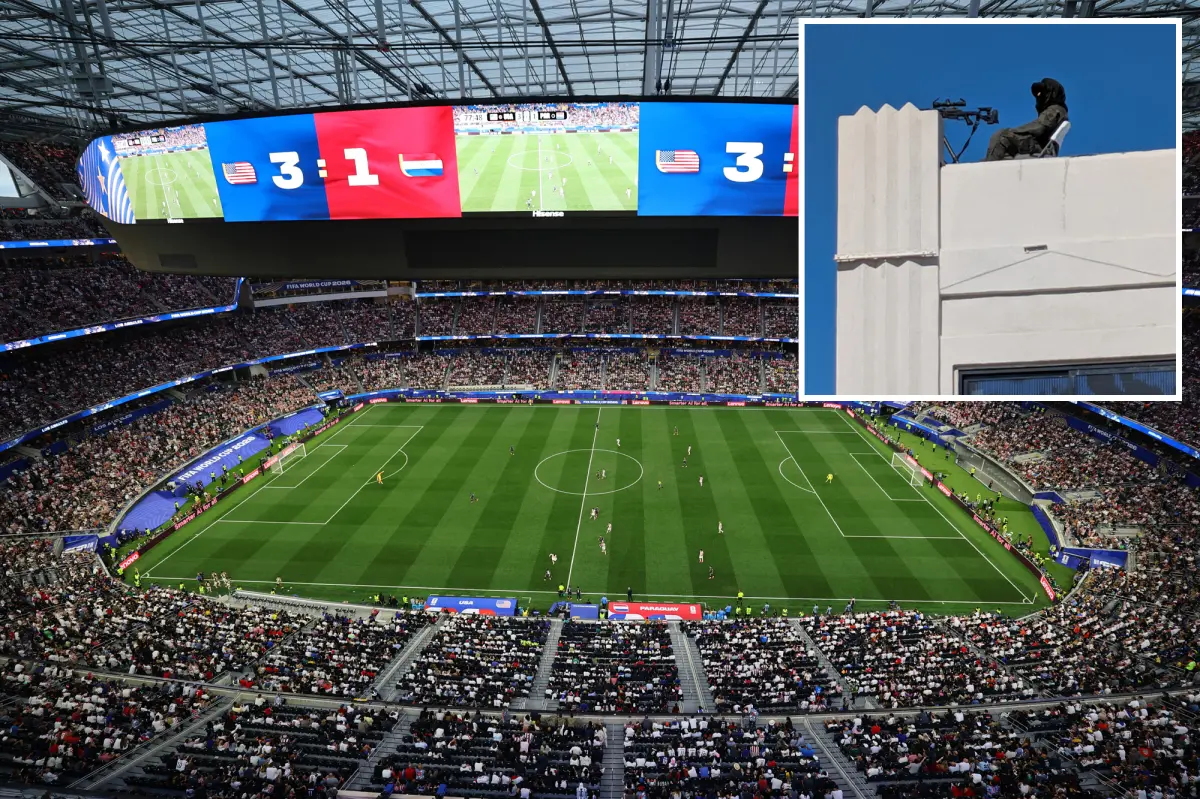
In an era dominated by instant digital connectivity, a series of arresting images captured atop the modest storefronts of Inglewood, California, quickly ignited a firestorm of public debate and collective anxiety. The photographs, circulated widely on social media platforms, depicted an unsettling and dystopian scene that felt more aligned with a cinematic war zone than a vibrant Southern California neighborhood preparing to celebrate a global sporting event. A user on X captured several high-resolution images of a dark, hooded figure dressed in tactical gear, casually perched on the flat roof of an ordinary clothing store on Market Street. Resting in front of this individual was a heavy-caliber sniper rifle, its long barrel balanced precisely on the building’s concrete ledge, pointing silently toward the streets below. Another picture revealed a similar tactical setup atop a local pawn and jewelry shop on the very same street, where the cold metal of a gun barrel glinted against the warm California sunshine. For the residents of this neighborhood, and for many who viewed the images from afar, the contrast was both jarring and immediate: just a mile away, the gleaming canopy of SoFi Stadium loomed as a monument to international athletic achievement, while on the asphalt beneath the hidden sniper rifles, local children were reportedly kicking soccer balls and playing in the street. This sudden, unannounced militarization of everyday spaces instantly transformed a moment of community anticipation into a stark reflection on the hidden costs of modern public safety.
The reaction of the local community and the businesses caught in the middle of this high-stakes security web highlights the deep divide between the operational planners who orchestrate these events and the citizens who actually inhabit the space. When reporters reached out to the local clothing store and pawnshop featured in the viral photographs, the disconnect was immediately apparent. A worker at the pawn and jewelry shop could offer no details about how the city secured permission to use their building, noting simply that management was unavailable to answer questions, illustrating how local business owners and employees are often left to navigate the surreal reality of having tactical law enforcement units nesting on their rooftops without their direct input or control. Market Street, historically a bustling commercial and cultural hub for the Inglewood community, had been blocked off to vehicles to host a festive street fair, complete with local food vendors, entertainment, and children’s activities, designed to lead up to a public screening of the highly anticipated match between Team USA and Paraguay. Yet, the physical and psychological landscape of this celebration was profoundly altered by the silent, armed guardians looking down from the rooftops. For many families attending the fair, the attempt to create a playful, accessible community space was marred by the underlying realization that their festive gathering required the continuous threat of lethal force to keep it secure, leaving residents to grapple with what it means to coexist with a militarized police presence in their own backyard.
In response to the growing public concern and the critical narratives circulating online, local leadership sought to reframe the presence of these armed figures, translating the imposing visuals of militarized force into the reassuring vocabulary of public service. Inglewood Mayor James Butts explicitly addressed the situation, clarifying that the hooded individuals in the photographs were not federal agents or occupying forces, but locally dispatched law enforcement officers officially designated as “overwatch officers.” According to Mayor Butts, because the World Cup fits the profile of a massive international event with a global profile, public safety protocols dictate that certain teams must secure the “high ground” to ensure they can respond instantaneously to catastrophic threats, such as an active shooter scenario. He further explained that these specific overwatch officers were stationed not for the stadium itself, but to secure the crowded street fair below on Market Street. Mayor Butts asserted that, rather than being frightened, many local residents and visitors expressed a profound sense of comfort and gratitude, knowing that law enforcement was preemptively in place to protect them from potential violence. This assertion, however, highlights a deep-seated paradox of modern urban life: it raises the troubling question of whether true peace of mind is achieved when communities feel safe, or whether we have simply been conditioned to accept the constant, looming threat of state surveillance and lethal intervention as the baseline price for entering public spaces.
The presence of snipers on the rooftops of Inglewood businesses represents merely the visible tip of an incredibly complex, multi-tiered security apparatus designed to transform the city into an impenetrable fortress for the duration of the tournament. Security planners and high-ranking law enforcement officials have characterized the current operation as an unprecedented undertaking, requiring a level of inter-agency cooperation rarely seen in local policing. At a press conference hosted by the California Office of Emergency Services, Inglewood Police Chief Mark Fronterotta described a vast, integrated network consisting of the Los Angeles Sheriff’s Department, the Los Angeles Police Department, the Inglewood Police Department, the FBI, and the Secret Service. Though Chief Fronterotta made no explicit mention of rooftop snipers during his public remarks, he spoke of a massive, multi-disciplinary deployment utilizing both highly visible uniformed officers and covert, non-visible personnel stationed at key transportation hubs, entertainment venues, and major crowd gathering points. Behind the scenes, these agencies have spent months training in counterterrorism response tactics, crowd control, and emergency communication, establishing dedicated hotlines and rapid-response protocols to address any potential disruption. This massive mobilization of resources demonstrates how major sporting events are no longer just athletic competitions, but massive operational exercises that push municipal infrastructure and policing capabilities to their absolute limits.
For city administrators and emergency planners, the massive security operation currently unfolding across Los Angeles and Inglewood is not just about safeguarding the immediate matches, but serves as a crucial, large-scale dress rehearsal for the upcoming 2028 Olympic Games. Officials have openly described this protective framework as a valuable precursor to the Olympics, allowing local and federal agencies to test new technologies, coordinate cross-jurisdictional communications, and establish a template for the extensive security measures that will define the city’s future. The plan involves the deployment of more highly visible police patrols, expanded surveillance camera networks, and restrictive security checkpoints throughout the metropolitan area, effectively creating a heavily regulated urban environment. However, this forward-looking security push has met with intense criticism from local grassroots organizations and activist groups, including the very poster on X who shared the rooftop photographs and raised alarms about the encroaching police state. Opponents of the 2028 Olympics argue that the temporary security measures implemented under the guise of international celebrations have a historical tendency to become permanent features of local policing, leading to the long-term militarization of marginalized communities. They warn that the hyper-surveillance, high-tech tracking, and heavy tactical presence currently being validated on the streets of Inglewood will outlast the games, ultimately eroding physical privacy, civil liberties, and the organic sense of freedom that should define local neighborhood life.
Ultimately, the striking images of snipers watching over a neighborhood street fair force us to look past the technical jargon of law enforcement and the grand promises of international events to confront the deeply human realities at play. When the final whistle blows, the global television cameras pack up, and the political dignitaries—like Governor Gavin Newsom who attended the match—return to their offices, the residents of Inglewood are left with the physical and emotional residue of a community that was temporarily transformed into a highly monitored zone. The image of children playing soccer on the pavement, completely juxtaposed with the silhouette of a tactical rifle on a pawnshop roof, serves as a poignant and enduring metaphor for the delicate, often painful balance between safety and liberty in the modern world. It challenges us to reconsider what kind of community we are building when our primary mechanism of protection is the imposing dominance of the high ground, and whether a neighborhood can truly thrive under the constant watch of hooded, armed guardians. Real public safety cannot be achieved solely through the accumulation of tactical assets, the installation of surveillance cameras, or the deployment of invisible forces; it is deeply rooted in the trust, connection, and agency of the people who walk those streets every day. As Los Angeles moves closer to its date with the global stage in 2028, the challenge will be to ensure that the pursuit of international prestige does not come at the cost of the humanity, comfort, and everyday freedom of the very people who make the city home.