





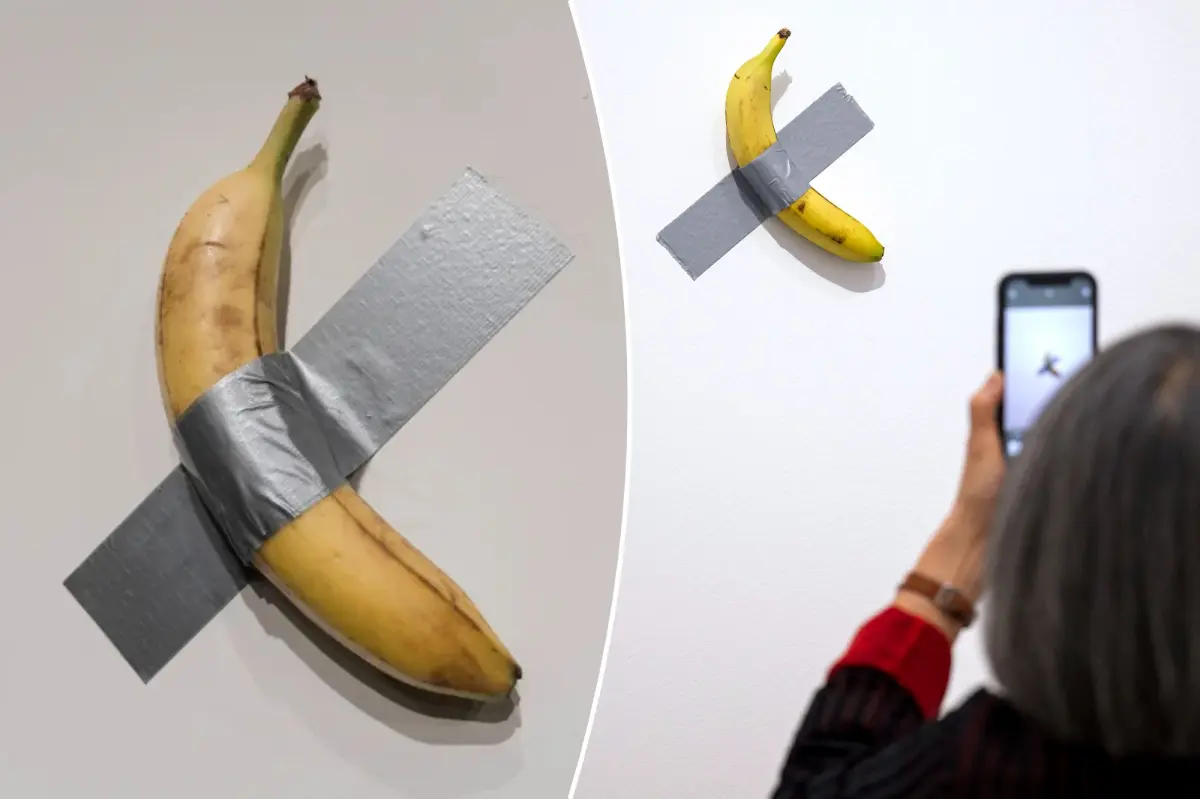
It was a heist ripe for the picking, unfolding in the quiet, sophisticated halls of the Centre Pompidou-Metz in northern France over a quiet weekend. A security guard, during a routine patrol through the museum’s contemporary galleries, stopped dead in his tracks before a blank, white wall that was supposed to be hosting one of the most talked-about masterpieces of the modern era. Where there should have been a bright yellow, crescent-shaped centerpiece, there was only a sticky patch of silver adhesive residue and a gaping void. Maurizio Cattelan’s infamous conceptual artwork, Comedian—which had recently reached an astronomical, headline-grabbing valuation of $6.2 million—had vanished. The “banana bandits” had struck, peeling the legendary fruit straight off its mount in a daring and delightfully absurd act of theft. Despite the multi-million-dollar price tag associated with the artwork, the museum’s immediate response highlighted the bizarre, upside-down logic of the modern art scene. Rather than launching a high-stakes, international dragnet with forensic teams and laser grids, the museum calmly filed a criminal lawsuit, alerted the local police, and then walked down to the nearest grocery store to buy a replacement banana for less than a dollar. Within hours, a fresh yellow fruit was taped back onto the wall, restoring the installation to its former glory. As representatives for the Pompidou-Metz dryly noted to the press, no “irreversible damage” had been done, highlighting the hilarious reality that a piece of art worth millions can be completely restored with a quick trip to the local produce aisle.
To fully understand how a simple piece of fruit came to command the GDP of a small island nation, one must journey back to the sunny, ultra-wealthy avenues of Miami Beach in December 2019. It was there, at the prestigious Art Basel art fair, that Italian visual artist and renowned cultural provocateur Maurizio Cattelan first unveiled Comedian to an unsuspecting and quickly polarized public. Cattelan, a creative trickster known for previous stunts like crafting a fully functioning 18-karat gold toilet titled America, had conceived the banana piece as a brilliant satire on the hyper-inflation and speculative madness of the international art market. He purchased the original banana for a modest 35 cents from an elderly fruit vendor on the streets of New York City, brought it to the gallery, and stuck it to the wall with a single piece of heavy-duty, industrial-grade duct tape. To the absolute shock of traditionalists and the unbridled glee of speculative investors, the piece sold almost immediately for a jaw-dropping $120,000. It instantly sparked an international media circus, igniting fierce debates in classrooms, boardrooms, and living rooms about the fundamental definition of artistic merit. Cattelan’s work was a mirror held up to global capitalism, proving that value is not inherent in the material itself, but is instead a fragile social construct manufactured by brand recognition, prestige, and the collective agreement of the wealthy elite.
The recent heist in France is far from the first time this appetizing pièce de résistance has met a dramatic, unexpected end at the hands of its audience, as the installation seems to possess an almost magnetic attraction for hungry provocateurs. In 2023, during an exhibition at the Leeum Museum of Art in Seoul, South Korea, an art student named Noh Huyn-soo stunned onlookers by casually peeling the banana off the wall and eating it on camera. When questioned by startled museum officials, Noh deadpanned that he had simply skipped breakfast that morning and was hungry, before taping the empty, discarded peel back to the wall as a cheeky addition to the exhibit. Rather than face prosecution, Noh’s stunt was embraced as a valid, performative response to Cattelan’s original provocation, and a fresh banana was swiftly installed. The narrative reached peak absurdity the following year at a high-stakes Sotheby’s auction, where cryptocurrency mogul Justin Sun purchased the rights to Comedian for an astonishing $6.2 million. Refusing to let his multi-million-dollar investment sit quietly in a climate-controlled vault, Sun hosted a highly publicized press conference where he ceremoniously ate the banana himself, claiming that consuming the fruit represented a sacred bridge between fine art, decentralized technology, and everyday physical life. By digesting his own investment, Sun transformed the act of consumption into the ultimate status symbol, cementing the idea that the true essence of Comedian is not the fruit itself, but the viral, fleeting moments of human interaction and disruption it continuously generates.
When the Centre Pompidou-Metz decided to exhibit a newly replicated version of the masterwork in May 2025, they were undeniably playing a high-stakes game with an audience that had grown to view the artwork as a participatory challenge. It took only a matter of months before the inevitable occurred, and on July 12, a ravenous gallery visitor bypassed the security barriers to gobble up the installation yet again, preying on the museum’s vulnerability just weeks before the weekend heist. This relentless cycle of theft, consumption, and resurrection reveals a fascinating psychological truth about how we interact with space and objects within cultural institutions. Typically, museums are designed as sacred, untouchable cathedrals of high culture, where visitors are expected to maintain a respectful, hushed distance from painted canvases and cold marble sculptures. Cattelan’s banana, however, completely shatters this stiff boundary because it is fundamentally democratic, cheap, and deeply familiar to every human being on the planet. It exists in the same domestic space as our daily breakfasts, whispering to our basic instincts and tempting us to break the unwritten laws of civilized museum behavior. Whether driven by hunger, political protest, or a simple desire for fifteen minutes of internet fame, those who dare to touch, eat, or steal the banana are actively participating in the art itself, fulfilling Cattelan’s vision of a masterpiece that is alive, chaotic, and beautifully unpredictable.
The brilliant, self-aware joke at the heart of Comedian is that absolutely anyone with a few dollars and a trip to the local hardware store can become an authentic art collector, a point that media outlets and everyday citizens have taken great joy in proving. Shortly after the initial Miami frenzy, journalists at The New York Post decided to put the high-society art market to the ultimate test by attempting to recreate the multi-million-dollar installation in their own office. They sent a reporter to a neighborhood bodega to purchase a standard banana for 80 cents and a roll of heavy-duty duct tape for $4.95, successfully replicating the legendary visual aesthetic on a plain wall in under sixty seconds. The experiment went viral, with readers eagerly consuming the story and laughing at how easily the physical reality of a $6.2 million asset could be duplicated for less than six dollars. This hilarious discrepancy exposes the fascinating mechanics of the high-end art trade, where buyers are not actually purchasing the physical, perishable produce—which will inevitably rot, turn brown, and liquefy within a week—but are instead buying a signed “certificate of authenticity.” This certificate is a legal and conceptual document that grants the owner the exclusive, official right to tape any banana to any wall and declare it a genuine Maurizio Cattelan original. It is the ultimate triumph of conceptualism over craftsmanship, demonstrating that in the modern world, the idea behind the object is infinitely more valuable than the object itself.
Ultimately, the latest escapade at the Centre Pompidou-Metz, where rogue banana bandits managed to slip away with a piece of cultural history, is just the latest page in an ongoing diary of modern absurdity that shows no signs of slowing down. In an era marked by deep economic divides, institutional skepticism, and the overwhelming noise of the digital age, there is something deeply therapeutic about watching a single taped piece of fruit throw the serious, starch-collared world of fine art into a state of hilarious chaos. It humanizes an industry that often feels incredibly exclusive, elitist, and out of touch with the average person, reminding us that art is at its best when it refuses to take itself too seriously. Whether the banana is being snatched by mysterious thieves under the cover of night, digested by a tech billionaire at a press conference, or recreated by a family on their kitchen wall, Comedian continues to earn its name by keeping the entire world thoroughly entertained. Maurizio Cattelan’s creation remains an undefeated monument to human playfulness, curiosity, and folly, proving that while millions of dollars can buy you a certificate of ownership, the real, laughter-filled joy of the joke belongs entirely to the public who gets to watch the spectacle unfold.