




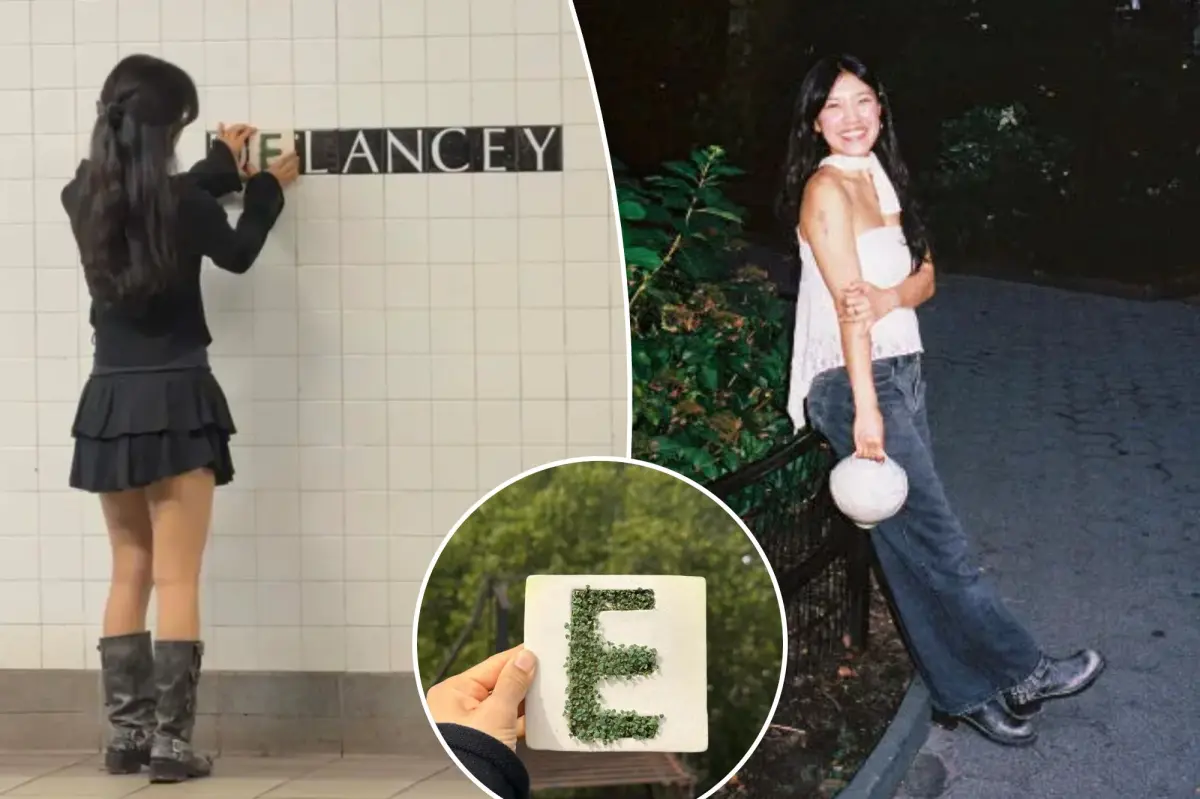
New York City’s subway is more than just a way to get from one borough to another. It is the city’s circulatory system, a rumbling, screeching, crowded lifeline that carries more than eight million people through their daily lives. It is also, inevitably, a place of wear and tear. Stations age, tiles crack, paint fades, and the constant pressure of millions of footsteps and trains leaves its marks everywhere. Most riders barely notice these small signs of decay. A missing tile on a platform wall is just part of the background noise of commuting, something to ignore as you check your phone or listen for your stop. But one Brooklyn artist looked at a broken tile and saw something entirely different: not a maintenance problem, but a canvas, a chance for life to push through the cracks. Her name is Eujue, and she recently became an unlikely internet sensation after posting a video that gathered over a million views. In the video, she is seen at the Delancey Street–Essex Street station on Manhattan’s Lower East Side, carefully replacing a broken white tile that once held the black letter “E.” Instead of restoring it with the same boring black text, she slid in a ceramic square of her own making, one where the letter “E” was formed by living chia plants, bright green and unmistakably alive. It was a tiny gesture in a massive system, but it captured the imagination of a city that is always hungry for art, meaning, and a little bit of wonder.
The act itself was deceptively simple, but the thinking behind it was deeply poetic. Eujue, who goes by only her first name, told reporters that the idea came from a poem she read in college: Richard Brautigan’s “All Watched Over by Machines of Loving Grace.” The poem imagines a future where plants, animals, and technology exist together in harmony, a gentle, almost utopian vision of balance between the natural world and human invention. That image stayed with her long after she left the classroom. It pushed her to imagine what it might look like if nature began to reclaim the spaces that were once taken from it, even in the most unlikely places, like a subway station. The chia plant “E” is exactly that kind of speculative object, a small piece of a post-apocalyptic world where greenery pushes through concrete and steel, where living things soften the hard edges of urban infrastructure. There is something quietly radical about the gesture. The subway is one of the most engineered, controlled, and artificial environments in the city. It is all metal, tile, fluorescent light, and regulated air. To place a living plant inside that environment, and to make it form a letter of the alphabet, is to suggest that nature cannot be fully locked out, that even underground, life finds a way. It also transforms a symbol of brokenness into a symbol of growth. The missing “E” was not just a flaw anymore; it became a statement, a tiny green rebellion against the grayness of daily commutes.
For Eujue, this was never just about fixing a tile. It was about changing the way New Yorkers see the spaces they move through every day. She has said that she does not want missing tiles to be dismissed as routine maintenance issues. Instead, she wants them to be seen as invitations, opportunities for artists to reshape the city around them. “NYC has always been a place where artists shape the city’s culture,” she said, “and I hope our public spaces can reflect that.” Her vision is one of care, connection, and collective ownership. She wants the everyday places we pass through, often without a second glance, to feel more loved, more personal, more tied to the people who actually live and work in the city. That is a powerful idea, especially in a place as vast and sometimes impersonal as New York. The subway is shared by millions, but it rarely feels like it belongs to anyone. Eujue’s project suggests that it can be different, that public spaces can carry the fingerprints of their communities, that a broken tile can become a small piece of public art made by a neighbor, not just a bureaucratic problem to be logged and forgotten. Her approach is not about grand gestures or expensive installations. It is about small, thoughtful interventions that accumulate into something larger, a city that feels more human because its flaws are met with creativity rather than indifference.
To help this idea spread, Eujue and her brother built something they call NYC Tile Watch, a website where New Yorkers can report missing or damaged subway tiles. The site was created with a simple but ambitious goal: to let routine subway upkeep and public art coexist. When someone spots a broken tile, they can file a report. Once a report is approved, local artists can step in and transform that broken tile into their own original creation. What was once a small eyesore becomes a piece of living, evolving art, and the dingy corners of the subway system start to feel a little more alive. The project is still in its early days, but it is already gaining traction. As of now, the site has accumulated twenty-four approved reports, and there is a public interest form that riders can fill out to show support and help gauge how many artists might want to participate. It is a beautiful idea because it relies on ordinary people noticing the spaces around them and then taking action. It turns commuters into collaborators. Instead of waiting for the city to fix every little thing, residents can become part of the solution, not by complaining, but by creating. The website is a bridge between the official world of the MTA and the unofficial world of street-level creativity, and it opens the door for a more participatory kind of urban life.
The response has been overwhelming. Eujue’s TikTok video did not just get views; it sparked a movement. Thousands of comments poured in, celebrating her work and cheering her on. One user wrote, “This is NYC. Art moves our city, I love it, it’s soooo NYC.” Another commenter offered to do what New Yorkers do best: help. “What if we New Yorkers pitch in watering them too! That way they live a little longer,” they said. That simple suggestion captured the spirit of the whole project. It is not enough to plant something; you have to care for it. The idea of strangers watering a chia plant growing out of a subway tile is almost impossibly charming, a vision of a city where people look out for the small, fragile things that make life more beautiful. In just one week, Eujue gained thousands of followers and became something of a local subway hero. But the attention has not just come from everyday riders. The movement has caught the eye of city officials as well. Eujue says she is currently in conversations with the Mayor’s team and the MTA about how NYC Tile Watch could potentially develop into a formal program. That would be a significant step, turning a grassroots art project into an official part of the city’s approach to public space. It is a sign that the idea is being taken seriously, not just as a viral moment, but as a real possibility for how the city can care for its infrastructure and its culture at the same time.
For Eujue, though, this is just the beginning. She is not interested in a single viral video or a brief moment of fame. She wants to build something lasting, something that makes New Yorkers and visitors alike feel a deeper kinship with the spaces around them. “I’d love to make the everyday places we move through feel more cared for and more connected to the people who live here,” she said. That is the heart of the whole project. It is about noticing what is broken and choosing to respond with beauty instead of indifference. It is about remembering that a city is not just steel, concrete, and tile; it is a living thing, shaped by the people who move through it. The missing “E” tile was a small change, but it made many people stop and think about how many overlooked spaces we pass by every day. How many cracks, chips, and empty spots do we ignore because they are just part of the scenery? Eujue’s work asks us to look again, to see those flaws as openings, as places where something new could grow. In a city that never sleeps, where everything moves fast and nothing stays the same for long, that is a powerful reminder. Cracks are not wack. They are opportunities. And with a little creativity, a little care, and a little green life, even the darkest corner of a subway station can become a place of wonder.