



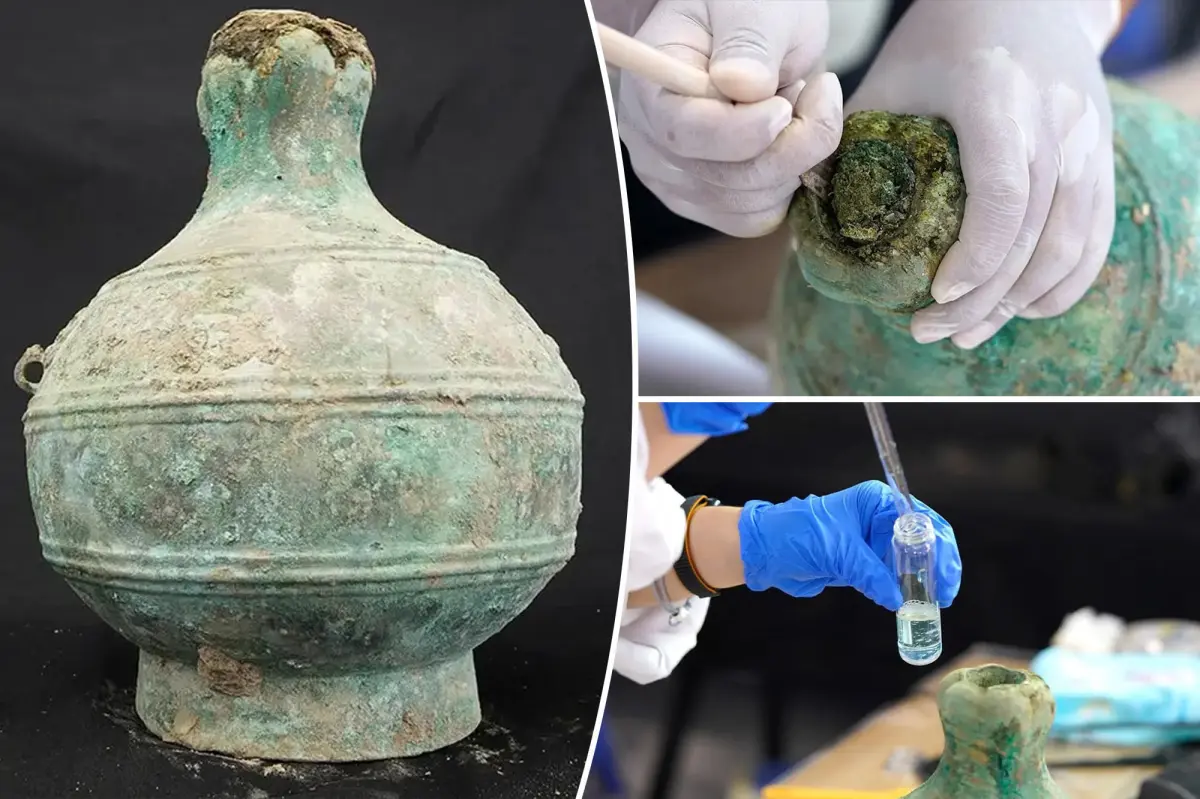
In the sun-bleached, windswept landscapes of the Ningxia Hui Autonomous Region in northwestern China, a dedicated team of archaeologists from Northwest University’s School of Cultural Heritage recently experienced the kind of profound, heart-stopping discovery that most researchers only dare to dream of in their wildest fantasies. While meticulously excavating the Shanjiabao cemetery—a sprawling, ancient burial ground containing 183 tombs that date back to the tumultuous Warring States Period (475–221 B.C.)—the team stumbled upon a remarkably preserved tomb belonging to the state of Qin. This was an era defined by constant, bloody warfare, a chaotic time when rival kingdoms vied for dominance before the ultimate unification of China. Yet, amidst the physical remnants of an age of iron and blood, the archaeologists uncovered a deeply personal, gentle, and utterly surprising relic of daily human life: a heavy bronze vessel that felt unexpectedly weighted. When the team, led by researcher Ruru Chen, carefully lifted the container from its resting place, they noticed it was far heavier than a vessel of its size should be, hinting at a secret hidden within. Upon carefully opening the sealed lid, they were stunned to find that it was not filled with dry dirt or ancient dust, but with nearly a gallon of actual, sloshing liquid. To their utter amazement, they had just uncovered 3.74 liters—more than fifteen cups—of still-liquid beer that had survived, undisturbed, for over 2,200 years. Chen recalled the overwhelming wave of shock, excitement, and deep reverence that washed over the excavation site as they realized the magnitude of what they were holding. This was a tangible, liquid bridge to the past, representing one of the largest volumes of ancient liquid alcohol ever recovered in archaeological history, reminding us that even in humanity’s darkest, most volatile, and violent epochs, the simple comfort of a shared drink and the warmth of community remained an essential part of the human experience.
The physical survival of this ancient beverage is nothing short of a scientific miracle, offering a mesmerizing glimpse into the preservation powers of both nature and ancient human craftsmanship. When the researchers peered inside the bronze vessel, they found a liquid that was entirely free of any noticeable or offensive odor, a silent testament to its pristine isolation from the decaying elements of the outside world. Visually, the liquid had transformed over the millennia into a clear, beautiful light blue-green hue—a striking aesthetic side effect caused by copper ions slowly leaching from the bronze walls of the container over twenty-two centuries. Resting quietly at the bottom of the vessel was a dark layer of sediment, the ancient physical remains of the grains and yeast that had once danced in the fermentation process. Typically, when archaeologists discover booze from antiquity, they are forced to work with microscopic trace residues dried onto the porous clay of broken jars, utilizing complex chemical washes to extract just a few molecules of ancient yeast or sugars. To find a massive, intact reservoir of actual liquid is incredibly rare, turning this site into an archaeological goldmine. Chen explained that this extraordinary preservation was the result of a perfect convergence of environmental and human factors. The arid, dry climate of the Ningxia region played a major role in keeping moisture and rot at bay, but the true credit belongs to the ancient metallurgy of the artisans who cast the bronze vessel, which possessed natural antimicrobial properties. Combined with the meticulous sealing methods used by the mourners to airtightly lock the container and the stable, cool, and oxygen-deprived conditions deep within the earth of the tomb chamber itself, this vessel essentially acted as a high-tech metallic time capsule, holding its breath for twenty-two centuries until modern hands could finally uncover its secrets.
To unlock the secrets of what this ancient elixir actually tasted like, the research team engaged in a fascinating exercise of molecular time travel, combining organic chemistry, botany, and historical analysis to reconstruct the original recipe. Their analysis revealed that the liquid was a non-distilled alcoholic beverage crafted primarily from millet, or possibly a sophisticated blend of millet, wheat, and barley. This was not the light, carbonated, and ice-cold yellow lager that modern consumers associate with beer, nor was it a high-proof, burning spirit like modern Chinese baijiu. Instead, this 2,200-year-old brew would have been a rich, thick, and likely sweet or slightly sour beverage, possessing a texture closer to a thin, comforting grain porridge or a rustic, unfiltered farmhouse ale, often consumed through straws to filter out the leftover husks of grain. The brewing process of the late Zhou and Qin dynasties was a highly respected, sacred craft that required a deep, intuitive understanding of biology and chemistry long before those scientific disciplines were formally named. Brewers utilized specialized fermentation starters to convert the stubborn starches of native grains like millet into fermentable sugars, transforming simple agricultural harvests into a source of warmth, energy, and joy. The inclusion of wheat and barley, which were still relatively new arrivals to the Chinese agricultural scene from western Eurasia, highlights a fascinating period of culinary experimentation and cultural exchange. It shows that ancient brewers were not just passively following traditions, but were actively seeking out new agricultural ingredients and blending techniques to perfect a craft that was as much an art form as it was a science, resulting in a beverage that was deeply tied to the land and the changing seasons.
Beyond its chemical composition, the presence of this large quantity of beer inside a tomb reveals a profoundly tender and human story about how our ancestors coped with the agonizing reality of death, grief, and the mystery of what lies beyond. During the Warring States Period, the transition from life to death was not seen as an absolute end, but rather as a journey into a shadowy afterlife that mirrored the physical world in almost every way. The deceased were believed to still possess physical and emotional needs, requiring food, clothing, weapons, and, of course, the simple comforts of food and drink to find peace in the spirit realm. By placing fifteen cups of freshly brewed beer in a beautiful, high-status bronze vessel right next to the deceased, the grieving family was performing a deeply loving, final act of familial hospitality. They were ensuring that their loved one would not have to face the cold, lonely journey into the afterlife empty-handed or thirsty, but could instead arrive with a premium, comforting beverage to enjoy, to toast with ancestral spirits, or to use as an offering to secure a favorable place in the next world. This ritualistic use of alcohol, known broadly in ancient Chinese culture as a cornerstone of the li (ritual and etiquette) system, was central to keeping the cosmic order balanced and showing respect to the departed. It reminds us that across thousands of years, the pain of losing a family member and the desperate urge to comfort them, even after they have drawn their last breath, is a universal human experience that transcends the boundaries of time, language, and culture, linking us to that ancient family through our shared capacity for love and sorrow.
This incredible discovery in Ningxia does not stand alone; rather, it is a brilliant jewel in a rapidly expanding crown of archaeological discoveries that highlight China’s ancient and deeply rooted relationship with the art of fermentation. Just recently, in 2024, another groundbreaking discovery was made in China’s neighboring Shaanxi province, where archaeologist Li Liu of Stanford University led a team that uncovered beer in a 2,300-year-old Qin state tomb. This ancient lager had been brewed from an remarkably diverse recipe of wheat, barley, millet, pulses, and wild grass seeds, showcasing an incredible depth of botanical knowledge. These parallel discoveries provide invaluable, physical proof that supports ancient historical texts from the late Zhou and Qin periods, which made frequent references to increasingly specialized, state-sanctioned, and professional brewing techniques. However, the roots of Chinese brewing stretch back infinitely deeper into the prehistoric past than these two-thousand-year-old finds. In Henan province, scientists previously discovered chemical evidence of a 9,000-year-old fermented drink made from rice, honey, hawthorn fruit, and wild grapes, sealed inside ancient clay jars at the Neolithic site of Jiahu. This incredible timeline shows a magnificent cultural and technological evolution, tracing how early humans transitioned from gathering wild fruits and honey to cultivating complex, highly organized grain-based agricultural systems, all driven in large part by the desire to refine and perfect the magical process of fermentation. It reveals a resilient society that, for nine millennia, has turned to the warm embrace of brewed beverages to mark their most sacred ceremonies, seal political alliances, celebrate the harvest, and bring comfort to their quiet moments of daily reflection.
Zooming out to a global scale, these extraordinary discoveries underscore the profound truth that beer is not merely a modern leisure product, but rather one of the fundamental cornerstones of human civilization, social structure, and community development. The oldest physical evidence of man-made alcohol ever found dates back an astonishing 13,000 years to Israel’s Raqefet Cave, where Natufian hunter-gatherers left behind traces of wheat- and barley-based beer inside stone mortars long before they ever built permanent homes, developed pottery, or planted the very first domestic crops. This has led many leading anthropologists to champion the fascinating “Beer Before Bread” hypothesis, which suggests that our nomadic ancestors may have actually settled down and pioneered the agricultural revolution not to feed themselves, but to guarantee a steady, reliable supply of grains specifically for brewing alcohol. Fermentation was a brilliant survival mechanism, providing a way to sanitize contaminated water, preserve precious calories, and create a social glue that brought people together to form the tight-knit communities required for humanity to thrive. As modern scientists gaze through their laboratory microscopes at the mesmerizing blue-green liquid recovered from the Shanjiabao cemetery, they are not just analyzing dead organic compounds and ancient yeasts; they are looking directly into a mirror of our shared human history. Across continents, across vast stretches of millennia, and through the rise and fall of countless mighty empires, our timeless desire to brew a drink, to share a glass with those we love, and to use it to tenderly honor the memory of those we have lost remains one of the most enduring, comforting, and beautifully human rituals we perform.