


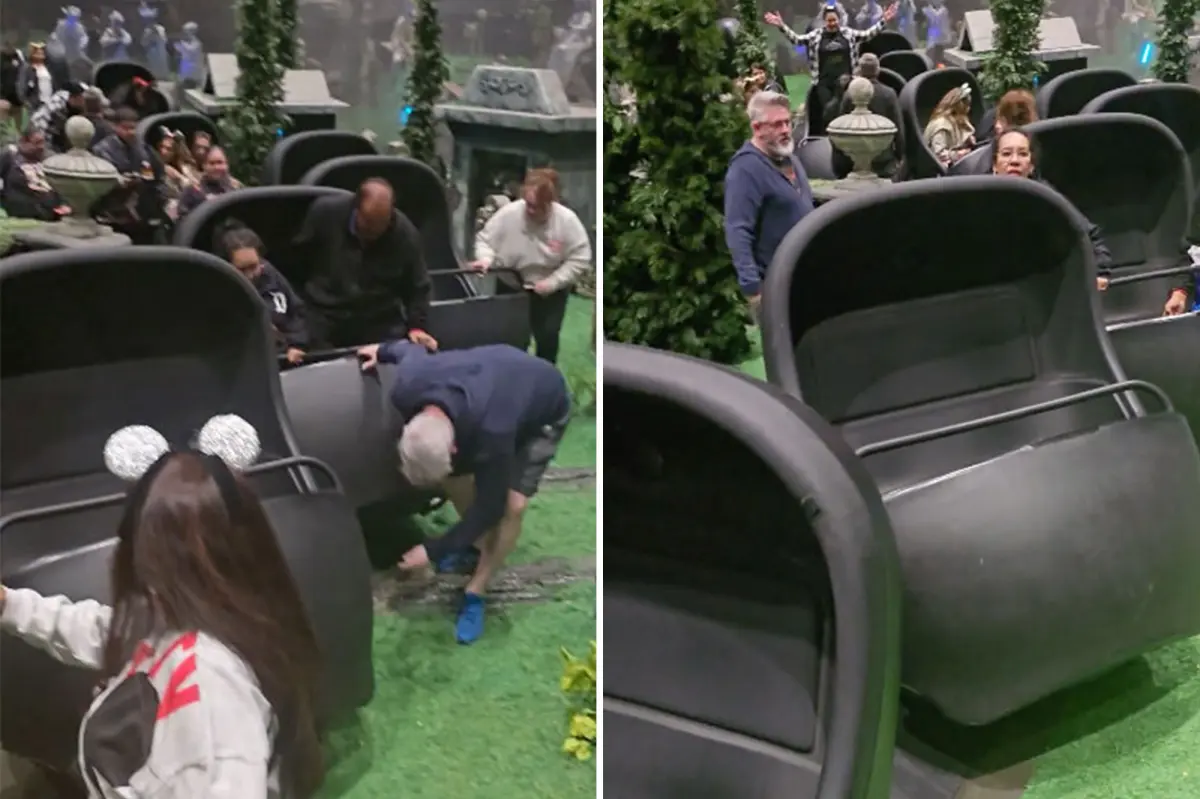
Disneyland has long guarded its reputation as the ultimate crucible of childhood wonder, a meticulously engineered sanctuary where the harsh realities of workaday anxieties and the mundane physics of the outside world are temporarily suspended in favor of pixie dust, cinematic nostalgia, and infallible operational precision. Yet, for a group of weary but excited late-night parkgoers seeking one final thrill before the park’s looming 11:00 p.m. closing time on May 27, the carefully constructed boundary between fantasy and reality dissolved in a highly unusual, startlingly unpolished fashion. As their carriages glided through the cool, dimly lit corridors of the legendary Haunted Mansion, the atmospheric hum of ghostly organ music, disembodied whispers, and spectral wails was suddenly cut short. The ride’s iconic black carriages, affectionately known to generations of Disney enthusiasts as “Doom Buggies,” ground to an abrupt and unceremonious halt, stranded in the heart of the attraction’s climactic cemetery scene, surrounded by mechanical ghouls and plastic tombstones frozen mid-projection. For those sitting in the dark, what began as a routine, temporary delay—a common occurrence on high-traffic Disney rides often caused by guests boarding with mobility assistance—soon transformed into an unprecedented, unfiltered look behind the heavy velvet curtain of the park’s theatrical illusion. The initial reaction among the stranded passengers was a mix of mild amusement and seasoned patience, a collective, unspoken assumption that the omnimover system would shudder back to life after a brief, routine mechanical reset. But as the minutes ticked away in the silent, darkened cavern of the graveyard, the ambient whimsy of the attraction gave way to a growing sense of vulnerability and curiosity, setting the stage for an evening those present would not soon forget as they realized the machinery of the “happiest place on earth” had fundamentally failed to live up to its polished, automated promise.
The true departure from the standard operating protocol occurred when the attraction’s work lights, typically reserved for overnight maintenance crews and safety inspections, illuminated the entire space. Suddenly, the eerie, comforting shadows of the Haunted Mansion’s spirit world were banished by the harsh, unyielding glare of industrial fluorescent lighting, fully exposing the raw skeleton of the magic. The intricate illusions of floating ghosts, rolling hills, and ancient moss-covered trees were instantly unmasked as a complex network of painted plywood, exposed steel rafters, dusty industrial scaffolding, and intricate wiring harnesses resting beneath the fake graveyard’s synthetic topsoil. For the riders trapped in this liminal space, it was a dizzying visual juxtaposition: the iconic, whimsical tombstones and mechanical foliage now looked like nothing more than cheap theatrical props scattered across a cold, cavernous warehouse floor. This sudden stripping away of the environmental immersion was a jarring experience for die-hard Disney purists who cherish the park’s legendary attention to detail, as the meticulously guarded secrets of the Haunted Mansion’s special effects were laid bare in seconds. Rather than gazing upon a supernatural playground of happy haunts, the guests found themselves staring at the naked plumbing of a mid-century theme park ride, a sight that was both fascinatingly mundane and deeply disappointing for those who prefer to keep the magic intact, revealing the fragile, physical reality that underpins our most cherished collective fantasies. To look upon the unfinished back sides of the set pieces, to see the dust gathered on the mechanical joints of the animatronic ghosts, and to realize just how close the illusion is to a simple school play set on a grand scale is to experience a unique kind of childhood disillusionment. It forced the stranded guests to confront the reality that the supernatural whimsy they had paid handsomely to experience was, in the end, merely a highly synchronized assembly of plastic, wire, and clever lighting tricks.
The physical reality of the breakdown soon transitioned from a visual curiosity into an active logistical puzzle for the stranded passengers, testing their patience and their trust in the park’s legendary guest safety procedures. Initially, the disembodied voice of a Disney Cast Member crackled over the attraction’s loudspeaker system, delivering the standard, reassuring spiel advising everyone to remain comfortably seated, keep their hands and feet inside the vehicles, and wait patiently for a staff member to walk the track and assist them. However, after approximately ten agonizing, silent minutes of waiting under the harsh fluorescents, the tone and content of the announcements shifted dramatically, catching the passengers entirely off guard. The loudspeaker crackled back to life, but this time, the voice delivered an unprecedented and highly unorthodox message: park staff were no longer able to assist them directly, and the guests were instructed to squeeze out of their own Doom Buggies and walk to the nearest emergency exit on their own. This sudden abandonment of the meticulously controlled, highly secure Disney guest-management protocol sparked a flurry of confusion and mild anxiety within the cavern. The voice on the speaker initially failed to explain how to safely exit the buggies, leaving guests to sit awkwardly in the brilliant light of the exposed graveyard for several minutes, looking at one another in disbelief before further instructions on how to manually release the heavy, clamshell safety bars were finally broadcast. Climbing out of the deep, specialized vehicles and navigating the uneven, industrial terrain of the track without the reassuring, hand-holding presence of a trained staff member felt, as one online user later described it, absolutely wild and thoroughly un-Disney, transforming ordinary, paying tourists into their own rescue crews as they carefully picked their way through a landscape of plastic tombstones, exposed floorboards, and dangling cords.
When details of the incident, along with behind-the-scenes footage of the illuminated graveyard, were posted to Reddit, the online Disney fan community erupted with a mixture of shock, fascination, and intense speculation, recognizing just how much of a departure this was from the park’s carefully guarded brand image. Former Disney employees, historically known as “Cast Members,” quickly flooded the discussion threads to offer their insights, expressing deep professional surprise at the highly unconventional nature of the evacuation. One veteran worker, who identified themselves as a former operator of the Haunted Mansion, emphasized that a “self-evacuation” is an exceedingly rare and tightly regulated scenario, hinting that such an action would only be authorized in the event of an extraordinary, catastrophic systemic failure or a potential hazard emergency that made standard, face-to-face cast assistance physically impossible. Others pointed out that during normal operational evacuations, Cast Members are strictly and repeatedly trained to systematically walk the tracks, manually unlocking each carriage one by one with a specialized tool to maintain absolute control over the flow of guests and prevent injuries on the dangerous, uneven backstage terrain. The stark departure from this rigid protocol led many to theorize that a severe software glitch had locked the primary control consoles, or that a systemic power failure had rendered the automated mechanical bypasses completely useless. Some speculated that a building-wide fire alarm may have triggered an automated safety message designed for catastrophic situations, though the original poster of the viral thread verified that no audible alarms, flashing sirens, or emergency strobe lights were heard or seen inside the ride during the entire ordeal. The consensus among the system’s insiders was clear: what these guests experienced was not just a minor mechanical hiccup, but a rare operational anomaly that broke almost every established safety rule in the modern Disney guest services handbook, exposing a significant, unexpected gap in the park’s usually flawless emergency response network.
This high-profile mechanical breakdown occurred at an incredibly sensitive and challenging moment for Disneyland, which is currently navigating a highly constrained, stressful summer season marked by widespread attraction closures, extensive renovations, and growing customer dissatisfaction. The park is grappling with the temporary loss of several high-capacity, heavy-hitting attractions, leaving guests with significantly fewer options to disperse the massive summer crowds and placing an immense operational load on the few operating rides left. Beloved mainstays such as the historic Pirates of the Caribbean and the high-energy Buzz Lightyear Astro Blaster are currently completely shut down for extensive, multi-month overhauls, while across the esplanade at Disney California Adventure, crowd-pleasing family magnets like the Inside Out Emotional Whirlwind and the Silly Symphony Swings are also sitting dark and quiet. The entertainment sector is feeling the pinch as well, with the legendary, high-concept nighttime spectacular “Fantasmic!” on the Rivers of America scheduled to sit out critical dates in mid-June, and the popular Pixie Hollow meet-and-greet area in Fantasyland limiting its operation to only a few days a week. Even the iconic, sweeping flight simulator, Soarin’ Over California, is scheduled for a sudden, temporary shutdown in early July to prepare for its transition back to Soarin’ Around the World. These coinciding closures have created a literal pressure cooker environment within the theme park’s gates, where fewer open attractions inevitably lead to ballooning wait times, longer queues for food, and increased mechanical wear and tear on the aging rides that remain functional. When an anchor attraction like the Haunted Mansion suffers a highly public, messy, and unscripted failure amidst these widespread systemic closures, it amplifies the mounting frustration among parkgoers who feel they are paying historic, premium, peak-season ticket prices for a significantly diminished, understaffed, and under-maintained vacation experience.
Ultimately, the Haunted Mansion incident serves as a poignant, deeply human reminder of the delicate, invisible contract that exists between modern, highly commercialized theme parks and their eager audiences. Guests arrive at Disney’s gates with an overwhelming willingness to suspend their disbelief, willingly trading the hard, predictable, and often stressful truths of everyday life for a few hours of flawless, beautifully curated fantasy. In exchange for their loyalty and financial investment, the park promises a seamless, invisible wrapper of high technology and narrative artistry, a place where the mechanical gears, dusty wires, and sterile safety warnings are completely hidden from view. But when the work lights flicker on and guests are left to awkwardly negotiate their own escape from a dusty, simulated graveyard, that unspoken contract is abruptly fractured, exposing the highly transactional, mechanical reality that sits just beneath the surface of our collective dreams. In our modern, hyper-connected era of social media, where every cracked wall, delayed ride, and operational stumble can be filmed and broadcast globally in a matter of minutes, maintaining this grand illusion becomes an increasingly uphill battle for theme park operators. It transforms what once would have been a quirky, forgotten late-night anecdote among a small group of friends into a viral sensation that sparks serious conversations about the preservation of high standards, corporate staffing priorities, and the declining quality of the luxury vacation experience. As Disney works to modernize its classic attractions for a new, highly demanding generation while managing severe labor shortages and aging mid-century infrastructure, they must confront the reality that true magic is not just built on nostalgic brands or high-tech projection mapping—it is built on consistent operational trust. When that trust is suddenly punctured by a rare, unassisted evacuation, the spell is shattered, leaving guests to walk out of the mansion not with memories of dancing ghosts and playful spooks, but with the stark, cold realization that they are just ordinary consumers navigating a brightly lit warehouse of clever but aging machinery.