


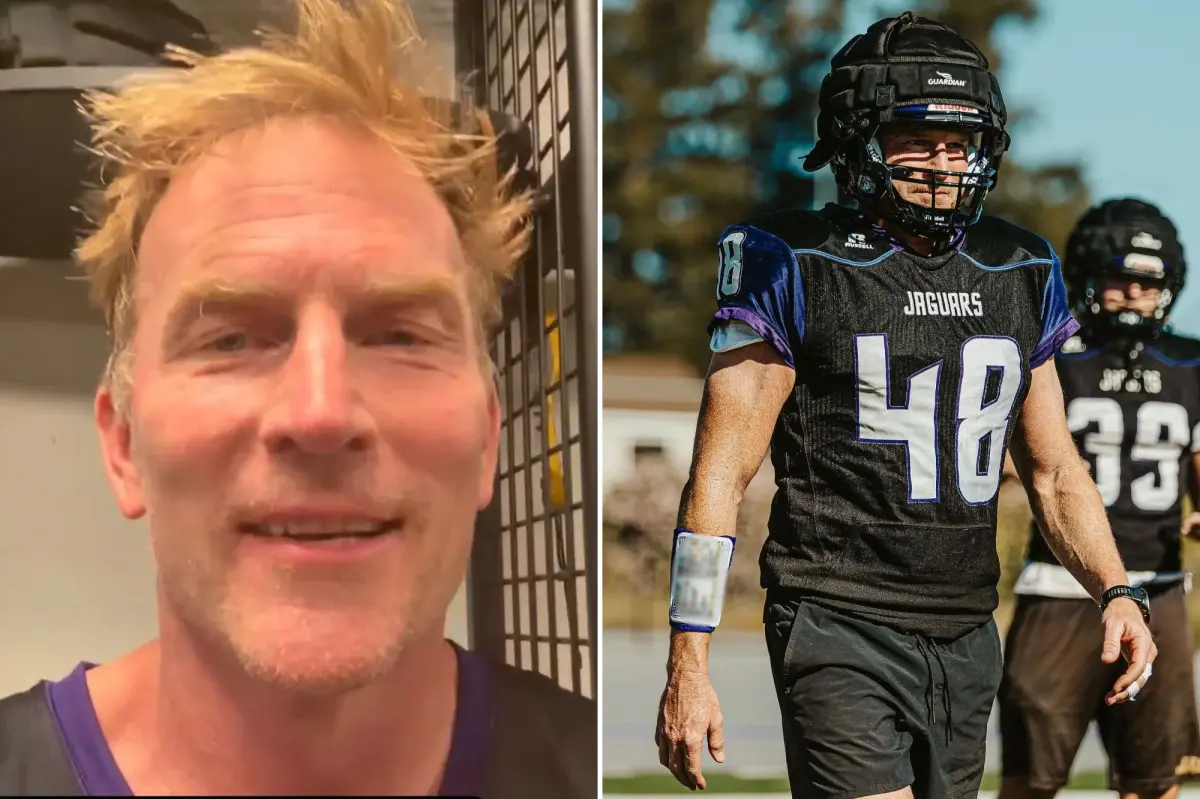
There are moments in life when the past calls out, not as a memory to be filed away, but as a question waiting for an answer. For Justin Buzzard, that call came on a quiet day when his son casually shared a social media reel — a video of a man in his sixties playing organized football somewhere on the East Coast. Buzzard, now 47 years old, was a South Bay pastor at Garden City Church, whose football career had ended before it truly began. He had played through high school, loved the violence and poetry of the game, then made it to college football only to have his freshman year derailed by injuries. For decades, that was just another chapter in a life that moved on into ministry, family, and faith. But the reel stirred something he thought had been long buried. It wasn’t envy, exactly, or nostalgia. It was a quiet voice whispering, why not me? That voice grew louder until it became impossible to ignore. So Buzzard, a middle-aged man with a congregation, a son, and a body that remembered years of hits, decided to try something almost absurd: to put on the helmet again, to compete, to see if the dream could be revived. He reached out to a coach at San Jose City College, fully expecting to be dismissed as a novelty or a fool. Instead, the coach agreed to talk. And before long, Buzzard found himself not just talking about football, but actually suiting up for the San Jose City College Jaguars as a defensive end — a 47-year-old pastor among teammates young enough to be his children. He has his own locker, his own equipment, and a place on the roster. The story could be dismissed as a midlife fantasy, but it is something deeper: a refusal to let the unfinished parts of our lives simply stay unfinished.
Buzzard’s football story is not one of glory, but of interruption. He played with passion throughout high school, the kind of player who loved the physical and mental demands of the line, who understood that football is about discipline and sacrifice as much as strength and speed. He took that passion to college and made the team, ready to build a future on the field. Then, during his freshman year, injuries struck. They were serious enough to derail his playing career, and suddenly the identity he had been building — the athlete, the teammate, the competitor — was taken from him. He didn’t choose to stop playing; the game was chosen for him to lose. That kind of loss leaves a quiet scar, the unspoken ache of something left undone. Over the years, Buzzard built a life that mattered deeply: he became a pastor, a spiritual shepherd for a community in the South Bay, a husband and father who learned to trade the adrenaline of the gridiron for the deeper rhythms of service and presence. Yet the football player never fully disappeared. He was there in the way he carried himself, in the discipline he brought to his calling, in the stories he told about his youth. So when his son showed him that video of an older man playing a young man’s game, it wasn’t just a novelty — it was an invitation. Buzzard began to wonder whether the injury that ended his college career had to be the final word. Could a man in his late forties, with a decade or more of wear and tear, truly go back and finish what was started? He decided the only way to find out was to reach out. He contacted a coach at San Jose City College, not quite knowing what to expect. To his surprise, the coach didn’t laugh or hang up. There was a conversation, a meeting, and then an opportunity. The door, long thought locked, creaked open.
The man on the other side of that door was Jim Winkler, head coach of the Jaguars. Winkler could have seen Buzzard as a risky experiment, a publicity stunt, or a liability. Instead, he saw something else: a person willing to be held to the same standard as everyone else. “Here’s the standard, here’s the rules that we go by,” Winkler told Buzzard. “As long as you can maintain those, I’ll give you an opportunity.” It was not a promise of playing time or an easy path. It was simply a chance to compete, to prove that a 47-year-old body and heart could still meet the demands of the sport. Buzzard took that chance. He made the team and was lined up again at defensive end, the position he had played during his brief college experience. In some ways, being back was strange — the sounds of the field, the smell of turf, the weight of the helmet, the cacophony of coaches shouting instructions. In other ways, it felt like coming home. But the reality of age could not be ignored. Buzzard told NBC Bay Area that his body is bruised and aches here and there, a natural consequence of colliding with men young enough to be his sons. Football is a game that punishes everyone eventually, and at 47, the margins are thinner, the recovery slower, the risks greater. Yet Buzzard has been pleasantly surprised by how his body has responded. “My body’s holding up a lot better than I thought,” he said. “Football, that’s the risk, is you get bruised, you get hurt, but I’m doing pretty well.” That honesty — acknowledging both the pain and the resilience — makes his presence on the field all the more admirable. He is not pretending to be young. He is simply refusing to let age be an excuse.
Beyond the personal comeback, Buzzard’s presence on the Jaguars has become an unexpected gift to the team. Coach Winkler sees the value clearly. “He’s been on the other side now,” Winkler said. “What I talk to these young guys about all the time, about not having regrets and leaving things undone, now he’s coming back.” For many players in their late teens and early twenties, the future feels infinite; they cannot yet comprehend the weight of a missed moment or a road not taken. They hear their coach’s words about effort and regret, but those ideas are still abstract. Then along comes a 47-year-old teammate who lived through that exact lesson, a man whose career was taken from him and never forgot it. Buzzard is living proof that opportunities do not always circle back around, but sometimes, in rare and mysterious ways, they do. His presence is a constant, embodied reminder that this game is a privilege, not a given. The young players have responded not with ridicule or distance, but with warmth and respect. They have given him a nickname, “OG,” a title that acknowledges both his age and his standing. They joke that their fathers are probably Buzzard’s age, but there is affection baked into that joke. He is not one of them, and they know it; he is something rarer, a bridge between generations. Buzzard is careful to describe the team culture as a brotherhood and a family, and he means those words in their fullest sense. He has become a mentor, an older presence who offers perspective, steadiness, and the quiet confidence that comes from a life already lived. In the locker room, he may be the oldest, but he is also one of the most grateful. He knows the cost of losing the game; he is determined to savor every moment of having it back.
Faith plays a large role in Buzzard’s return to the field, even if he doesn’t wear it on his jersey. As a pastor, he has spent decades telling people about grace, redemption, and the possibility of a new chapter. Now he is living out that message in full public view, trading sermons for sprints, and the pulpit for the practice field. There is a profound humility in the image of a pastor pulling on shoulder pads and taking directions from coaches half his age. It is not a capitulation; it is an act of obedience to the belief that God gives life and calls people to live it fully. Football is not contrary to his faith; it is an expression of it. The sport teaches sacrifice, fellowship, perseverance, forgiveness — all the virtues that Buzzard has been preaching for years. When he takes his position on the defensive line, he is not leaving his calling behind. He is carrying it into a different arena. He sees his teammates not just as players, but as young men with stories, pressures, and dreams. He has a pastor’s heart, and that heart beats just as strongly on the fifty-yard line as it does in a sanctuary. He says he is grateful for the opportunity, and that gratitude is not mere politeness. It is the result of decades of wondering what might have been, of carrying an old injury not just in his body but in his spirit. Now, each practice, each drill, each moment in the huddle is a kind of prayer — a thanksgiving for a second chance that almost no one gets. The bruises and aches are not obstacles; they are reminders that he is alive and doing something meaningful with his once-broken football dream. He shows up not to prove he is still young, but to prove that life can be reclaimed at any age, and that there is no statute of limitations on a calling.
As the season opener approaches, Buzzard stands at the edge of something both thrilling and uncertain. His first game will be on August 29 at San Jose City College, in front of his own community, likely with family, friends, church members, and teammates all watching. No one knows how much playing time he will see, or how the season will treat a man whose body has already given so much and taken so much. But the result almost feels secondary. Buzzard has already achieved something more important than a win: he has shown that a dream deferred is not necessarily a dream denied. He has answered the question that began with a son’s casual video and a father’s buried longing. He said maybe I should give it a shot, and then he did. His story is not about athleticism or fame; it is about courage, hope, and the audacity to believe that our stories are not finished until they are finished. It is also a message for everyone who has ever wondered what would happen if they went back to something they had to leave behind. Buzzard is not just playing for the Jaguars; he is playing for every person who has ever been tempted to say it’s too late. His pads are heavy, his bruises are real, but his smile is genuine. He is the “OG,” the pastor, the father, the man who refused to let an old injury have the final word. And when he runs onto the field in August, he will not be an old man chasing a lost youth. He will be a grown man embracing the moment, grateful to be one of the few who get to go back, line up, and finally finish what they started.