


1. The Weight of a Single Chair
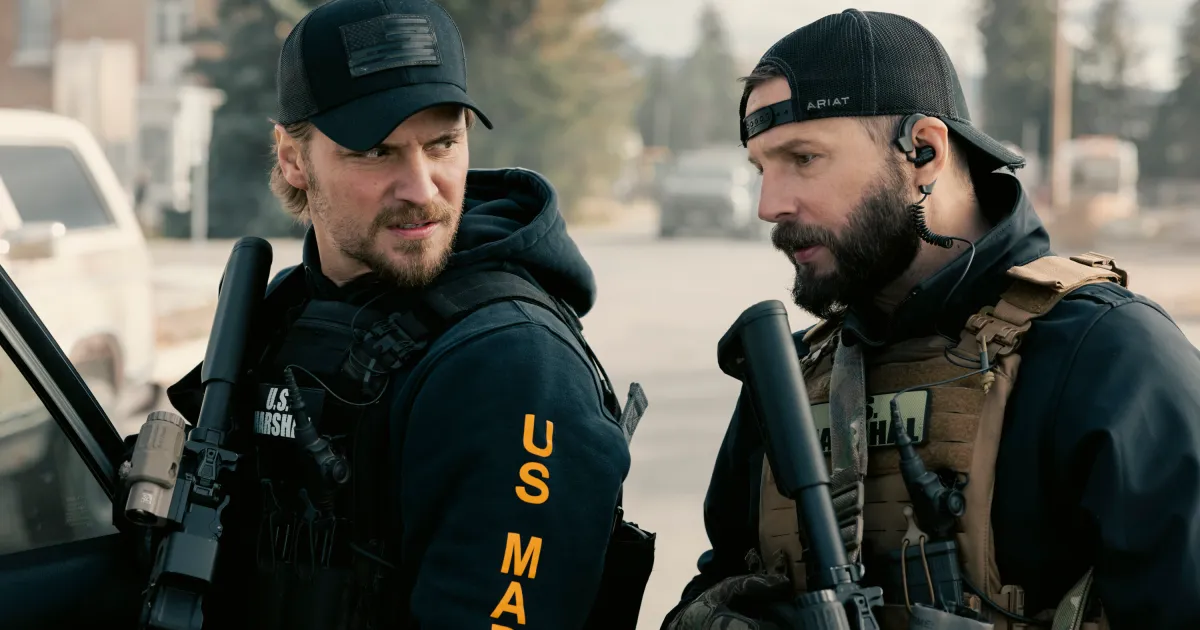
In the quiet, sterile corridor of a hospital, where time seems to stretch and the fluorescent lights hum with clinical indifference, a man sits alone, bracing himself for the invisible battle ahead. This is Cal, a central figure in the Yellowstone spinoff Marshals, and his world has just been upended by a diagnosis that no one is ever truly prepared to hear. The Sunday, October 18 episode of the series unfolds with a profound rawness, capturing Cal’s first chemotherapy session—a ritual of modern medicine that feels both life-saving and deeply dehumanizing. He had told his squad, with a stoic determination that masked his inner turmoil, that he didn’t want company. He wanted to face this particular demon by himself, to preserve the illusion of control in a situation where control is an illusion. Yet, as he sat in that stark room, the weight of his mortality pressing down on him, the bravado crumbled. The camera lingers on his face, a landscape of fear, exhaustion, and vulnerability. It is in this moment of utter solitude that Belle appears, not as a colleague or a subordinate, but as the woman who has come to mean something deeper to him. Her presence is a quiet, unspoken promise. She doesn’t have the words to fix him, nor does she try. She simply sits beside him, and in that shared silence, the episode closes with a faint, grateful smile breaking through Cal’s exhaustion. This is not a story about fighting cancer with inspirational speeches; it is a story about the simple, profound power of not having to fight alone.
2. A Recurring Shadow in the Yellowstone Universe
Cal’s journey through chemotherapy is not an isolated narrative device within the Yellowstone universe; rather, it places him in a lineage of characters who have faced the grim reaper in the form of disease. He is the second character in this sprawling saga to battle cancer, a statistic that mirrors the series’ commitment to exploring the unglamorous, brutal realities of life. The first was Monica, the beloved wife of Kayce Dutton, who was introduced to audiences in the original Yellowstone series that aired from 2018 to 2024. For Cal, the diagnosis is more than a plot point—it is a crucible that tests his identity. As a marshal, he is trained to be the protector, the one who runs toward danger. Cancer, however, is an enemy that doesn’t negotiate, and it forces him into the passive role of a patient, stripped of his badge, his gun, and his agency. The show’s creators have handled this storyline with a deliberate lack of melodrama, instead focusing on the small, mundane details of treatment: the exhaustion, the nausea, the faint hope that every scan will bring good news. It’s a humanizing process that allows viewers to see Cal not as an action hero but as a man who is terrified, fragile, and still clinging to the idea of a future. His decision to go through treatment alone, and Belle’s refusal to let him, speaks to a broader human truth: we often push away those we love when we are at our most afraid, because their presence makes our vulnerability undeniable.
3. The Echoes of a Past Love Story
To truly understand the weight of Monica’s fate in Marshals, one must look back at the original Yellowstone narrative, where Kayce and Monica’s love story served as the emotional heart of a series defined by land, power, and violence. Monica was introduced not merely as Kayce’s wife but as a grounding force, a woman who straddled two worlds: the Broken Rock Indian Reservation where she taught at the local school, and the stark, rugged world of the Yellowstone Ranch. Her intelligence and compassion were evident as she transitioned from a small-town educator to a professor at Montana State University, all while navigating the complexities of a marriage to a former U.S. Navy SEAL haunted by his past. Kayce’s relationship with his father, John Dutton, played by Kevin Costner, was tempestuous, but it was Monica who provided the moral compass. She pushed Kayce to reconcile, to choose family over legacy, and to find a life beyond the violence. When John died, Kayce inherited the ranch, and by the finale of the original series, the two were alive, together, and seemingly at peace. Their ending was a rare moment of grace in a universe that thrived on tragedy. They had weathered storms—kidnappings, miscarriages, betrayals—and emerged with their bond intact. For fans, their happiness was a reward, a testament to endurance. That perfect, hard-won ending is precisely why the revelation in Marshals carries such devastating weight.
4. The Cruel Interruption of Real Life
When Marshals premiered in March, viewers were blindsided by a detail that recontextualized everything they had believed about the Dutton family: Monica had died. The cause was cancer, a slow, insidious thief that had stolen the future they had fought to build. Showrunner Spencer Hudnut addressed this narrative choice with a poignant honesty, explaining that Kayce’s perfect ending was exactly the problem. “He really needed to be shaken out of that,” Hudnut told TVLine, acknowledging that tragedy has always been Kayce’s shadow. The decision to kill off Monica was not a ratings ploy or a gratuitous shock; it was a narrative necessity to push Kayce out of a complacent peace and into a new chapter of grief and purpose. But Hudnut was careful to emphasize that Monica’s death is not merely a device to make Kayce suffer. Instead, she becomes a guiding presence. Her memory propels him forward, shaping his decisions and leading him to the rally where he protects their son, Tate. In a profound way, Monica is still the hinge on which Kayce’s life swings, even after her death. This is a love story that refuses to end at the grave; it transforms into a haunting, benevolent force. The showrunner stressed that he wanted to be respectful of her character and the beautiful ending she had in Yellowstone. “Unfortunately, real life intervened,” he said, a phrase that resonates with anyone who has lost someone to a disease that does not care about narrative arcs or happy endings.
5. A Silent Farewell and a Visible Presence
The handling of Monica’s posthumous role in Marshals is a masterclass in delicate storytelling. Kelsey Asbille, the actress who brought Monica to life, has not publicly spoken about her character’s onscreen death, and that silence itself feels respectful, allowing audiences to grieve the character without the noise of press interviews or social media commentary. However, Asbille did grant the production permission to use her likeness, which allowed Marshals to include photographs of Monica on screen. These small, visual reminders serve as touchstones for Kayce, and for the audience, grounding his grief in a tangible reality. It is one thing to hear that a character has died; it is another to see her face in a dusty frame, a faded snapshot of a life that was. The inclusion of these photos is a quiet acknowledgment that even though the actor is no longer on set, her legacy lives on in the fabric of the show. For Kayce, these images are both a comfort and a wound—reminders of mornings shared, arguments resolved, and a future that will never come. The show thus walks a narrow line between honoring a beloved character and moving the story forward. It does so by making Monica’s death not the end of her story but the catalyst for a new one. She is present in every decision Kayce makes, in every moment of doubt and fear, and in the way he now fights to protect what remains of his family. Her absence is a palpable presence, a reminder that love, once real, does not simply vanish.
6. The Legacy of Grief and the Endurance of the Human Spirit
At its core, Marshals is not merely a spinoff about law enforcement in the rugged American West; it is a meditation on how we carry loss, how we find the strength to continue when the foundation of our lives is shaken. Cal’s chemotherapy and Kayce’s widowhood are two parallel explorations of the same theme: the vulnerability of the human body and the resilience of the human spirit. Cal’s story is a forward-looking struggle, a fight for survival that is still being written, while Kayce’s is a backward-looking reckoning, an attempt to make peace with a love that has been taken. Both men are forced to redefine their identities outside of their roles as protectors and enforcers. They must learn to be protected, to accept help, and to acknowledge that strength often looks like sitting quietly in a hospital room or letting grief wash over you without drowning. The show’s creators have chosen to handle these storylines with a grace that is rare in television, refusing to exploit pain for shock value. Instead, they offer a compassionate portrait of people who are broken and are slowly, imperfectly, putting themselves back together. As the series airs on CBS Sundays at 8 p.m. ET, followed by streaming on Paramount+, it invites viewers to sit with these uncomfortable truths: that life is ephemeral, that love is fleeting, and that the only way to survive is to allow others to sit beside us in the sterile rooms, holding our hands, until the fear subsides. In that quiet solidarity, we find a humanity that no badge, no ranch, and no amount of power can replicate. It is the story of two men learning that the greatest courage is not in fighting death, but in embracing the life they still have, one fragile day at a time.