


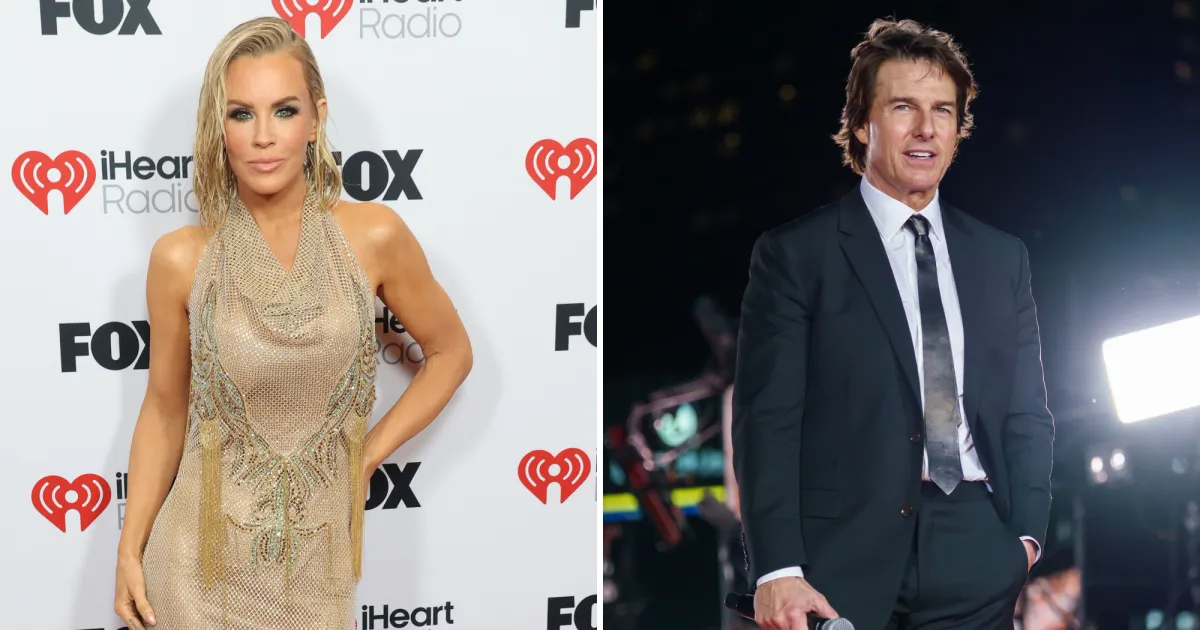
Jenny McCarthy has never been one to keep a story to herself, and her latest Hollywood flashback is the kind of anecdote that feels equal parts surreal, unsettling, and strangely fascinating. On the October 15 episode of her self-titled podcast, the 53-year-old actress and comedian opened up about a moment in her past that has clearly stayed with her: attending Tom Cruise and Katie Holmes’ 2006 wedding while she was dating Jim Carrey. McCarthy didn’t just attend the glamorous celebration—she claimed that Cruise, now 64, took the opportunity to try to recruit her into the Church of Scientology. “He tried to bring me into Scientology,” she said plainly. But the story went much deeper than a casual pitch. McCarthy described being at the rehearsal dinner, seated “literally across” from the bride and groom and their tight inner circle. The atmosphere, she recalled, was charged and watchful, like a private gathering where everyone knew something she didn’t. And then the evening took an even stranger turn. Holmes, who was then still married to Cruise and had just given birth to their daughter Suri, was handed the baby by a nanny—and McCarthy, who had grown up around babies thanks to her mother’s work as a nanny, felt an instinct to connect. That instinct, however, would soon place her in what she described as the “belly of the beast.”
The baby moment started out innocent enough. McCarthy spotted the nanny bring little Suri over to Katie Holmes, and because she genuinely loves babies and had been surrounded by them her whole life, she walked over and asked, “Can I hold the baby?” That simple, warm gesture seemed to trigger something in the room. McCarthy recalled that the entire party went silent and turned to look at her in unison—a slow, synchronized turn of heads that she compared directly to the disturbing vibe of Roman Polanski’s Rosemary’s Baby. “I got the Scientology stare,” she said, imitating the blank, piercing gaze of the wedding guests. It was the kind of moment, she suggested, that could make a person feel watched, judged, and perhaps even warned. Katie Holmes, who was 29 at the time and had not yet left the marriage, slowly passed the infant over to McCarthy while the silence thickened. McCarthy seemed to navigate the situation with a kind of performative normalcy, bouncing the baby gently and chirping, “Hi baby,” as if refusing to let the eerie energy rattle her. But no one else spoke. The conversations had simply stopped. After she handed the baby back, the room seemed to exhale and return to its previous chatter. McCarthy’s internal response was far less calm. She recalled thinking to herself, “OK, I am in the belly of the beast right now.” It was a phrase that captured the strange blend of fascination and danger she felt in that moment—an ordinary human interaction transformed into a test of belonging, loyalty, and nerve inside a famously guarded celebrity circle.
As if that weren’t enough, the dinner conversation would only get more uncomfortable. McCarthy claimed that during the same rehearsal dinner, Cruise introduced her to David Miscavige, the 66-year-old leader of the Church of Scientology. In the context of the wedding, Miscavige served as Cruise’s best man, which was a striking sign of how deeply entwined Cruise’s personal and religious lives were at the time. McCarthy, known for her quick tongue and irreverent sense of humor, couldn’t resist making a joke. She told Miscavige, “Haha, you got picked. Congratulations.” It was a cheeky, passive-aggressive quip—she admitted she tried to make it sound “kinda nice” but knew exactly what she was doing. Miscavige did not find it amusing. “He did not like that,” McCarthy said, and then she added with a wicked delight, “and I loved every second of it.” She described the moment as a tiny act of rebellion, a small provocation delivered to one of the most powerful and feared figures in the controversial religious organization. Cruise, for his part, let out a loud laugh, which McCarthy interpreted as an attempt to “cover the uncomfortable moment.” But the damage, or perhaps the thrill, was already done. For McCarthy, the exchange offered a rare glimpse into the kind of social pressure that surrounded Cruise and his inner circle. She admitted that Cruise has always been “a very nice human being” in her personal experiences with him, but she also said it was obvious he was “very programmed.” Her one small interaction with Miscavige left her shaken enough to imagine what it would be like to actually live and work under his authority. “I’m a strong woman,” she said, “but just from that little interaction, it’s like he could have broke me easily.” It was a striking admission from someone who had built a career on being outspoken and unafraid.
To understand why McCarthy’s story resonates so deeply, it helps to remember the cultural landscape of the mid-2000s. Tom Cruise and Katie Holmes were one of the most scrutinized celebrity couples in the world. Their whirlwind romance, their infamous couch-jumping moment on Oprah, and the secrecy surrounding their wedding made them tabloid fixtures. Cruise was already a prominent figure in Scientology, and Holmes, who had grown up in a Catholic family in Ohio, became the subject of endless speculation about her involvement in the church. Their 2012 divorce ended the marriage, and Holmes was awarded primary custody of Suri. Since then, Cruise’s public relationship with Suri has been a recurring topic of concern, with reports suggesting years of estrangement. McCarthy’s account adds a new layer to that history, albeit one told from the perspective of an outsider who happened to be in the room. Her wedding story paints a picture of a celebration that was less about romantic joy than about control, hierarchy, and vigilance. Every gesture, every glance, every conversation seemed to be measured. The fact that McCarthy’s simple request to hold a baby could produce an atmosphere of suspicion says more about the world Cruise inhabited than about her own intentions. And yet, McCarthy refused to be wholly cruel about Cruise. She acknowledged his kindness, even while describing him as programmed. That contradictory mix—warmth and unease, charm and menace, charisma and conformity—is what makes her story so compelling. It’s not the rant of a bitter ex or a tabloid gossip; it feels like a genuine attempt to make sense of something strange and overwhelming.
McCarthy’s retelling on her podcast, where her guest and friend Anne Gollert Hill sat across from her, was full of theatrical detail and playful storytelling. She turned her head slowly to demonstrate exactly how the other guests stared at her, and she gently rocked an imaginary baby as she described trying to cut the tension. This is the kind of memory that becomes more vivid with time, not less—partly because it involved so many larger-than-life figures, and partly because it hinted at broader questions about power and belief. McCarthy has never been shy about sharing her own controversial opinions, from her long-running skepticism about childhood vaccines to her candid takes on Hollywood’s darker corners. That background makes her a uniquely unreliable yet also uniquely entertaining narrator; she embraces the messiness of her own perspective and doesn’t pretend to be neutral. In telling this story, she wasn’t trying to destroy Cruise or expose Scientology in any systematic way. She was simply describing a night when she found herself surrounded by a kind of extreme social control and chose to meet it with humor, baby talk, and a tiny, cheeky act of defiance. It was her way of saying, “I see you, and I’m not going to be intimidated.” Her comment to Miscavige, delivered with a smile and a joke, was the same spirit in a different form. She refused to be flattened by the gravity of the moment, even if she admitted the experience left her rattled. And Cruise, who has not publicly responded to her claims, remains a figure surrounded by silence and mystery—both the subject of enormous public fascination and a man whose life seems guarded by invisible forces.
In the end, McCarthy’s story is more than just tabloid fodder. It’s a human story about what it feels like to walk into a room where the rules are different, where ordinary kindness is treated as a threat, and where a joke can feel like a grenade tossed onto a polished dinner table. Her comparison to Rosemary’s Baby was perfect because that film is about the terror of being trapped inside a cheerful, intimate setting that is secretly hostile. She didn’t experience anything overtly dangerous, but she felt the weight of a watchful, closed system. She also recognized that even someone as powerful and charming as Tom Cruise is still a person inside that system—a person who might laugh a little too loudly to smooth over a difficult moment. McCarthy’s instinct to talk to the baby, to joke with the church leader, and to later recount it all with such vivid, wry self-awareness is a testament to her own stubborn humanity. She wasn’t recruited, and she didn’t join. She walked away with a story that has become even more interesting as the years have gone by. Whether you believe every detail of her account or take it with a grain of salt, her tale of that strange wedding weekend offers a glimpse into a world most of us will never see—a world of celebrity, power, and belief, where even holding a baby can feel like a political statement. And somehow, McCarthy managed to walk through it with a smile, a laugh, and that wonderfully unshakable sense of herself.